
Exploring the Meaning of Entaphiazo in Greek
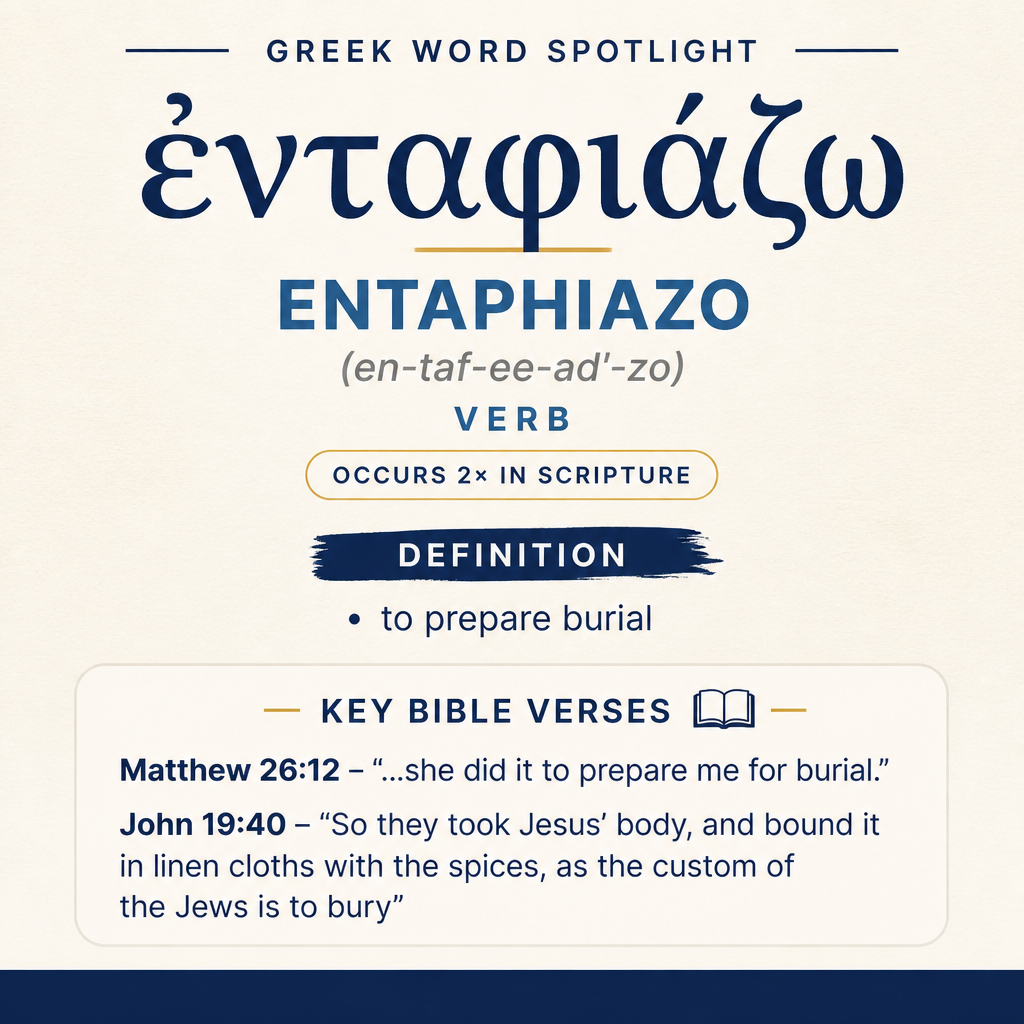
ἐνταφιάζω means “to prepare burial” and occurs twice in Scripture: Matthew 26:12 and John 19:40.
Core Meaning
ἐνταφιάζω means “to prepare burial.” In Matthew 26:12, it describes preparing Jesus for burial through poured ointment.
Learn More →Gospel Occurrences
This verb occurs 2 times in Scripture. The occurrences are Matthew 26:12 and John 19:40.
Learn More →Burial Actions
In John 19:40, Jesus’ body is bound in linen cloths with spices. The verse presents this as the Jews’ custom for burial.
Learn More →ἐνταφιάζω speaks of preparing someone for burial, and it appears in two Gospel scenes: an anointing that anticipates death and a careful handling of Jesus’ body after the crucifixion. In both, the word marks deliberate, purposeful action directed toward burial as an event that is about to occur or is already underway.
Root and Related Words
ἐνταφιάζω is associated with the preposition en (ἐν), “in/on/among” (Strong’s G1722), and with taphos (τάφος), “grave” (Strong’s G5028). Together these related elements keep the verb’s focus close to burial and the place or state connected with the grave.

Occurrences
“For in pouring this ointment on my body, she did it to prepare me for burial.” (Matthew 26:12)
Here ἐνταφιάζω is tied to a concrete act—“pouring this ointment on my body”—and the clause explains what that act accomplishes: “she did it to prepare me for burial.” The verb frames the anointing not as a general gesture, but as a burial-directed preparation. The wording “prepare me for burial” also sets the action within an anticipatory moment: the body is still present in the scene, and the preparation is done beforehand, while there is still opportunity to act directly upon Jesus’ body with ointment. By using a verb that explicitly points to burial, the sentence makes the anointing interpretive: it receives its meaning from the approaching burial and not merely from the immediate act of pouring.
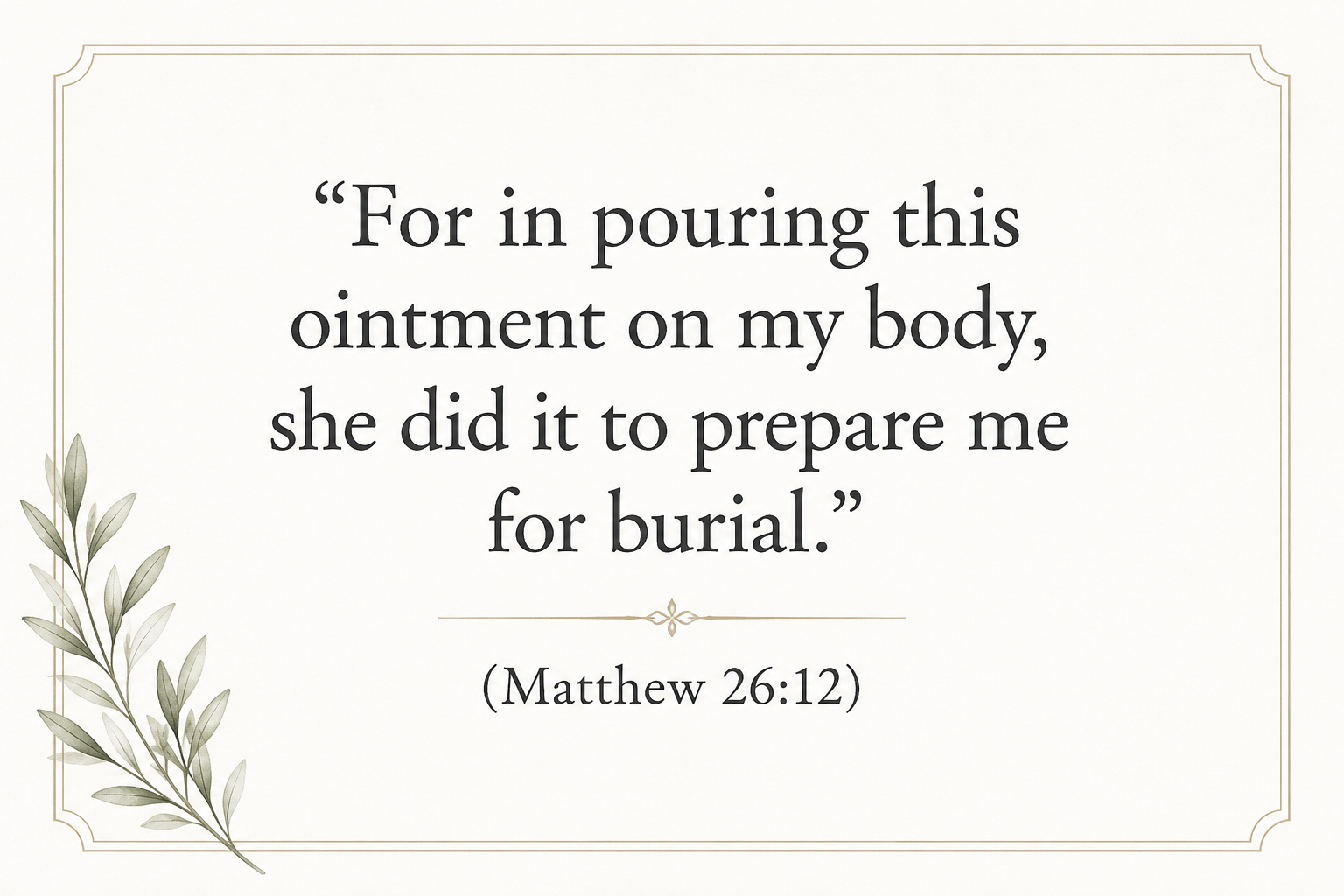
The structure of the line emphasizes intent. The first phrase identifies the action (“in pouring this ointment on my body”), while the second assigns its purpose (“she did it to prepare me for burial”). ἐνταφιάζω therefore contributes a sense of directedness: the ointment is applied with burial in view, and the body is treated in a way that corresponds to that end.
“So they took Jesus’ body, and bound it in linen cloths with the spices, as the custom of the Jews is to bury.” (John 19:40)
In this scene ἐνταφιάζω stands alongside a sequence of physical actions: “they took Jesus’ body,” “bound it in linen cloths,” and did so “with the spices.” The verb belongs to a context where burial preparation is not a single act but a coordinated process involving handling, wrapping, and the use of spices. The statement “as the custom of the Jews is to bury” places the action within an established pattern of burial practice, so the verb’s force is not only that burial is being prepared, but that it is being done in a recognized manner.
Because the verse begins with “So,” it reads as the continuation of events, and ἐνταφιάζω fits the transition from death to burial. The direct object, “Jesus’ body,” is central: the burial preparation is not abstract, but is carried out on the body itself. In this setting, the word highlights careful, tangible attention—binding with linen cloths and spices—within the broader act of burying.
Sense and Usage
Across these occurrences, ἐνταφιάζω consistently signals purposeful preparation oriented toward burial. In Matthew 26:12 the preparation is expressed through anointing with ointment; in John 19:40 it is expressed through taking the body, binding it in linen cloths, and applying spices. The verb is elastic enough to cover different kinds of preparatory actions—liquid ointment in one scene, cloth and spices in the other—while keeping the same endpoint in view: burial.
The two contexts also show how the idea of preparation for burial can operate on either side of death. Matthew’s line presents an act whose significance is defined by what is coming (“prepare me for burial”) even while Jesus is still present to speak about the meaning of the act. John’s line presents the preparation as part of the burial procedure itself, described in calm, procedural terms and linked to customary practice. In both, the verb keeps the reader oriented to the body and to the handling of the body as an integral part of burial preparation.
The association of ἐνταφιάζω with en (ἐν), “in/on/among,” and with taphos (τάφος), “grave,” aligns with the way the verb functions in these passages: burial preparation is action that moves the body toward the sphere of burial—toward the conditions and practices appropriate to the grave. The word therefore carries a concrete, tactile flavor in usage, because it is anchored in what is done to the body: ointment poured on it (Matthew 26:12) and linen and spices bound around it (John 19:40).
Burial Imagery
In Matthew 26:12 the imagery is intimate and immediate: ointment poured “on my body” is interpreted as burial preparation, turning a present act into a sign of what lies ahead. In John 19:40 the imagery is methodical: taking the body, binding it with linen cloths, and surrounding it with spices “to bury” according to custom. Together these verses let ἐνταφιάζω evoke burial as a set of embodied actions—touch, wrapping, fragrance—focused on honoring the body in view of burial.
Sources: Lexical data from Strong’s Exhaustive Concordance and the Translators Brief Lexicon of Extended Strongs for Greek (STEPBible, CC BY). Occurrence data from the Translators Amalgamated Greek New Testament (STEPBible, CC BY). Scripture quotations from the World English Bible (public domain).




