Exploring the Meaning of Energes in Greek
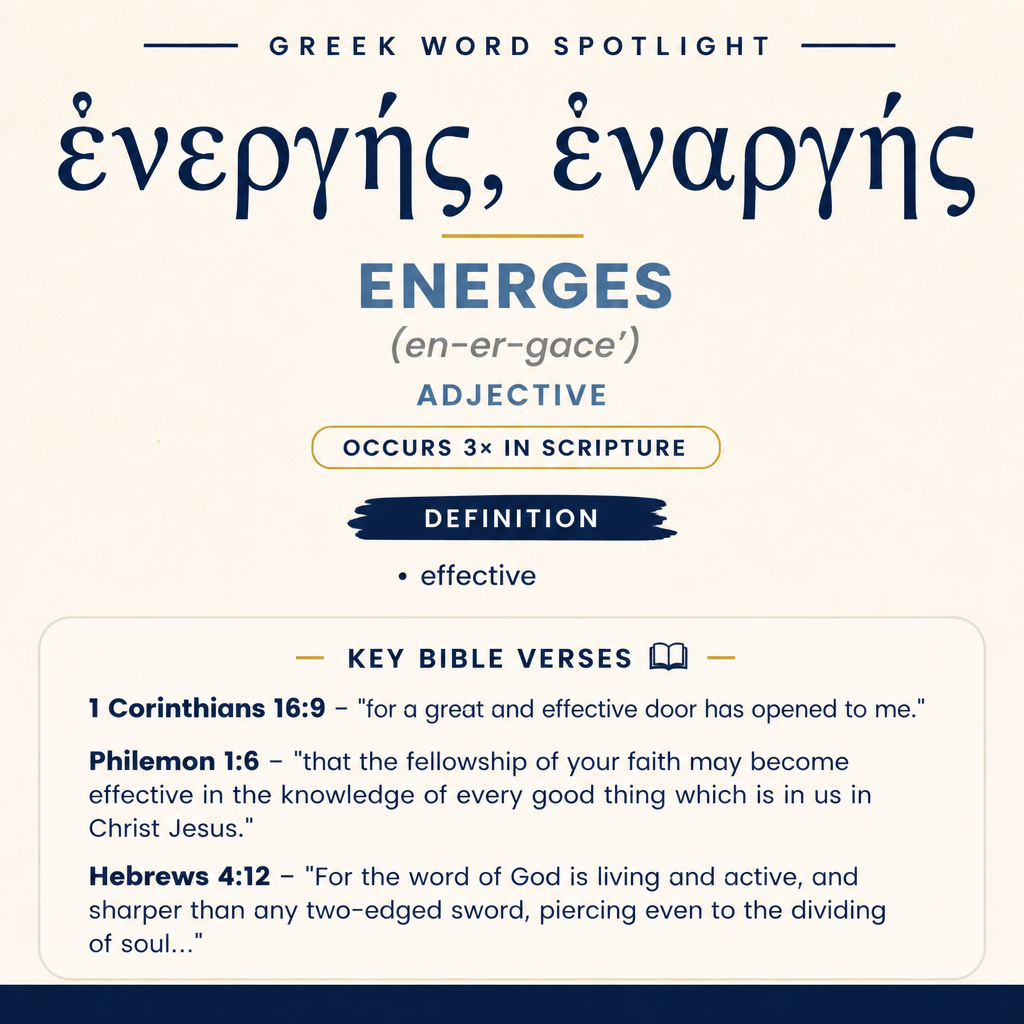
ἐνεργής / ἐναργής means “effective” and occurs three times: 1 Corinthians 16:9, Philemon 1:6, and Hebrews 4:12.
Core Meaning
The word means “effective.” It appears in Scripture as ἐνεργής / ἐναργής.
Learn More →Pauline Letters
In 1 Corinthians 16:9 it describes a “great and effective door” opened amid many adversaries. In Philemon 1:6 it describes faith-fellowship becoming effective in knowing every good thing in Christ.
Learn More →God’s Word
In Hebrews 4:12 it is used of the word of God as “living and active,” piercing and dividing even soul and spirit.
Learn More →Energes means “effective.” It appears in three New Testament settings: a mission opportunity described as an “effective door,” a prayer that faith’s fellowship might “become effective,” and a portrayal of God’s word as “living and active.”
Root and Related Words
Energes is connected with the preposition en (ἐν), “in/on/among” (Strong’s G1722), and with the noun ergon (ἔργον), “work” (Strong’s G2041). These related terms place Energes in the orbit of action that happens “in” a sphere and expresses itself in “work.”

Occurrences
“for a great and effective door has opened to me, and there are many adversaries.” (1 Corinthians 16:9)
Here Energes qualifies a “door” that “has opened.” The picture is of access or entry that is not merely available but proves effective for the apostle’s work. The phrase holds together two realities: the opportunity is “great,” and it is effective in the sense that it functions as a real opening for ministry, even though “there are many adversaries.” Energes therefore marks the door as one that actually works as an entrance—an opening with real traction—rather than a theoretical possibility. The effectiveness of the door does not erase opposition; instead, the verse sets effectiveness and adversity side by side, presenting an opportunity that is genuinely open and operative in the midst of resistance.

“that the fellowship of your faith may become effective in the knowledge of every good thing which is in us in Christ Jesus.” (Philemon 1:6)
In this prayer, effectiveness is something the “fellowship of your faith” may “become.” The movement is toward a condition where shared faith expresses itself with effect as it is tied to “the knowledge of every good thing which is in us in Christ Jesus.” Energes is not attached to a physical image here but to relational and spiritual sharing (“fellowship”) that is meant to have real results. The line connects effectiveness with “knowledge,” not as bare information but as recognition of “every good thing” located “in us in Christ Jesus.” The word therefore contributes the idea that faith’s fellowship is meant to operate in a way that genuinely produces outcomes consistent with what is known and possessed in Christ, rather than remaining passive or merely internal.
“For the word of God is living and active, and sharper than any two-edged sword, piercing even to the dividing of soul and spirit, of both joints and marrow, and is able to discern the thoughts and intentions of the heart.” (Hebrews 4:12)
Energes appears in a cluster of vivid descriptions: “living and active,” “sharper than any two-edged sword,” “piercing,” “dividing,” and “able to discern.” The adjective strengthens the portrayal of the word of God as something that does things—its activity is expressed through cutting imagery and penetrating ability. The verse’s sequence moves from what the word is (“living and active”) to what it is like (“sharper than any two-edged sword”) to what it does (“piercing… dividing… able to discern”). Within that flow, Energes stands at the front as a headline quality: the word is not inert. The ensuing verbs and images unpack what “active” looks like in this context: it penetrates to the deepest places named (“soul and spirit,” “joints and marrow”) and reaches the inward life by discerning “thoughts and intentions of the heart.”
Sense and Usage
Across these three passages, “effective” is applied to three different kinds of realities: an open “door,” the “fellowship” of faith, and “the word of God.” In each case the adjective signals that something is not only present but operative—its presence makes a difference in what follows.
In 1 Corinthians 16:9, effectiveness is tied to opportunity. The “door” is already “opened,” and Energes underscores that this opening functions as a meaningful avenue for action. The verse frames effectiveness as compatible with conflict: the door is effective even though adversaries are many. Effectiveness, then, does not depend on an absence of obstacles; it belongs to the character of the opportunity as a door that truly opens access.
In Philemon 1:6, effectiveness is tied to growth and expression. The “fellowship of your faith” is envisioned as becoming effective, and the means named is “the knowledge of every good thing which is in us in Christ Jesus.” Effectiveness here is not an abstract label but a hoped-for condition in which shared faith exerts real influence through recognized good realities “in us.” The sentence places effectiveness within the sphere of Christ (“in Christ Jesus”), so the effect is not detached from that relational location.
In Hebrews 4:12, effectiveness is tied to penetrating power and discernment. The word of God is described as “living and active,” and the rest of the verse elaborates with imagery of sharpness and piercing. The effectiveness of the word is shown not by outward force but by inward reach: it presses into the deepest dividing lines the author can name and renders discernment about “thoughts and intentions.” In this usage, being effective includes the capacity to expose, separate, and judge what lies within the human heart.
Taken together, these passages display effectiveness as a quality that shows itself in results appropriate to the subject: a door that opens real access, a fellowship that becomes productively engaged with what is known in Christ, and a divine word that actively penetrates and discerns. The adjective remains stable while the scene changes; its effect is to insist that what it modifies truly works in the situation described.
Imagery
The word’s imagery ranges from the concrete to the inward. In 1 Corinthians, effectiveness is pictured as an open door that leads somewhere despite adversaries at hand. In Hebrews, effectiveness becomes the energy of a sharp blade that pierces and divides, reaching even the hidden territory of “thoughts and intentions of the heart.” Between these, Philemon uses relational language—“fellowship”—and envisions effectiveness as something that comes into being through knowledge of “every good thing… in Christ Jesus.”
Sources: Lexical data from Strong’s Exhaustive Concordance and the Translators Brief Lexicon of Extended Strongs for Greek (STEPBible, CC BY). Occurrence data from the Translators Amalgamated Greek New Testament (STEPBible, CC BY). Scripture quotations from the World English Bible (public domain).