
Exploring the Meaning of Enedreuo in Greek
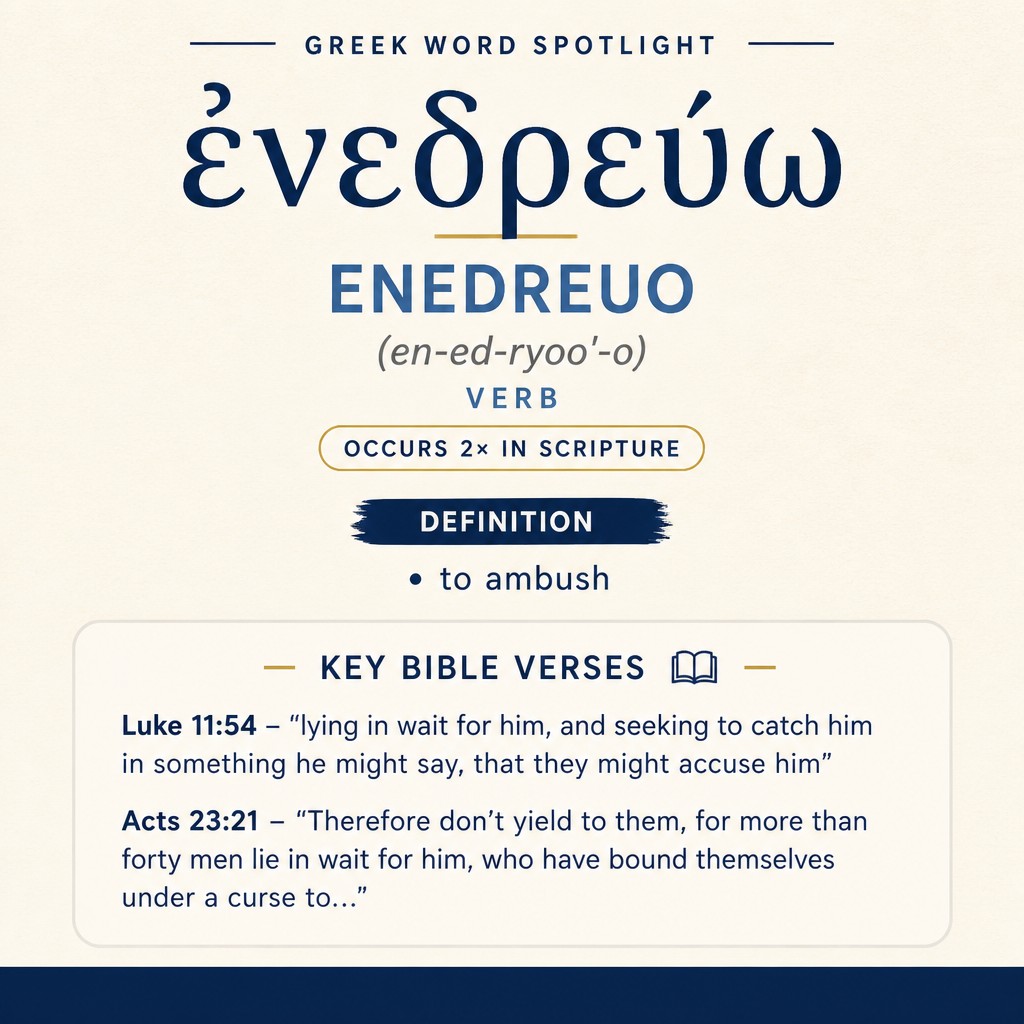
ἐνεδρεύω means “to ambush” and appears twice in Scripture: Luke 11:54 and Acts 23:21.
Core Meaning
ἐνεδρεύω means “to ambush.” It describes deliberate lying-in-wait to trap a person.
Learn More →Luke 11:54
In Luke 11:54, opponents lie in wait for Jesus, seeking to catch him in something he might say. Their goal is accusation.
Learn More →Acts 23:21
In Acts 23:21, more than forty men lie in wait for Paul. They have bound themselves under a curse.
Learn More →ἐνεδρεύω means “to ambush,” depicting hostile action carried out through concealment and calculated timing rather than open confrontation. It appears in two New Testament scenes: opponents attempting to trap Jesus in his speech and conspirators lying in wait to kill Paul.
Root and Related Words
ἐνεδρεύω is connected with enedra (ἐνέδρα), “plot/ambush” (Strong’s G1747). The verb expresses the act that corresponds to such a plot: taking a concealed position and waiting to strike or to seize an opening.

Occurrences
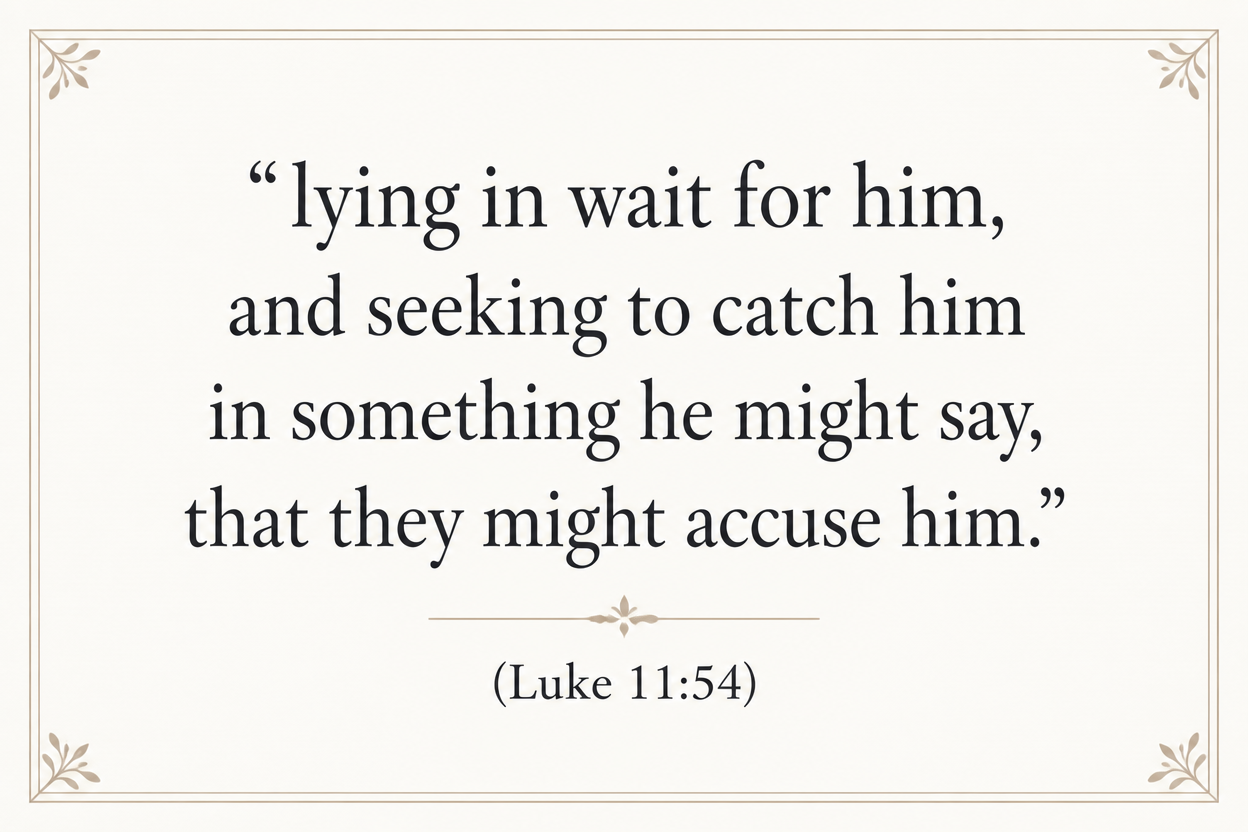
“lying in wait for him, and seeking to catch him in something he might say, that they might accuse him.” (Luke 11:54)
Here ἐνεδρεύω frames a scene of opposition that operates through surveillance and verbal entrapment. The action is not described as an immediate attack; it is a sustained posture of “lying in wait,” paired with “seeking to catch him in something he might say.” The ambush is therefore carried out in the realm of speech: the listeners position themselves to exploit a moment, hoping for a statement that can be turned into an accusation. The word gives the line a predatory feel—patient, watchful, and intent on a sudden capture—while the stated aim (“that they might accuse him”) shows why the waiting matters: the desired outcome depends on timing and a perceived opening rather than straightforward debate.
Within the sentence, the verb also helps define the character of the opponents’ approach. They do not merely disagree or question; they “lie in wait.” That phrasing marks their listening as tactical. Even before anything is said, the relationship is set: one party speaks, and the other stands ready to pounce on a phrase. ἐνεδρεύω supplies the atmosphere of danger, but the danger is channeled through legal or rhetorical leverage—an accusation built from “something he might say.”
“Therefore don’t yield to them, for more than forty men lie in wait for him, who have bound themselves under a curse to neither eat nor drink until they have killed him. Now they are ready, looking for the promise from you.” (Acts 23:21)
In Acts 23:21, ἐνεδρεύω appears in a more physically violent setting. The warning is direct: “don’t yield to them,” because “more than forty men lie in wait for him.” The ambush is not merely a general intention to harm; it is organized, multiple-person, and bound to a grim objective. The conspirators have “bound themselves under a curse to neither eat nor drink until they have killed him,” which portrays their waiting as determined and urgent. ἐνεδρεύω captures both the concealment and the readiness: they are not wandering aggressors but a coordinated group positioned for a decisive moment.
The sentence adds two details that sharpen how ambush works in this narrative. First, their posture is coupled with self-imposed constraint (“neither eat nor drink”), which suggests a vigil-like persistence: the waiting continues until the attack succeeds. Second, the plot depends on cooperation from an authority: “Now they are ready, looking for the promise from you.” That final clause shows that their ambush requires a particular set of circumstances to be arranged—some assurance or action that will put the target within reach. ἐνεδρεύω therefore describes not only the concealed attackers but also the broader mechanics of an ambush as a coordinated plan, poised to activate when the promised conditions are met.
Sense and Usage
Across these two uses, “to ambush” is consistently portrayed as a strategy of concealment, patience, and intention. In Luke 11:54, the target is the person’s words: the attackers wait for an utterance that can be “caught” and used “that they might accuse him.” The ambush is intellectual and forensic in its immediate aim, yet it is still described with language of predation and sudden capture. In Acts 23:21, the target is the person’s life: the attackers wait to “have killed him,” and their readiness is emphasized by the size of the group (“more than forty men”) and by the vow that binds them to the outcome.
These passages show that ἐνεδρεύω can describe an ambush without specifying the exact mechanics of the hidden position; the focus is on the posture of waiting for a vulnerable moment. The word fits both a trap laid for speech and a trap laid for a person’s movement, because the shared element is not the weapon but the method: concealed opposition waiting to act at the chosen time. In both scenes, the ambush is purposeful and directed at a particular individual (“for him” / “for him”), highlighting that the action is personal and targeted rather than random violence or general hostility.
Another common feature is that ἐνεδρεύω sits alongside explicit statements of intent. Luke pairs the waiting with “seeking to catch him” and an end goal of accusation. Acts pairs the waiting with a declared resolve to kill and with readiness conditioned on receiving a “promise.” The verb thus works well when the narrative wants to describe more than hostility: it portrays hostility that has been organized into a plan and held in reserve, ready to spring when the desired opening arrives. The word’s force lies in the combination of concealment and imminence—harm is prepared, and the moment of execution is being awaited.
Imagery
The imagery carried by ἐνεδρεύω in these passages is the tension of concealed threat. In Luke 11:54, the listener becomes a hunter of phrases, waiting to seize “something he might say.” In Acts 23:21, the hunters are many, bound together by a vow, “ready” and scanning for the signal that will set their plan in motion. In both, the word paints opposition as something crouched and watchful—danger that is not always visible, but positioned to strike when the opportunity appears.
Sources: Lexical data from Strong’s Exhaustive Concordance and the Translators Brief Lexicon of Extended Strongs for Greek (STEPBible, CC BY). Occurrence data from the Translators Amalgamated Greek New Testament (STEPBible, CC BY). Scripture quotations from the World English Bible (public domain).





