Exploring the Meaning of Emploke in Greek
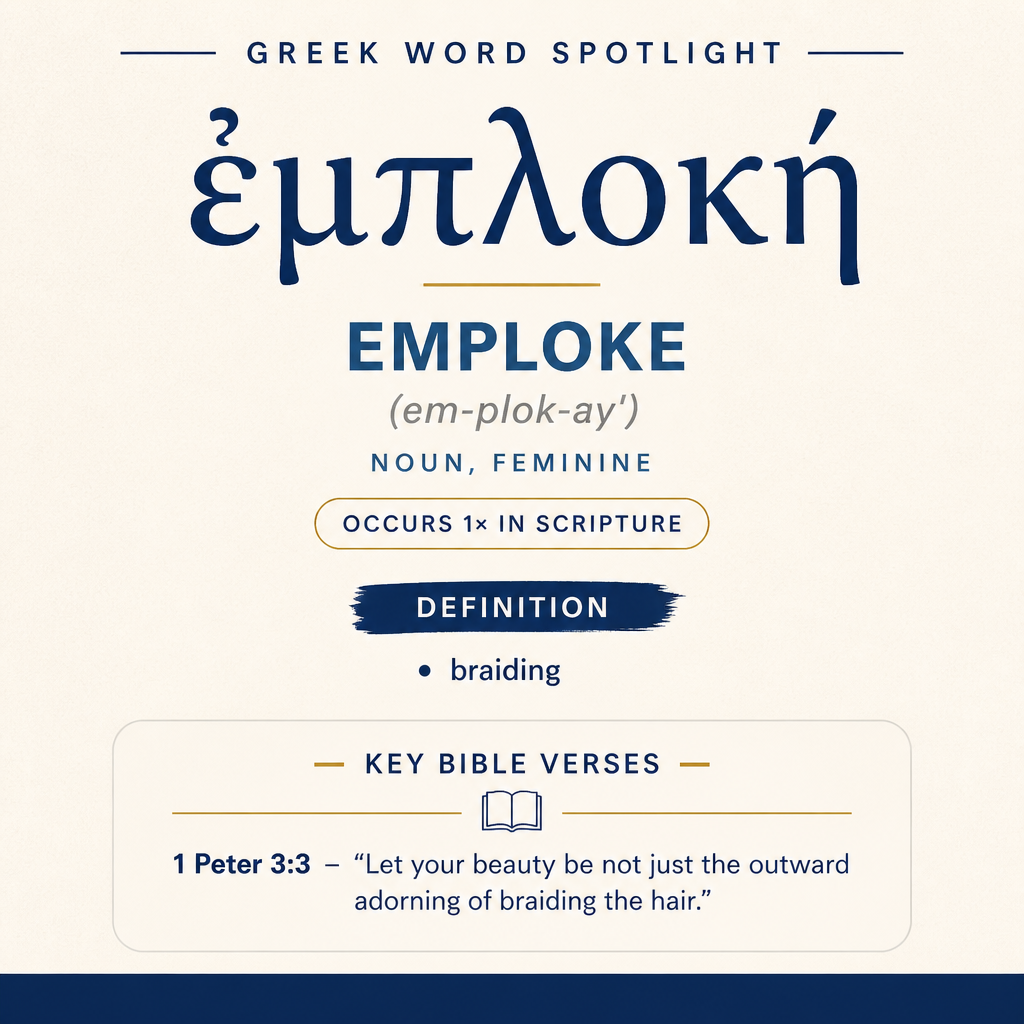
ἐμπλοκή means “braiding” and appears once in Scripture in 1 Peter 3:3.
Verse Context
In 1 Peter 3:3, it refers to the outward adorning of braiding the hair.
Learn More →ἐμπλοκή refers to “braiding” and appears in a single New Testament context addressing outward adornment. In its lone occurrence, it names a specific styling practice set alongside other visible forms of ornamentation.
Root and Related Words
ἐμπλοκή is derived from the verb empleko (ἐμπλέκω), “to entangle/involve.”

Occurrences
“Let your beauty be not just the outward adorning of braiding the hair, and of wearing jewels of gold, or of putting on fine clothing;” (1 Peter 3:3)
Here ἐμπλοκή names an “outward adorning” practice and is framed as one item in a list of visible enhancements. The verse places “braiding the hair” alongside “wearing jewels of gold” and “putting on fine clothing,” so the word functions as a concrete example of intentional personal presentation. Within the sentence, “braiding” is not treated in isolation but as part of a coordinated set of adornments—hair arrangement, jewelry, and clothing—that together form what can be seen on the outside.
The structure of the wording also highlights ἐμπλοκή as an activity rather than a static object: it is something done to the hair. Because it appears in a sequence introduced by “the outward adorning of…,” the term is integrated into a broader category of external styling choices, not as an accidental or incidental detail but as a recognized and nameable form of adornment within the community being addressed.
Sense and Usage
As “braiding,” ἐμπλοκή points to the deliberate interweaving involved in arranging hair. In 1 Peter 3:3 it operates at the level of everyday, visible practice: a person’s appearance can be shaped through selected actions, and braiding is one such action. The verse treats it as a representative form of outward beautification, paired with materials (“jewels of gold”) and garments (“fine clothing”) that similarly contribute to an external impression.
The immediate phrasing (“not just the outward adorning of…”) sets “braiding” within a comparison of what may be emphasized. Because ἐμπλοκή is grouped with recognizable signs of effort and expense, its sense in context is not merely that hair is arranged, but that it is arranged as adornment—an intentional enhancement in the sphere of appearance. The term therefore carries a practical, observable force: it evokes hands working through strands, forming a patterned arrangement that can be noticed by others, and it stands as one clear instance of the outward forms of beauty the verse places into perspective.
Imagery
The image native to ἐμπλοκή is tactile and orderly: hair being worked into a crafted arrangement. In 1 Peter 3:3, that imagery sits among other outward markers—gold jewelry and fine clothing—so “braiding” contributes a domestic, bodily detail to the verse’s depiction of adornment, calling attention to the visible results of careful preparation.
Sources: Lexical data from Strong’s Exhaustive Concordance and the Translators Brief Lexicon of Extended Strongs for Greek (STEPBible, CC BY). Occurrence data from the Translators Amalgamated Greek New Testament (STEPBible, CC BY). Scripture quotations from the World English Bible (public domain).