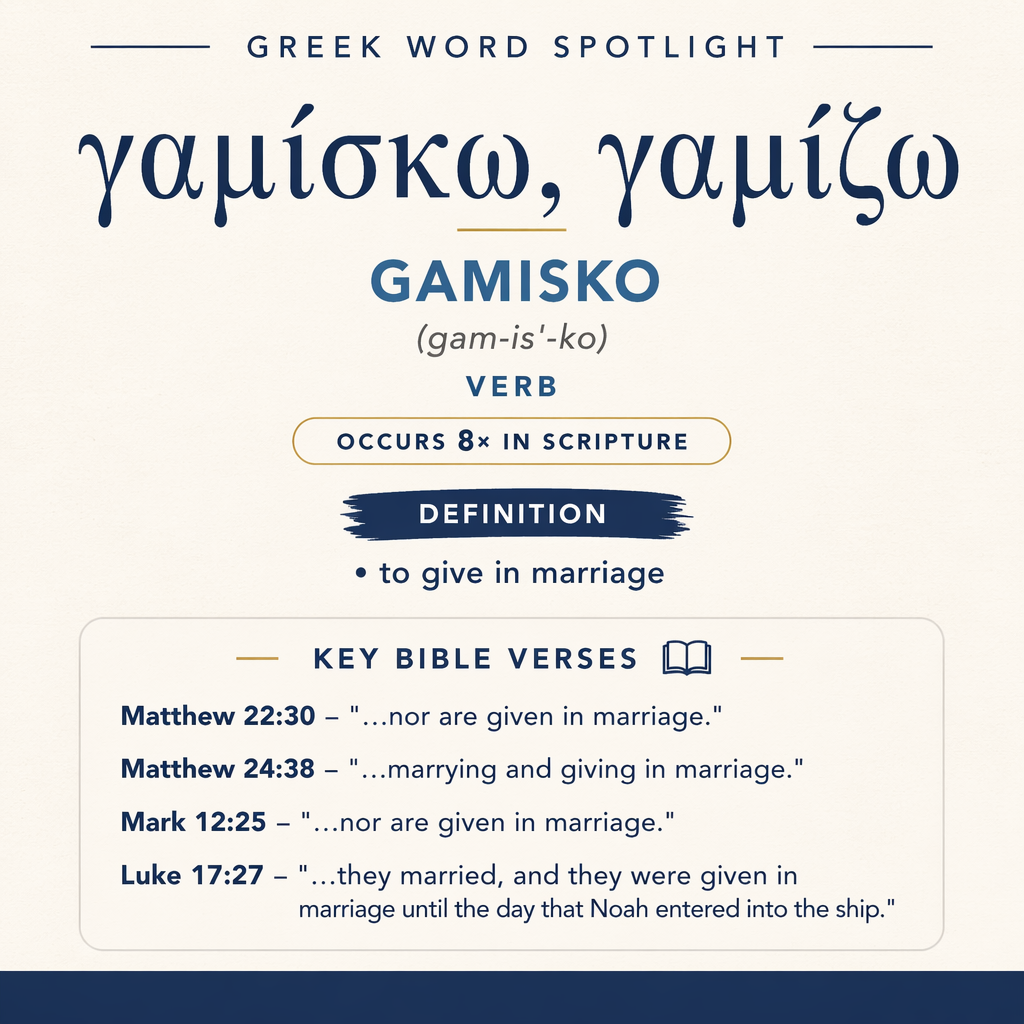
γαμίσκω, γαμίζω means “to give in marriage.” In the New Testament it appears in sayings about life “in the resurrection” and “this age,” and in descriptions of ordinary human life continuing up to the flood in Noah’s day, as well as in Paul’s counsel about arranging a marriage.
Occurrences
“For in the resurrection they neither marry, nor are given in marriage, but are like God’s angels in heaven.” (Matthew 22:30)
Here the verb is paired with “marry,” setting two sides of human marriage practice alongside each other: the act of marrying and the act of being given in marriage. The statement places both activities on the side of present earthly life by denying them “in the resurrection,” and contrasts that future condition with being “like God’s angels in heaven.” The word contributes the social, family-arranging aspect of marriage that accompanies personal marrying.
“For as in those days which were before the flood they were eating and drinking, marrying and giving in marriage, until the day that Noah entered into the ship,” (Matthew 24:38)
In this portrayal of “those days which were before the flood,” “giving in marriage” stands among routine activities (“eating and drinking”) and major life events (“marrying”). The word helps depict the normal continuation of family life and household decisions right up “until the day that Noah entered into the ship.” It adds the sense of deliberate, arranged participation in marriage that is part of a community’s ordinary rhythm.
“For when they will rise from the dead, they neither marry, nor are given in marriage, but are like angels in heaven.” (Mark 12:25)
This line parallels the resurrection saying found elsewhere: once people “will rise from the dead,” neither marrying nor being given in marriage continues. The verb again marks a distinct marital action alongside marrying, and its negation emphasizes a discontinuity between the patterns of “this age” and the life connected with resurrection. The comparison “like angels in heaven” frames the change not as a mere alteration of customs, but as part of a different mode of existence.
“They ate, they drank, they married, and they were given in marriage until the day that Noah entered into the ship, and the flood came and destroyed them all.” (Luke 17:27)
Luke’s description lists actions in a repeated, rhythmic style: “They ate, they drank, they married, and they were given in marriage.” The verb contributes to a picture of society continuing its family-forming practices—both marrying and giving in marriage—right up to a sudden turning point. The clause “until the day that Noah entered into the ship” ties these activities to a specific deadline, and “the flood came and destroyed them all” shows that normalcy did not signal safety.
“Jesus said to them, “The children of this age marry, and are given in marriage.” (Luke 20:34)
In this saying, “the children of this age” are described by what they characteristically do: they “marry, and are given in marriage.” The verb is placed as a standard feature of “this age,” presenting the giving in marriage as a recognized social practice by which marriages are formed. The pairing suggests a full portrait of marriage as both personal action and communal or familial arrangement.
“But those who are considered worthy to attain to that age and the resurrection from the dead neither marry nor are given in marriage.” (Luke 20:35)
Here the verb falls under a double limitation: it does not apply to those “considered worthy to attain to that age” nor to those connected with “the resurrection from the dead.” The statement mirrors Luke 20:34 by marking the transition from one age to another: what characterizes “the children of this age” is not carried over into “that age.” The word’s contribution is to represent marriage not only as a personal choice but also as an action carried out upon someone—being given in marriage—both of which cease in the described future state.
“So then both he who gives his own virgin in marriage does well, and he who doesn’t give her in marriage does better.” (1 Corinthians 7:38)
In Paul’s practical counsel, the verb is used with a direct object and possessive language: “he who gives his own virgin in marriage.” The wording foregrounds the role of a responsible party who can either arrange the marriage or refrain from doing so. The verse evaluates two courses of action—giving in marriage and not giving in marriage—calling the first “well” and the second “better,” which makes the verb the pivot for an ethical comparison about the decision to proceed with a marriage arrangement.
Sense and Usage
Across these passages, “to give in marriage” functions as a distinct element within the broader topic of marriage. The repeated pairing with “marry” (Matthew 22:30; Mark 12:25; Luke 20:34–35) gives the clearest clue to its force in context: it names the action that complements the individual act of marrying. The expression “are given in marriage” casts marriage as something that may be done to or for a person within a community’s established pattern, not merely as an inward decision. Without adding any new gloss, the consistent collocation shows that the term belongs to the sphere of arranging and effecting marriage as a social act.
Two clusters of texts highlight different facets of the same practice. In the resurrection sayings, the verb is used in categorical negations (“neither… nor…”). In Matthew 22:30 and Mark 12:25, the denial is framed by resurrection (“in the resurrection,” “when they will rise from the dead”) and by comparison to angels in heaven. Luke 20:34–35 develops this by setting “this age” alongside “that age,” making the practice of giving in marriage a marker of the present order. The verb thus contributes to eschatological contrast: it helps define what belongs to current human society and what does not characterize the future state described in these sayings.
The Noah passages (Matthew 24:38; Luke 17:27) place “giving in marriage” in lists of commonplace actions: eating, drinking, marrying, giving in marriage. The effect is not to single the practice out as unusual, but to embed it in the normal continuity of life. The word specifically strengthens the picture of ordinary household and family arrangements continuing right up to a decisive interruption (“until the day that Noah entered into the ship”). In Luke, the sequence culminates with sudden judgment (“the flood came and destroyed them all”), so the list functions as a portrait of unbroken normal activity rather than as an explanation of wrongdoing. “Giving in marriage” in this setting signals stability, planning, and ongoing social order—precisely the kind of activity people pursue when they assume tomorrow will be like today.
In 1 Corinthians 7:38 the verb is not part of a general contrast between ages or an illustrative list, but appears in an evaluative statement about a concrete decision. The construction “gives his own virgin in marriage” portrays an agent who has authority or responsibility in arranging a woman’s marriage, and Paul’s comparison between doing so and refraining shows that the act can be weighed as a deliberate course of action. Within the same basic meaning, this usage highlights the practical and relational dimension of “giving in marriage”: it is something done on behalf of another person, with consequences that can be assessed as “well” or “better” in a particular pastoral situation.
Imagery
Because the word appears in set pairings and in vivid narrative framing, it carries strong everyday imagery. In the flood sayings, “giving in marriage” evokes households making plans, families joining, and communities continuing familiar ceremonies “until the day that Noah entered into the ship” (Matthew 24:38; Luke 17:27). In the resurrection sayings, the same practice becomes a boundary marker: what is familiar and socially embedded in “this age” does not define “that age and the resurrection from the dead” (Luke 20:35), where people are described as “like angels in heaven” (Matthew 22:30; Mark 12:25).
Sources:
Lexical data from Strong’s Exhaustive Concordance and the Translators Brief Lexicon of Extended Strongs for Greek (STEPBible, CC BY). Occurrence data from the Translators Amalgamated Greek New Testament (STEPBible, CC BY). Scripture quotations from the World English Bible (public domain).