
Understanding the Meaning of Apokteino in Greek
ἀποκτείνω means “to kill” and occurs 75 times in Scripture, including in Matthew 10:28; 14:5; 16:21; 17:23; 21:35,38–39; 22:6.
Core Meaning
ἀποκτείνω is defined as “to kill.” It is used for putting someone to death.
Learn More →Matthew Examples
In Matthew it describes killing the body (Matthew 10:28). It is used for killing servants and the heir in parables (Matthew 21:35,38–39; 22:6).
Learn More →Scripture Frequency
This verb occurs 75 times in Scripture. The provided occurrences include multiple uses across Matthew 10–22.
Learn More →ἀποκτείνω means “to kill.” In the passages quoted below, it appears in sayings of Jesus, predictions of his death, and parables and warnings where killing marks hostility, injustice, or threatened persecution.
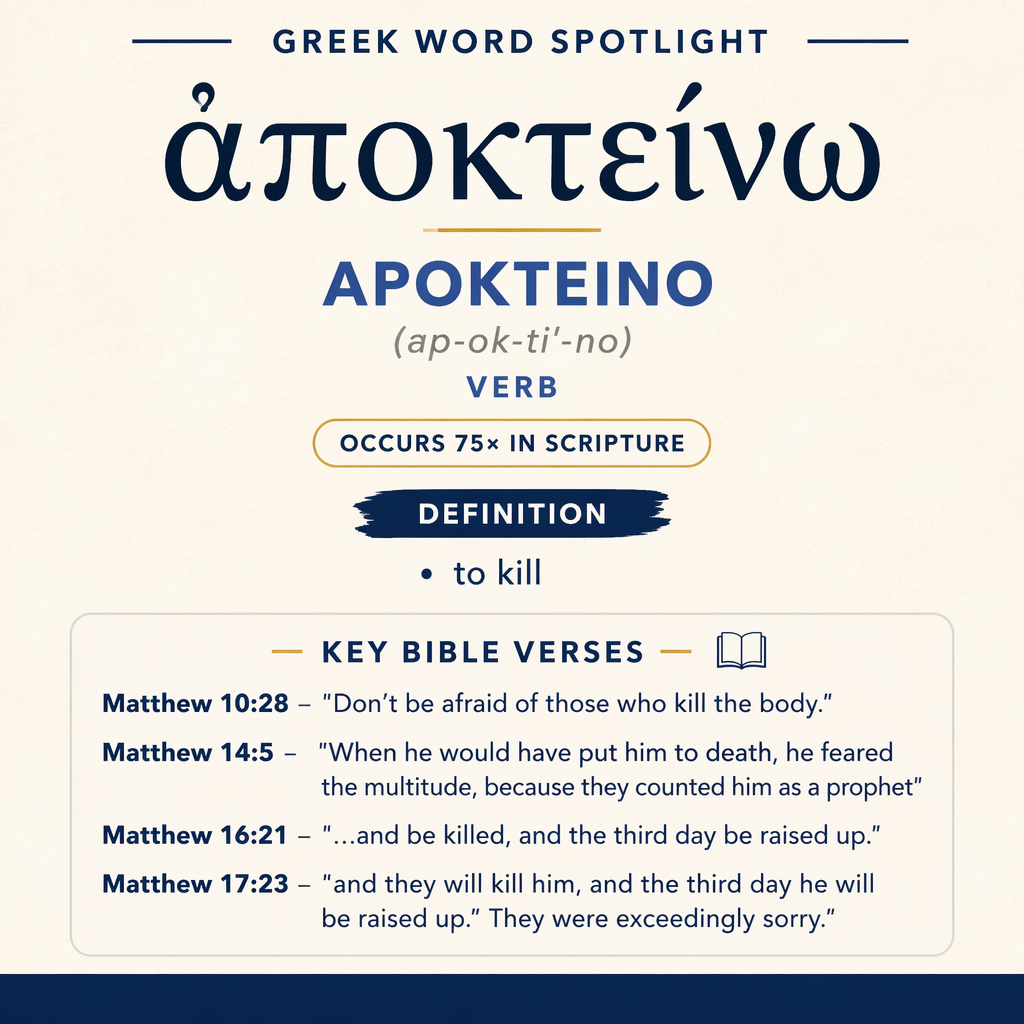
Occurrences
Matthew 10:28 — “Don’t be afraid of those who kill the body, but are not able to kill the soul. Rather, fear him who is able to destroy both soul and body in Gehenna.”
Here the verb is set in a contrast: some can “kill the body,” yet their reach stops there. The statement frames killing as a real, feared act in human conflict, but also as a limited power; it becomes a boundary marker between what human opponents can do and what exceeds human control.

Matthew 14:5 — “When he would have put him to death, he feared the multitude, because they counted him as a prophet.”
Killing is presented as an intended outcome (“would have put him to death”), yet restrained by public reaction. The verb communicates a deliberate plan rather than an accident, and the verse places that plan within political calculation: fear of the crowd delays what power might otherwise enact.
Matthew 16:21 — “From that time, Jesus began to show his disciples that he must go to Jerusalem and suffer many things from the elders, chief priests, and scribes, and be killed, and the third day be raised up.”
In this prediction, killing stands as one element in a sequence: going to Jerusalem, suffering at the hands of named authorities, then being killed, followed by being raised. The verb supplies the concrete endpoint of the suffering described, tying opposition from leaders to an actual death rather than mere harassment.
Matthew 17:23 — “and they will kill him, and the third day he will be raised up.” They were exceedingly sorry.
This reiteration keeps the focus tight: “they will kill him” is paired directly with the promise of being raised. The disciples’ sorrow shows the emotional weight the verb carries in narrative context: killing is heard as loss and finality, even though the saying immediately places it alongside restoration.
Matthew 21:35 — “The farmers took his servants, beat one, killed another, and stoned another.”
Within the parable’s escalation of violence, killing is placed between beating and stoning, marking a step beyond abuse into death. The verb intensifies the farmers’ rejection of the owner’s claims: the servants are not merely turned away; one is ended.
Matthew 21:38 — “But the farmers, when they saw the son, said among themselves, ‘This is the heir. Come, let’s kill him, and seize his inheritance.’”
Killing is here proposed as a means to an end: seizing an inheritance. The verb is tied to motive and deliberation—speech, agreement, and a planned action—so that killing functions as calculated removal of the rightful heir.
Matthew 21:39 — “So they took him, and threw him out of the vineyard, and killed him.”
This verse narrates the plan’s execution in three movements: seizure, expulsion, and killing. The verb is the culminating act that completes the farmers’ rejection; after the son is cast out, killing seals the violence as irreversible within the story.
Matthew 22:6 — “and the rest grabbed his servants, and treated them shamefully, and killed them.”
Again in parabolic form, killing is joined with humiliation (“treated them shamefully”), portraying contempt that becomes lethal. The verb depicts hostility that refuses even basic respect for messengers, turning disgrace into death.
Matthew 23:34 — “Therefore behold, I send to you prophets, wise men, and scribes. Some of them you will kill and crucify; and some of them you will scourge in your synagogues, and persecute from city to city;”
Killing appears as one anticipated response to those who are sent—set alongside crucifixion, scourging, and persecution. The verb helps categorize the range of rejection: some messengers will face violent death, while others experience continuing oppression across places.
Matthew 23:37 — “Jerusalem, Jerusalem, who kills the prophets, and stones those who are sent to her! How often I would have gathered your children together, even as a hen gathers her chicks under her wings, and you would not!”
In this lament, killing is described as a characteristic action: the city is addressed as one “who kills the prophets.” The verb functions as a moral indictment, set against the image of protective gathering; killing and stoning embody the refusal of care and the rejection of those sent.
Matthew 24:9 — “Then they will deliver you up to oppression, and will kill you. You will be hated by all of the nations for my name’s sake.”
Here the verb is directed toward the disciples (“will kill you”) within a broader forecast of oppression and hatred. Killing is presented as a possible climax of hostility against Jesus’ followers, emerging from a chain of social action: delivery to oppression, hatred by nations, and lethal violence.
Matthew 26:4 — “They took counsel together that they might take Jesus by deceit, and kill him.”
This scene portrays killing as the goal of a plotted strategy. The verb is paired with “counsel together” and “deceit,” highlighting intentionality: the act is not spontaneous but the outcome of coordinated planning to end Jesus’ life.

Sense and Usage
Across these occurrences, ἀποκτείνω consistently denotes the act of killing as a decisive endpoint, whether threatened, intended, predicted, or carried out. Several texts emphasize the planning behind the act. In Matthew 14:5 and Matthew 26:4, the verb is embedded in deliberation—first checked by fear of the multitude, later pursued through counsel and deceit—so killing is portrayed as something authorities can choose, delay, and scheme to accomplish.
In the passion predictions (Matthew 16:21; 17:23), killing functions as the concrete outcome of opposition and suffering, yet it is framed within a sequence that continues beyond death (“and the third day be raised up”). The verb therefore contributes to the realism of the forecast: the suffering leads to an actual death, not merely to rejection. At the same time, the sayings place killing in a narrative arc whose next clause pushes past the finality that the disciples instinctively feel (“They were exceedingly sorry”).
In the parables (Matthew 21:35, 21:38, 21:39; 22:6), ἀποκτείνω sharpens the portrayal of violent refusal. The verb is repeatedly linked with abuse, shame, and dispossession: servants are beaten and shamed, then killed; the son is targeted precisely because he is “the heir,” and killing is proposed as the route to stolen inheritance. In these scenes, killing is not random violence but the extreme expression of rejecting legitimate claims and silencing rightful messengers. The narrative pattern—grabbing, beating, stoning, shaming, throwing out—sets killing as the culminating act that demonstrates hardened hostility.
In Jesus’ warnings and lament (Matthew 10:28; 23:34; 23:37; 24:9), the verb marks the threat faced by prophets, sent ones, and disciples. Matthew 10:28 limits human capacity to “kill the body,” situating killing within the realm of what persecutors can do, while redirecting fear toward one who can do more than kill. Matthew 23:34 and 23:37 portray killing as a recurring response to those sent, placing it among other forms of persecution; the repetition of the idea across these sayings gives killing a communal and historical dimension within the discourse, not merely an isolated incident. Matthew 24:9 extends the warning to the followers themselves, depicting killing as a possible outcome of widespread hatred “by all of the nations.”
Imagery
The quoted passages attach vivid settings to killing: a body threatened by human violence (Matthew 10:28), public pressure restraining an execution (Matthew 14:5), leaders in Jerusalem as agents of lethal rejection (Matthew 16:21), and a plotted death by deceit (Matthew 26:4). The parables intensify the imagery through scenes of a vineyard, servants assaulted, an heir seized and cast out, and messengers shamed and killed (Matthew 21:35–39; 22:6). Together these texts make killing the clearest marker of enmity in action—whether as a feared possibility, a settled plan, or an act that reveals what a community is willing to do to silence those sent to it.
Sources: Lexical data from Strong’s Exhaustive Concordance and the Translators Brief Lexicon of Extended Strongs for Greek (STEPBible, CC BY). Occurrence data from the Translators Amalgamated Greek New Testament (STEPBible, CC BY). Scripture quotations from the World English Bible (public domain).





