
Exploring the Meaning of Aneko in Greek
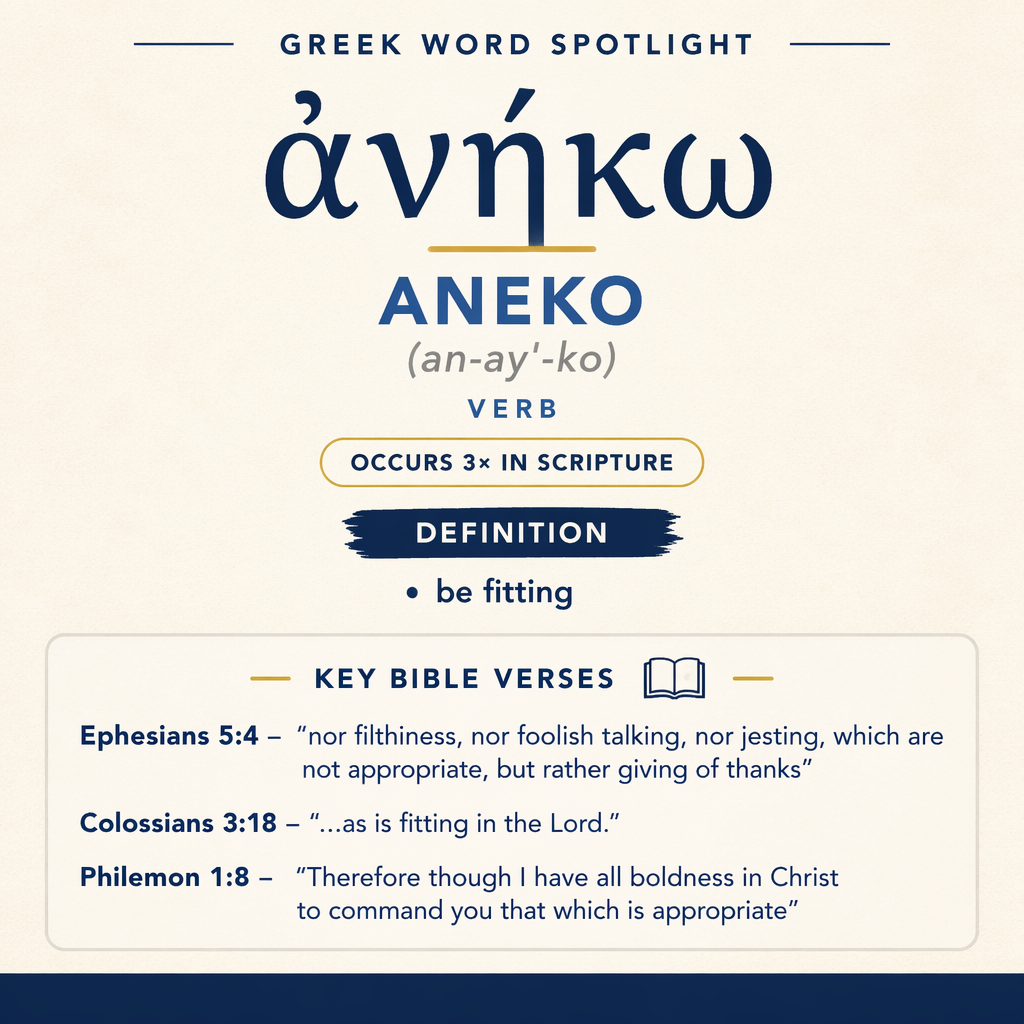
ἀνήκω means “be fitting” and appears three times in Scripture: Ephesians 5:4, Colossians 3:18, and Philemon 1:8.
Scripture Occurrences
This word occurs 3 times in Scripture. It appears in Ephesians 5:4, Colossians 3:18, and Philemon 1:8.
Learn More →Context Examples
In Ephesians 5:4 it marks certain speech as “not appropriate.” In Colossians 3:18 and Philemon 1:8 it identifies what is “fitting” or “appropriate.”
Learn More →ἀνήκω expresses what is fitting, appropriate, or proper within a given situation. In the New Testament it appears in three Pauline settings where conduct and speech are weighed against what suits life “in the Lord” and “in Christ.”
Root and Related Words
ἀνήκω is related to the verb heko (ἥκω), “to come/be present” (Strong’s G2240), and to the preposition ana (ἀνά), “each” (Strong’s G303). These related terms sit behind the form and help frame ἀνήκω as language of what “belongs” in a particular setting—what is suitably at hand for the moment or for each case.

Occurrences
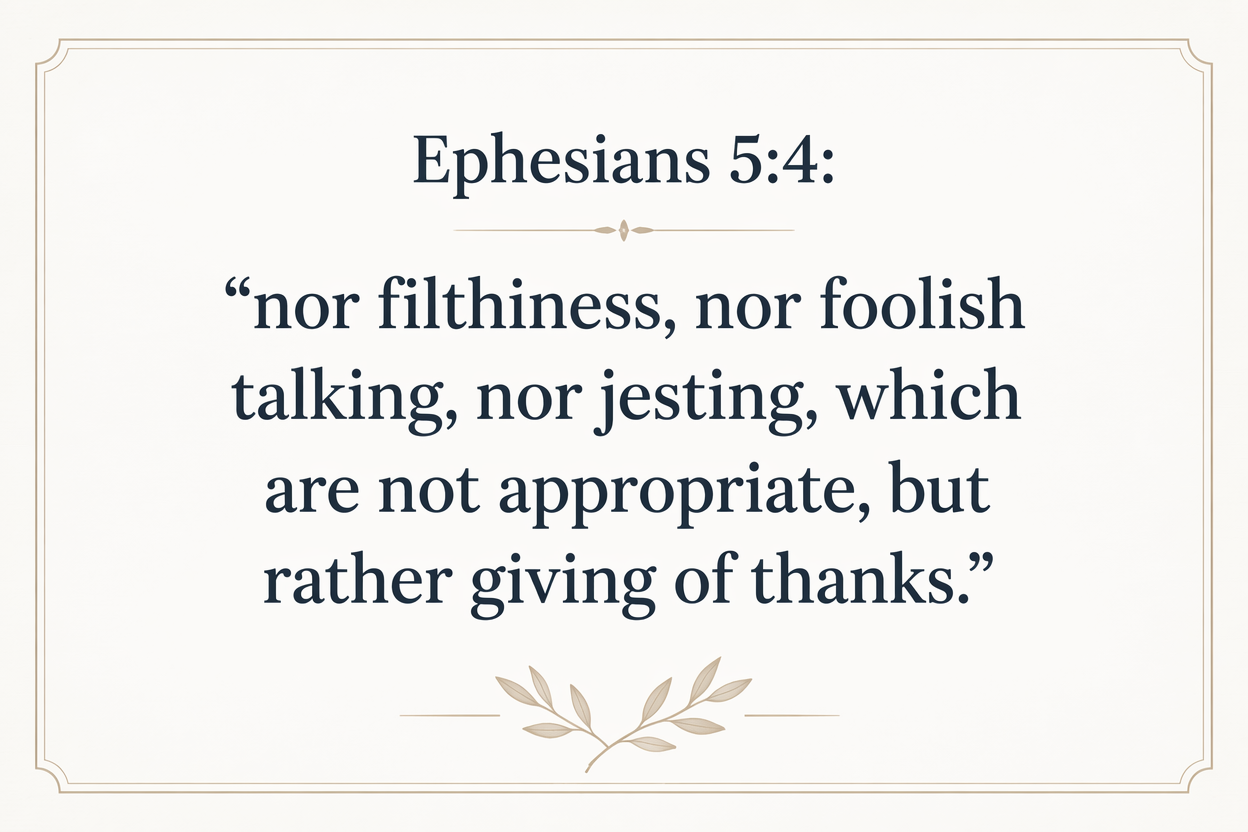
Ephesians 5:4: “nor filthiness, nor foolish talking, nor jesting, which are not appropriate, but rather giving of thanks.”
Here ἀνήκω functions as an evaluative word set inside a list. The verse lays out several kinds of speech—“filthiness,” “foolish talking,” and “jesting”—and then judges them together as “not appropriate.” The force of ἀνήκω is practical: it is not merely that such speech is undesirable, but that it does not fit the community’s pattern of life. The contrast that follows sharpens the sense of what fits: “but rather giving of thanks.” In this scene, what is “appropriate” is defined by the alternative practice that should take its place. ἀνήκω therefore marks a boundary between speech that does not belong and speech that does.
Colossians 3:18: “Wives, be in subjection to your husbands, as is fitting in the Lord.”
In Colossians the word appears as a brief moral qualifier attached to a household instruction. The command is not given in isolation; it is framed by the phrase “as is fitting in the Lord.” ἀνήκω here serves to locate the instruction within a sphere of belonging—what suits those who live “in the Lord.” The wording makes the fittingness more than a matter of cultural expectation; it is tied to a specifically Christian domain named in the verse itself. The term therefore works as a rationale, presenting the action as one that coheres with the claimed identity and allegiance expressed by “in the Lord.”
Philemon 1:8: “Therefore though I have all boldness in Christ to command you that which is appropriate,”
In Philemon ἀνήκω appears within a personal appeal, not a general instruction list. The speaker states he has “all boldness in Christ to command” what is “appropriate.” The word here is linked to the idea of rightful moral expectation: something can be commanded because it is fitting. At the same time, the verse’s rhetoric places “appropriate” under the banner of “in Christ,” which parallels the grounding seen in Colossians (“in the Lord”). ἀνήκω thus contributes a measured tone: the writer could issue a command and can describe the requested action as proper, yet he couches this propriety within the relationship implied by being “in Christ.”
Sense and Usage
Across these passages ἀνήκω operates as a term of suitability—language that assesses whether words or actions match the setting, the people involved, and the spiritual sphere named in the text. It does not merely label something as “good” in the abstract; it speaks to congruence. In Ephesians 5:4 the focus is public and verbal: certain kinds of talk are judged to be out of place, while “giving of thanks” is presented as the speech that properly belongs. In Colossians 3:18 and Philemon 1:8 the focus shifts from speech to relational conduct and interpersonal obligation, yet the same idea holds: there is a kind of action that fits the relationship and the shared confession expressed by “in the Lord” and “in Christ.”
The three contexts show how flexible the word is while staying anchored in the same evaluative core. It can condemn (speech that is “not appropriate”), it can commend (a relational posture that “is fitting”), and it can authorize exhortation (a request framed as something that is “appropriate” to command). In each case, ἀνήκω quietly invokes a standard of propriety that is not left undefined: the verses themselves supply the relevant frame—thanksgiving replacing corrupt speech; life “in the Lord” shaping household behavior; “boldness in Christ” grounding an appeal. Thus the “fittingness” is not presented as a free-floating social instinct but as an assessment tied to the Christian identity explicitly named in the immediate lines.
Another shared feature is the way ἀνήκω sits near choices and alternatives. Ephesians places it at a fork in the road (“not appropriate, but rather giving of thanks”), so the reader hears fittingness as selection: one kind of speech is excluded because another is suited to take its place. Colossians likewise frames fittingness as the manner in which an instruction is to be understood (“as is fitting in the Lord”), limiting the command by grounding it in a particular sphere. Philemon frames fittingness within persuasion: the speaker’s authority to command is acknowledged, but the appropriateness of the command is what makes that authority morally intelligible. In all three, ἀνήκω works less like a bare label and more like a hinge word—connecting conduct to the context that makes it suitable.
Imagery
The passages give ἀνήκω an everyday moral texture: speech can be “not appropriate” and can be replaced by “giving of thanks” (Ephesians 5:4), household relations can be characterized as “fitting in the Lord” (Colossians 3:18), and a personal appeal can be framed as something properly commanded “in Christ” (Philemon 1:8). The word’s imagery is therefore the imagery of fit—of words and actions either belonging where they are spoken and done, or standing out as mismatched to the life named in these verses.
Sources: Lexical data from Strong’s Exhaustive Concordance and the Translators Brief Lexicon of Extended Strongs for Greek (STEPBible, CC BY). Occurrence data from the Translators Amalgamated Greek New Testament (STEPBible, CC BY). Scripture quotations from the World English Bible (public domain).




