
Exploring the Meaning of Aneklaletos in Greek
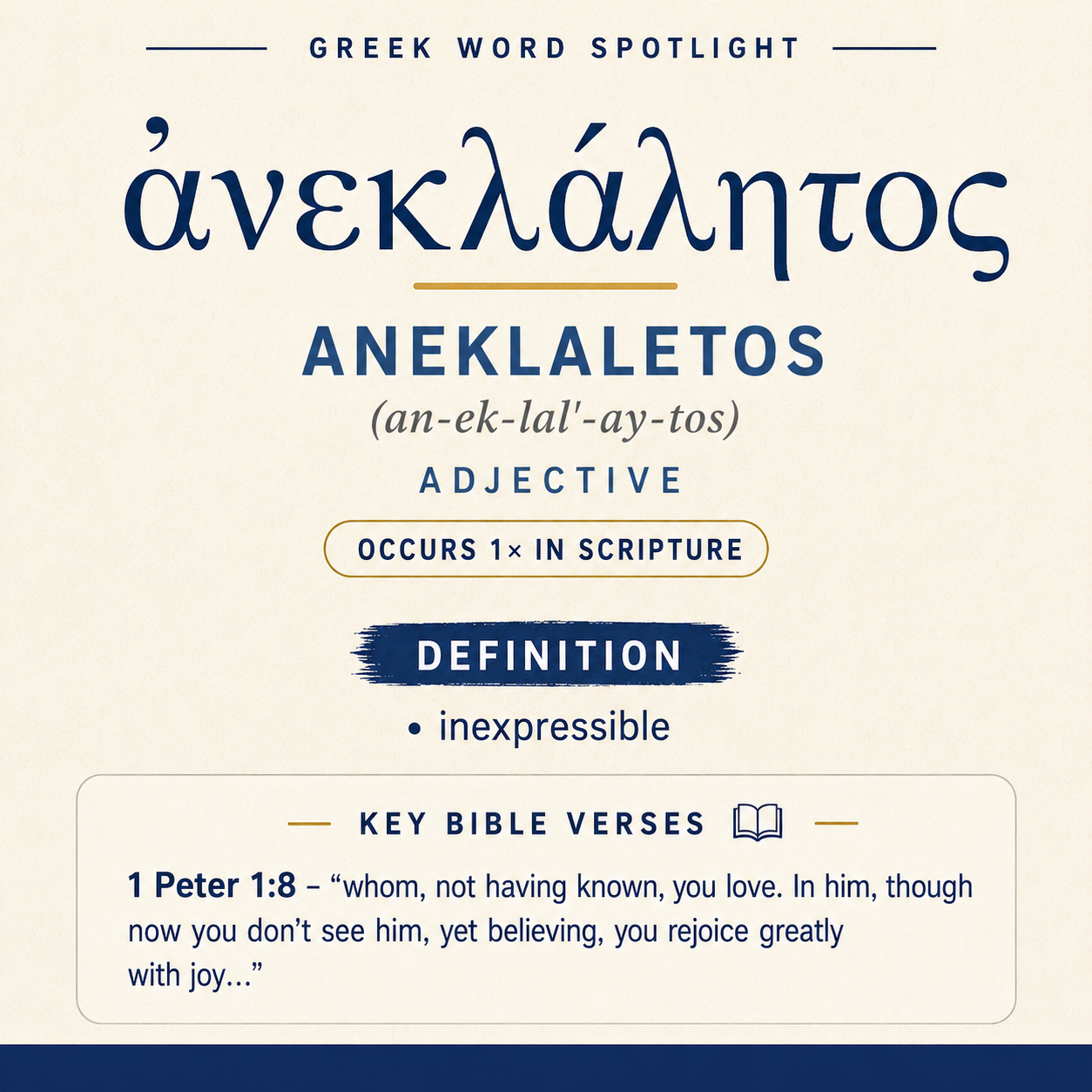
ἀνεκλάλητος means “inexpressible” and appears once in Scripture at 1 Peter 1:8.
Scripture Occurrence
This word occurs 1 time in Scripture. Its single occurrence is in 1 Peter 1:8.
Learn More →Verse Context
In 1 Peter 1:8, it describes the joy of those who believe in Christ though they do not see him.
Learn More →ἀνεκλάλητος means “inexpressible.” It appears once, describing the quality of Christian joy in 1 Peter 1:8.
Root and Related Words
ἀνεκλάλητος is connected with ἐκλαλέω (eklaleo), “to speak out” (Strong’s G1583). Strong’s also associates it with α (Alpha), “Alpha” (Strong’s G1).

Occurrences
“whom, not having known, you love. In him, though now you don’t see him, yet believing, you rejoice greatly with joy that is unspeakable and full of glory,” (1 Peter 1:8)
In this sentence, ἀνεκλάλητος qualifies “joy” by placing it beyond the reach of normal verbal expression. The line is carefully built from relational and experiential clauses—“not having known, you love,” “though now you don’t see him, yet believing”—and then moves to an emotional and communal outcome: “you rejoice greatly.” Within that progression, “joy that is unspeakable” indicates that the rejoicing is not merely intense, but of such a kind that speech cannot carry it in a straightforward way. The word functions as a boundary-marker for language: the readers’ joy is real and active (“you rejoice greatly”), yet it exceeds what can be fully put into words.

The immediate context in the verse reinforces this. The joy is tied to a person (“In him … yet believing”), not to visible confirmation (“though now you don’t see him”). The adjective therefore does not stand alone as an abstract description of a feeling; it is anchored in a lived posture of faith and love directed toward the unseen. In that setting, the word paints joy as something that can be experienced and expressed through rejoicing, but still cannot be exhaustively articulated. The text also adds a second quality: it is “full of glory.” ἀνεκλάλητος sits alongside this fullness, pairing the inability to express the joy with an affirmation that it is weighty and radiant in character as the verse describes it.
Sense and Usage
With the sense “inexpressible,” ἀνεκλάλητος marks a limit of speech rather than a lack of joy. In 1 Peter 1:8 the readers are not silent; they “rejoice greatly.” The word therefore frames their joy as surpassing verbal explanation while still producing visible, active rejoicing. The adjective’s placement immediately after “joy” keeps the focus on the quality of that joy rather than on the mechanics of speaking: it is a joy that cannot be fully said, even when it is deeply felt and outwardly celebrated.
The verse connects this inexpressible joy to two tension-filled realities: love without prior physical knowing (“not having known, you love”) and faith without present sight (“though now you don’t see him, yet believing”). ἀνεκλάλητος contributes to that tension by showing that the inner experience generated by love and belief can overflow ordinary descriptive categories. In the verse’s own rhythm, the readers’ relationship to Christ is described by what is missing (no past knowing, no present seeing) and what is present (love, belief, rejoicing). The adjective highlights that the resulting joy is not simply an emotional reaction that can be measured and narrated in typical terms; it belongs to the same pattern as the other realities of the verse—genuine, personal, and not dependent on sight.
The final phrase, “full of glory,” gives the joy a further dimension within the verse’s language. ἀνεκλάλητος does not replace that description but complements it: the joy is both too great for plain speech and characterized by “glory” in the wording of the passage. As used here, the word thus works less like a decorative intensifier and more like an interpretive cue, telling the reader how to understand the rejoicing—an experienced reality whose depth resists complete verbal capture.
Imagery
In 1 Peter 1:8, ἀνεκλάλητος evokes the picture of praise and rejoicing that rises from faith in the unseen. The verse’s imagery is not of silence but of overflowing gladness—rejoicing that is present and abundant, yet still described as beyond words.
Sources: Lexical data from Strong’s Exhaustive Concordance and the Translators Brief Lexicon of Extended Strongs for Greek (STEPBible, CC BY). Occurrence data from the Translators Amalgamated Greek New Testament (STEPBible, CC BY). Scripture quotations from the World English Bible (public domain).





