
Exploring the Meaning of Anektoteros in Greek
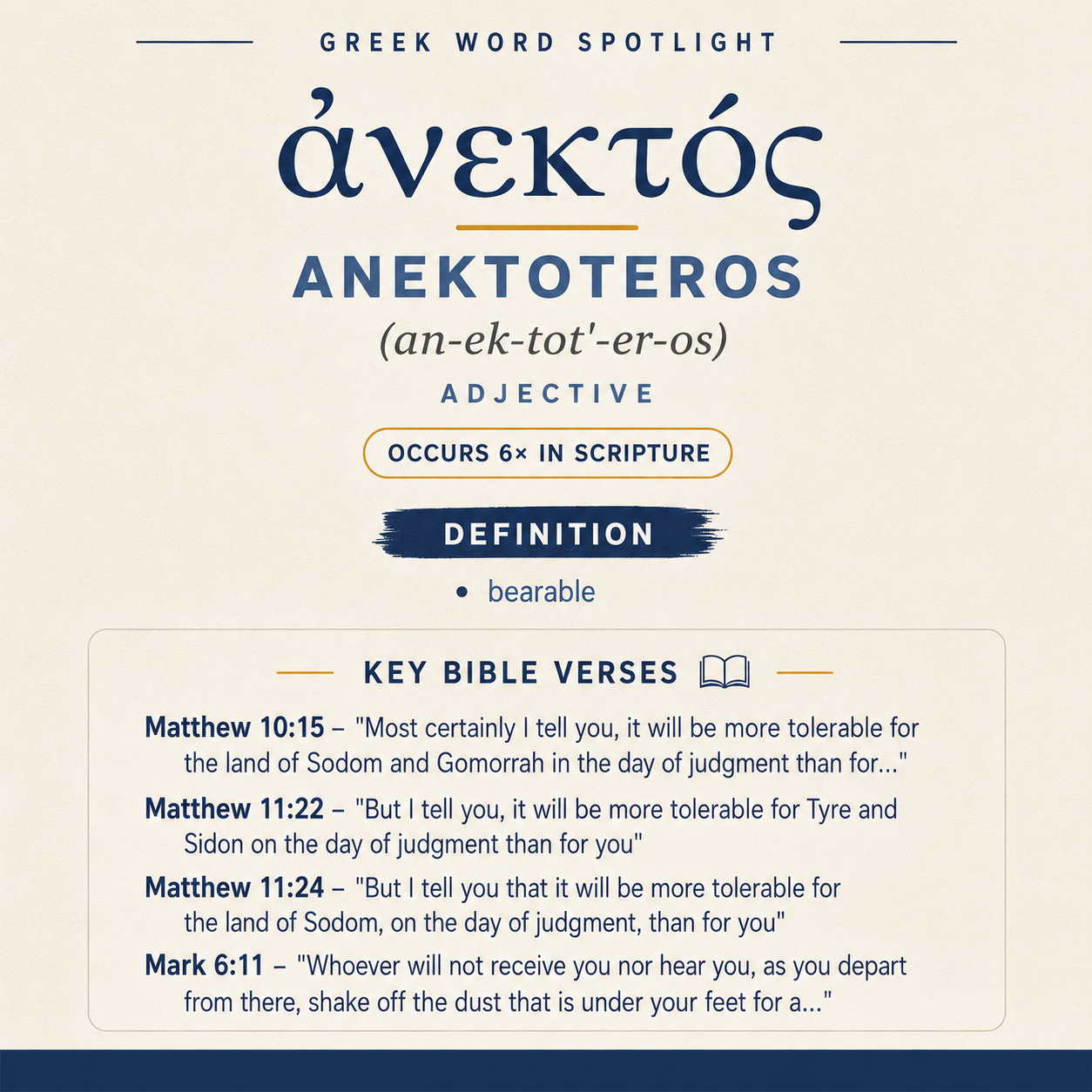
ἀνεκτός means “bearable” and occurs six times in Matthew, Mark, and Luke in judgment-day comparisons.
Core Meaning
ἀνεκτός is defined as “bearable.” In these passages it appears in the comparative sense “more tolerable.”
Learn More →Gospel Occurrences
It occurs in Matthew 10:15; 11:22; 11:24; Mark 6:11; Luke 10:12; and Luke 10:14. Each occurrence is in the Gospels.
Learn More →Judgment Comparisons
The word is used in statements about the day of judgment. It compares what is “more tolerable” for Sodom, Tyre and Sidon, and Sodom and Gomorrah than for others.
Learn More →ἀνεκτός expresses what is “bearable,” appearing in sayings of Jesus that compare how “tolerable” judgment will be for different cities and regions. In each setting it sharpens the contrast between communities that respond to the message and those that refuse it, setting their accountability side by side with well-known examples of notorious places.
Root and Related Words
ἀνεκτός is connected with the verb anechomai (ἀνέχω), “to endure.”

Occurrences
Matthew 10:15 — “Most certainly I tell you, it will be more tolerable for the land of Sodom and Gomorrah in the day of judgment than for that city.”
Here ἀνεκτός is set inside a solemn comparison: one city’s coming evaluation is described as less “tolerable” than that of “the land of Sodom and Gomorrah.” The word frames judgment as something that must be borne, and it places two burdens on the scale—the burden assigned to the rejecting city, and the burden assigned to Sodom and Gomorrah. By saying “more tolerable … than for that city,” the statement does not merely announce judgment; it ranks its severity, making refusal to “receive” and “hear” (the surrounding mission context) carry a heavier, less bearable outcome.

Matthew 11:22 — “But I tell you, it will be more tolerable for Tyre and Sidon on the day of judgment than for you.”
In this saying, ἀνεκτός again functions comparatively (“more tolerable … than for you”), but the contrast partner shifts to “Tyre and Sidon.” The phrase “on the day of judgment” anchors the comparison in an eschatological courtroom scene, and ἀνεκτός depicts the judgment as something experienced—endured—by those under it. The direct address (“for you”) makes the comparison pointed: the audience is told that another pair of cities will find that day more bearable than they will.
Matthew 11:24 — “But I tell you that it will be more tolerable for the land of Sodom, on the day of judgment, than for you.”
This occurrence reinforces the same comparative structure but returns to “the land of Sodom,” now singular. ἀνεκτός still evaluates the relative weight of judgment, but the repetition of “on the day of judgment” keeps the emphasis on the future reckoning rather than present circumstance. The word’s contribution is to make the comparison not abstract but experiential: the day will be faced with differing degrees of bearability. The statement’s force lies in the surprising ordering—Sodom’s judgment is presented as the more tolerable burden when set beside “you.”
Mark 6:11 — “Whoever will not receive you nor hear you, as you depart from there, shake off the dust that is under your feet for a testimony against them. Assuredly, I tell you, it will be more tolerable for Sodom and Gomorrah in the day of judgment than for that city!”
Here ἀνεκτός is embedded in a concrete mission scenario with actions and gestures: some “will not receive you nor hear you,” and the response commanded is to “shake off the dust … for a testimony against them.” Against that backdrop, “more tolerable” interprets the gravity of the rejection. The dust-shaking is not the judgment itself but a sign “against them,” and ἀνεκτός names what the sign points toward: a coming day when the consequences must be borne. By invoking “Sodom and Gomorrah,” the saying assigns the rejecting city a less bearable judgment than places already infamous for catastrophic judgment, intensifying the warning attached to refusing the message.
Luke 10:12 — “I tell you, it will be more tolerable in that day for Sodom than for that city.”
Luke’s form is tighter: “in that day” stands in for the fuller phrase “the day of judgment,” but the function of ἀνεκτός remains the same—measuring how bearable the day will be for different parties. The contrast is again between “Sodom” and “that city,” and ἀνεκτός supplies the evaluative term that makes the comparison meaningful. The phrase “for Sodom” places even that notorious name under judgment, yet the word “more tolerable” insists that another city’s outcome will be harder to bear.
Luke 10:14 — “But it will be more tolerable for Tyre and Sidon in the judgment than for you.”
This parallel to Matthew 11:22 includes the phrasing “in the judgment,” focusing the comparison not only on a day but on the event of judgment itself. ἀνεκτός depicts that judgment as an ordeal whose severity can be compared. The judgment is not presented as uniform; rather, some will find it “more tolerable” than others. As in the other direct-address sayings, the second-person “for you” makes the contrast personal and admonitory, stressing that the audience’s stance places them under a less bearable verdict than “Tyre and Sidon.”
Sense and Usage
Across these six occurrences, ἀνεκτός consistently appears in comparative form (“more tolerable”), functioning to grade the severity of judgment between two referents. The word’s basic idea of bearability is not applied to ordinary hardships but to the experience of “the day of judgment,” “in that day,” or “in the judgment.” That repeated setting gives the term a legal and eschatological horizon: it is the coming reckoning that will be endured, and ἀνεκτός provides language for the degree to which it can be endured.
The comparisons also show how the term is used rhetorically. Each saying assumes that judgment is unavoidable for all named places (“Sodom,” “Sodom and Gomorrah,” “Tyre and Sidon,” and the addressed “city” or “you”), yet ἀνεκτός draws a sharp distinction in accountability. The “more tolerable” side of the comparison is always a set of cities with established negative associations, and the “less tolerable” side is the city or audience being warned. The effect is to heighten the seriousness of rejecting the messengers (“will not receive you nor hear you”) and to frame that rejection as producing a uniquely hard-to-bear outcome.
Because ἀνεκτός is anchored in the judgment setting, it functions as more than an adjective of comfort or inconvenience. It becomes a term for the relative weight of a verdict. The sayings do not quantify the difference, but they do insist on real gradation: one judgment can be “more tolerable” than another. In that way the word helps express proportionality—judgment envisioned as something whose burden corresponds to the response of those judged.
Imagery
The imagery carried by ἀνεκτός in these passages is the image of a day that must be faced and borne. “That day,” “the day of judgment,” and “the judgment” are portrayed as an ordeal with varying heaviness, and the named cities become benchmarks on a scale of what can be endured. In Mark’s scene, the shaken-off dust “for a testimony against them” adds a visible sign that points forward to that less bearable outcome, connecting a simple travel gesture with the looming, weighty reality that ἀνεκτός describes.
Sources: Lexical data from Strong’s Exhaustive Concordance and the Translators Brief Lexicon of Extended Strongs for Greek (STEPBible, CC BY). Occurrence data from the Translators Amalgamated Greek New Testament (STEPBible, CC BY). Scripture quotations from the World English Bible (public domain).





