Exploring the Meaning of Amphodon in Greek
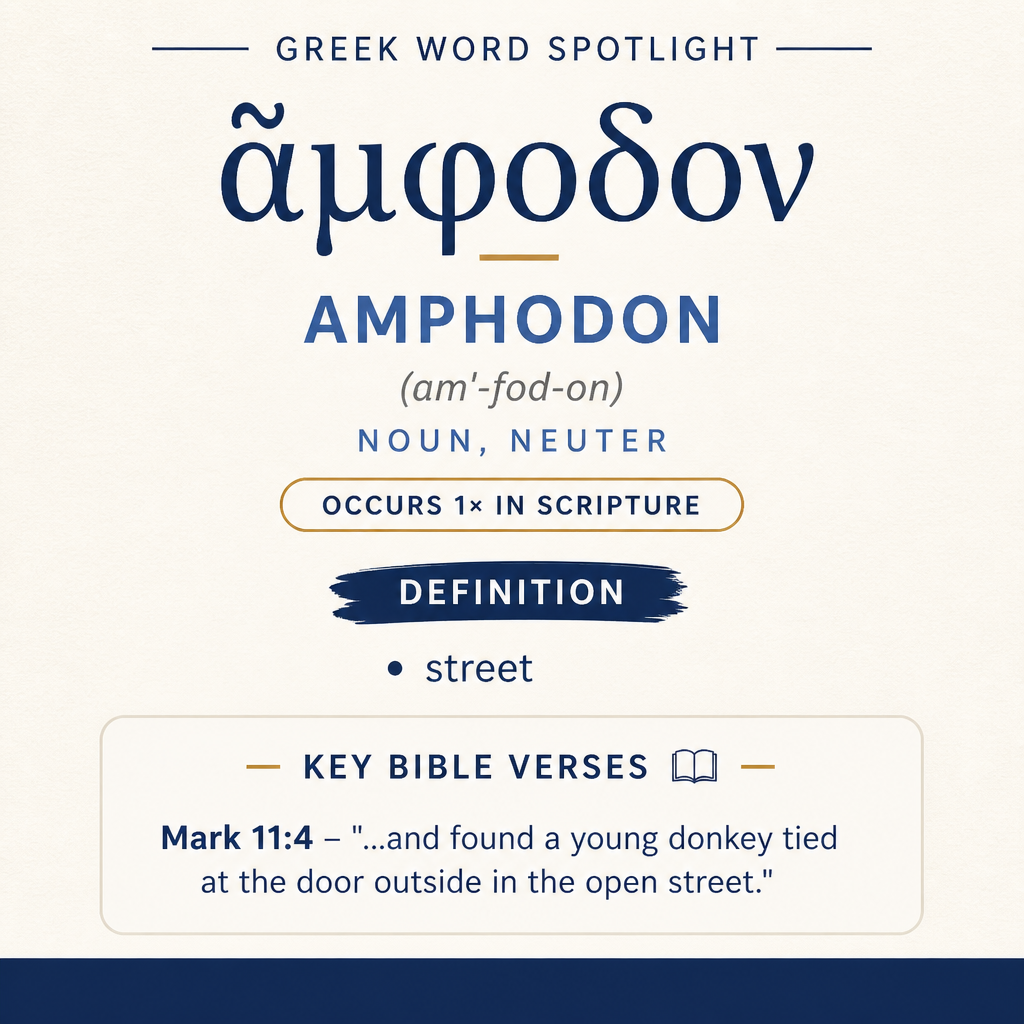
ἄμφοδον means “street” and appears once in Scripture in Mark 11:4.
Mark 11:4 Context
In Mark 11:4, it describes the open street where the young donkey was tied outside a door.
Learn More →ἄμφοδον means “street” and appears once in the New Testament, in Mark’s account of Jesus’ entry into Jerusalem. In its single context it names the public outdoor space where a young donkey is found tied and ready to be led away.
Root and Related Words
ἄμφοδον (Amphodon) is connected with ἀμφότερος (amphoteros), “both” (Strong’s G297), and ὁδός (hodos), “road” (Strong’s G3598). These related words frame the term within the sphere of travel and public ways, and they help explain why the narrative setting is an outdoor thoroughfare rather than a private interior.

Occurrences
“They went away, and found a young donkey tied at the door outside in the open street, and they untied him.” (Mark 11:4)
In Mark 11:4, ἄμφοδον marks the location as an “open street,” emphasizing that the donkey is secured in a place accessible from outside: “at the door outside.” The word anchors the action in a public, everyday setting where movement is expected—people can come and go, doors open onto it, and an animal can be tethered where it is visible and reachable. This matters for the sequence of verbs that drive the verse: the disciples “went away,” “found” the donkey, and “untied him.” The street functions as the practical space that makes these actions straightforward: the donkey is not hidden or locked away, but situated where it can be encountered in passing and released without entering a private room.

The phrasing “tied at the door outside” places the animal at the boundary between a doorway and the street. ἄμφοδον thus supports the picture of a threshold location: close enough to a door to be described in relation to it, yet clearly “outside,” in the shared space of the street. The verse’s specificity—“young donkey,” “tied,” “at the door,” “outside,” “in the open street”—creates a tightly focused scene. Within that focus, ἄμφοδον contributes the concrete environmental detail that the disciples’ discovery happens in the open, where tethering is visible and where untying can be an observable act.
Sense and Usage
With the simple sense “street,” ἄμφοδον in Mark 11:4 functions as a narrative locator: it identifies the kind of place where the object of the disciples’ search is found. The word does not describe the donkey or the door; it describes the space around them. That spatial labeling shapes how the reader imagines the logistics. A “street” is not merely “outside” in a general sense; it is an outdoor passage where people and animals move, and where doors may open onto public access. Mark’s wording “open street” reinforces this openness: the donkey is in a place that is exposed and accessible, not enclosed.
Because ἄμφοδον occurs only here, its semantic profile is built entirely from this one scene. In Mark 11:4 the “street” is associated with three features in the verse itself: (1) it is adjacent to a door (“at the door”), (2) it is outside (“outside”), and (3) it is open (“open street”). Those descriptive cues are not separate definitions, but they show how the street is being used in context: as a public exterior space tied to ordinary architectural boundaries. The street is the setting where an animal can be tethered at a doorway without being inside the house, and where those sent can carry out their task by locating and untying the animal.
The word also serves pacing and verisimilitude. The disciples’ mission succeeds quickly: they go, they find, they untie. ἄμφοδον supports that quickness by pointing to a location where finding is plausible. A donkey tied “in the open street” is in a place where it can be readily noticed. The term therefore contributes to the narrative’s clarity: the reader can picture the donkey’s position and understand how the disciples could approach it and untie it.
Finally, the placement “in the open street” implies that the street is part of shared space. The verse itself does not comment on who else is present, but it portrays the action as taking place where public access is normal. The “street” is thus the stage for a small but decisive act—untying the donkey—that prepares for what follows in the broader story.
Imagery
Mark 11:4 ties ἄμφοδον to a vivid, ordinary image: a young donkey secured at an exterior doorway, standing in the open air of the street until someone comes to untie it. The word “street” places the moment in the common spaces of daily life—doorways opening outward, animals tethered where they can be reached, and a brief, purposeful movement carried out in full view of the outdoors.
Sources: Lexical data from Strong’s Exhaustive Concordance and the Translators Brief Lexicon of Extended Strongs for Greek (STEPBible, CC BY). Occurrence data from the Translators Amalgamated Greek New Testament (STEPBible, CC BY). Scripture quotations from the World English Bible (public domain).