Uncovering the Meaning of ‘Ownow in Hebrew
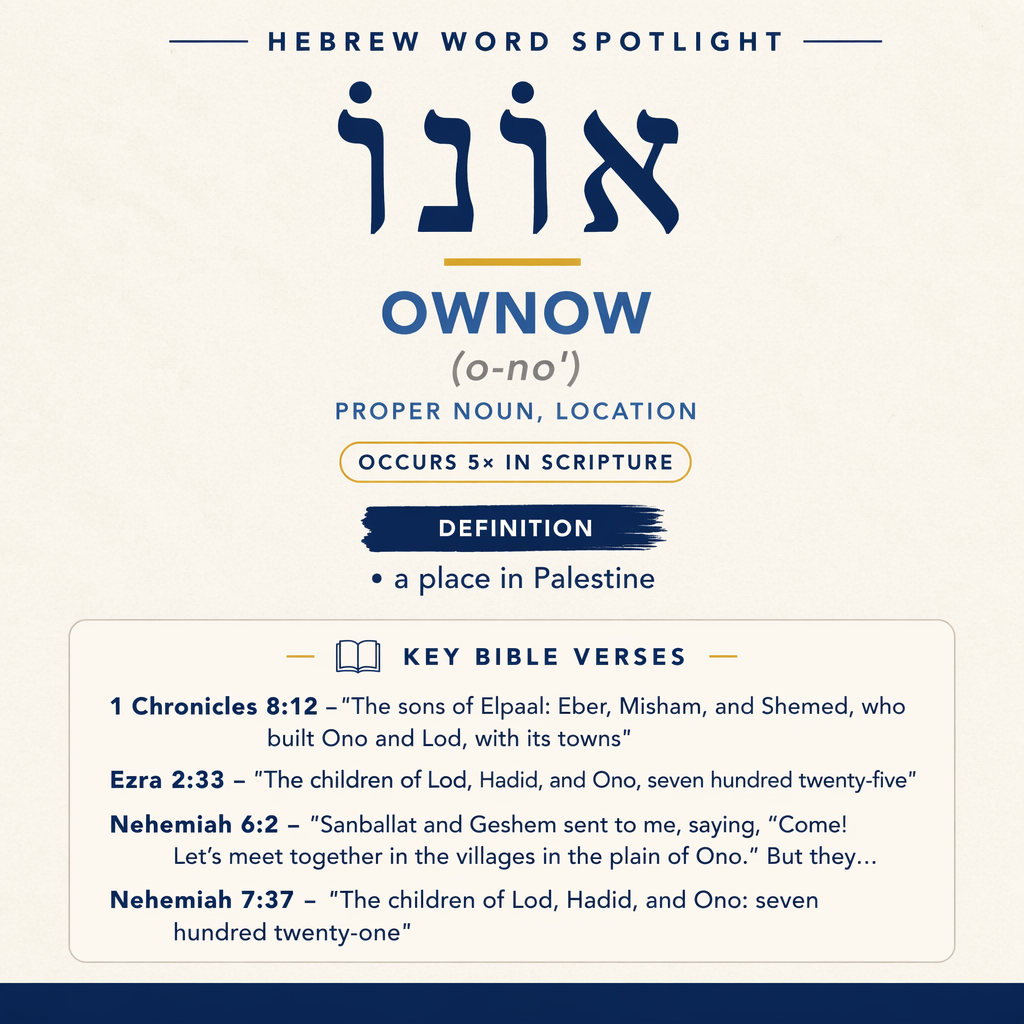
אוֹנוֹ (Ownow) means a place in Palestine, appearing in 1 Chronicles, Ezra, and Nehemiah.
Scripture Occurrences
It occurs 5 times in Scripture: 1 Chronicles 8:12; Ezra 2:33; Nehemiah 6:2; 7:37; 11:35.
Learn More →Context Notes
Ono is linked with Lod and nearby towns in lists of people and places, and it is named as a plain in Nehemiah 6:2.
Learn More →אוֹנוֹ (Ownow) names a place in Palestine. It appears in genealogical and settlement notices, and in a narrative moment where it marks the intended meeting site for an act of harm.
Occurrences
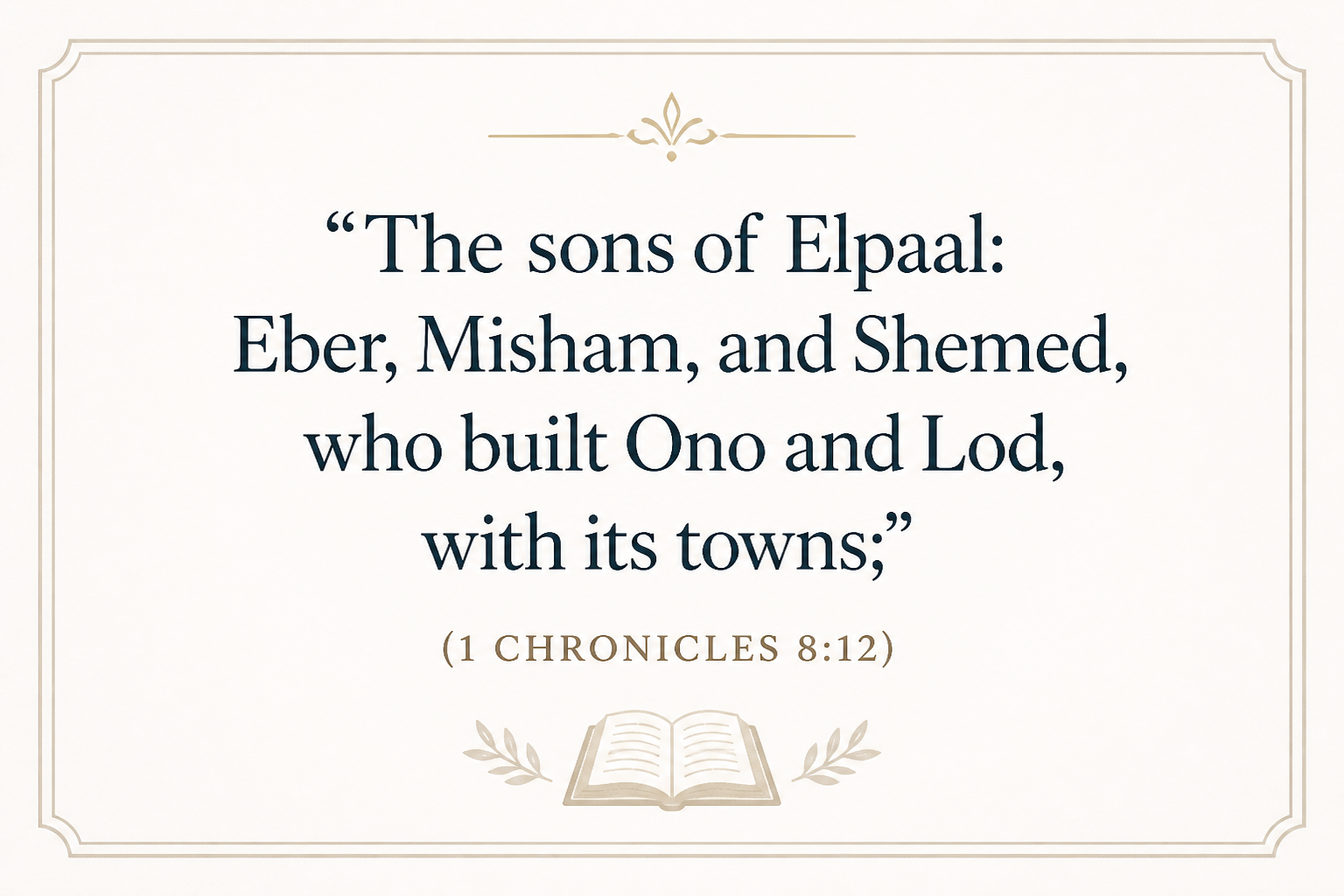
“The sons of Elpaal: Eber, Misham, and Shemed, who built Ono and Lod, with its towns;” (1 Chronicles 8:12)
Here Ono is presented as a built place associated with the sons of Elpaal, set alongside Lod and described with “its towns.” The wording makes Ono part of a small cluster of named localities linked to family lines and to development of inhabited space. In this sentence, the name functions as a concrete marker of where building and settlement activity took place, not simply a point on a map but a locality with dependent settlements (“its towns”) connected to it.
“The children of Lod, Hadid, and Ono, seven hundred twenty-five.” (Ezra 2:33)
Ono appears in a returnee list, grouped with Lod and Hadid under a single count. In this setting the place-name serves as an identifier for a community of “children” associated with that locality. The verse frames Ono as one of the anchoring places by which people are organized and counted, suggesting a recognized civic or regional identity that could be named succinctly and paired with other nearby centers for administrative purposes.
“Sanballat and Geshem sent to me, saying, “Come! Let’s meet together in the villages in the plain of Ono.” But they intended to harm me.” (Nehemiah 6:2)
In this narrative line, Ono is not merely a hometown label but the geographic setting for a proposed encounter: “the villages in the plain of Ono.” The phrase locates Ono within a broader terrain (“plain”) and within a pattern of settlement (“villages”), evoking a spread of small habitations rather than a single fortified point. The place-name contributes to the scene by providing a plausible, specific meeting area—one that could be reached and named—while the closing comment (“they intended to harm me”) casts the proposed location as part of a strategy. Ono becomes the named space where intent and geography intersect: an outwardly ordinary rendezvous site that, in context, is meant to facilitate harm.
“The children of Lod, Hadid, and Ono: seven hundred twenty-one.” (Nehemiah 7:37)
As in Ezra, Ono is grouped with Lod and Hadid and tied to a numbered total. The recurrence of the same trio of place-names reinforces Ono’s function as a stable reference point for community identity and record-keeping. The verse’s structure—place-names followed by a count—uses Ono as part of a formal cataloging of people, showing that the name had enough clarity and recognition to serve in official enumeration.
“Lod, and Ono, the valley of craftsmen.” (Nehemiah 11:35)
Ono appears again beside Lod, now linked with “the valley of craftsmen.” The construction makes Ono part of a geographical description that includes a distinctive economic or occupational feature. Even though the phrase “the valley of craftsmen” is not grammatically expanded here, it supplies an associational color to the locality: the name Ono stands within an area identified with skilled work. In this list-like verse, Ono’s contribution is to locate settlement in relation to a valley characterized by craft activity, placing the town within a lived landscape shaped by labor and production.

Sense and Usage
Across these passages, Ono functions consistently as a specific place in Palestine that helps readers track people, building, and movement. In 1 Chronicles 8:12, it is tied to building and to a network of nearby “towns,” which presents Ono as a center with surrounding habitation. In Ezra 2:33 and Nehemiah 7:37, the name shifts into a register of social accounting: Ono is one of the place-identifiers by which “children” are grouped and numbered, indicating that the locality was a recognized point of origin or association for a body of people. Nehemiah 11:35 adds a descriptive attachment—“the valley of craftsmen”—which situates Ono in a landscape known for a kind of work, implying that the place could be evoked not only by name but by a characteristic setting tied to artisans.
Nehemiah 6:2 uses Ono differently, yet without changing its essential sense as a real locality. The detail “the villages in the plain of Ono” shows Ono as a region that includes multiple smaller settlements and a plain, making it suitable as a meeting area. The narrative’s explicit remark about harmful intent makes the choice of location significant: a plain with villages provides space and perhaps distance from the more guarded or populated centers, allowing the invitation to sound ordinary while serving a hostile plan. Thus Ono can function both as a settled place tied to family building and returnee identity, and as a named region used for arranging movement and encounters.
In these texts, Ono repeatedly appears alongside Lod (and often Hadid), which gives it a relational clarity: it is part of a set of locations that can be named together without further explanation. This recurring pairing makes Ono a coordinate within a familiar local geography, where naming adjacent places communicates more than a single point—suggesting a corridor or cluster of settlements that could be built, repopulated, administered, and traversed.
Local Color
The name Ono carries grounded imagery because the passages attach it to tangible features: “its towns” (1 Chronicles 8:12), “villages in the plain” (Nehemiah 6:2), and “the valley of craftsmen” (Nehemiah 11:35). These phrases sketch a place that is not isolated: it is connected to dependent settlements, spread across open terrain, and associated with a working valley. Within that ordinary landscape, the narrative in Nehemiah briefly turns Ono into a backdrop for danger, showing how a recognizable place could become the stage for hidden intentions without ceasing to be a real, inhabited locality.
Sources: Lexical data from Strong’s Exhaustive Concordance and the Open Scriptures Hebrew Lexicon. Occurrence data from the Westminster Leningrad Codex with STEPBible reference data (CC BY). Scripture quotations from the World English Bible (public domain).