
Unraveling the Meaning of ‘own in Hebrew
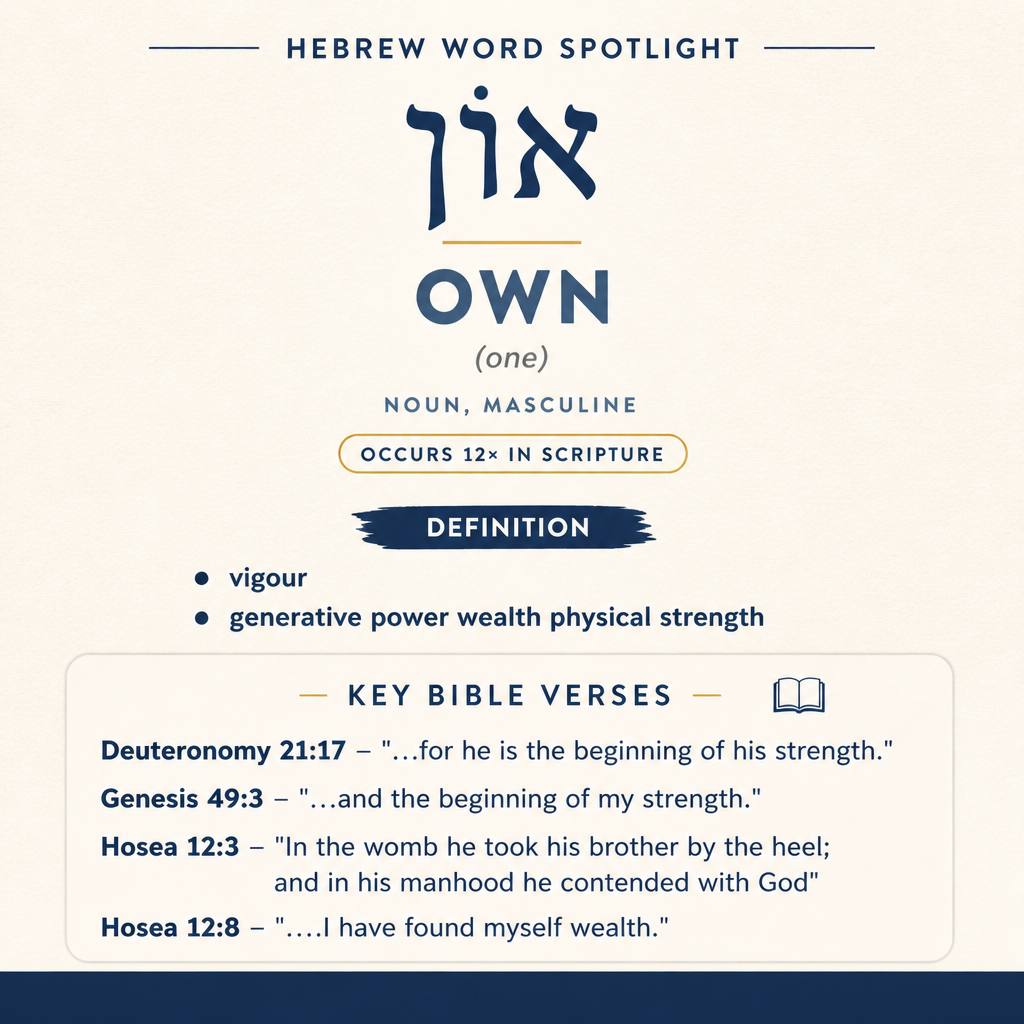
אוֹן means vigour, generative power, wealth, and physical strength, appearing 12 times in Scripture, including Deuteronomy 21:17; Genesis 49:3; Hosea 12; Isaiah 40; and Job 18.
Family Rights
In Deuteronomy 21:17 it appears in the context of acknowledging the firstborn and granting a double portion.
Learn More →Strength Themes
Genesis 49:3 connects it with a firstborn’s might and strength, and Isaiah 40:29 speaks of God increasing strength.
Learn More →אוֹן (own) expresses vigor—strength, generative power, wealth, and physical force—and it appears in scenes ranging from family inheritance and birthright to cosmic might and the frailty of the wicked. Its uses cluster around what constitutes a person’s capacity and resources, whether in the body, in offspring, or in property.

Occurrences
Deuteronomy 21:17 — “but he shall acknowledge the firstborn, the son of the hated, by giving him a double portion of all that he has; for he is the beginning of his strength. The right of the firstborn is his.”
Here אוֹן marks the firstborn as the “beginning” of a father’s strength. In the legal setting of inheritance, that strength is treated as something that has a start-point and is embodied in the first son; the “double portion” recognizes that the father’s capacity is represented, in a foundational way, by that child.
Genesis 49:3 — ““Reuben, you are my firstborn, my might, and the beginning of my strength; excelling in dignity, and excelling in power.”
In Jacob’s address to Reuben, אוֹן stands parallel to “my might” and is set within a string of terms of preeminence (“excelling in dignity… in power”). The word contributes the idea that the firstborn concentrates a father’s potency—both as personal force (“my might”) and as a generative beginning (“the beginning of my strength”).
Hosea 12:3 — “In the womb he took his brother by the heel; and in his manhood he contended with God.”
Here the verse contrasts two stages of life—“in the womb” and “in his manhood.” Within this frame, אוֹן connects to adult vigor: the strength associated with maturity is the setting for striving (“he contended with God”). The word’s contribution is to locate the action in the sphere of developed human capacity, not infancy.
Hosea 12:8 — “Ephraim said, “Surely I have become rich, I have found myself wealth. In all my wealth they won’t find in me any iniquity that is sin.””
In Ephraim’s claim, אוֹן aligns with “rich” and “wealth” and becomes the basis for self-justification: “In all my wealth they won’t find in me any iniquity.” The word thus operates in the register of resources and possessions—capacity expressed as accumulated goods—and shows how such wealth can be invoked as evidence of innocence or security.
Isaiah 40:26 — “Lift up your eyes on high, and see who has created these, who brings out their army by number. He calls them all by name. by the greatness of his might, and because he is strong in power, not one is lacking.”
In this call to look “on high,” the vocabulary of might and power frames the ordered heavens: an “army by number,” each called “by name,” with none missing. אוֹן contributes to the portrayal of effective, sustaining strength—power that does not merely exist but successfully musters and maintains a complete host.
Isaiah 40:29 — “He gives power to the weak. He increases the strength of him who has no might.”
Here strength is not assumed; it is granted. The verse sets up a stark contrast between “the weak” and the one “who has no might,” and then declares an increase of strength. In this usage, אוֹן highlights strength as something measurable and augmentable—something that can be lacking and then supplied.
Job 18:7 — “The steps of his strength will be shortened. His own counsel will cast him down.”
Within Job’s description of a downfall, strength is pictured as having “steps,” a path or stride that can be curtailed. אוֹן adds the sense of forward-moving capacity—progress powered by vigor—only to show it being cut short, and paired with self-defeating “counsel” that precipitates collapse.
Job 18:12 — “His strength will be famished. Calamity will be ready at his side.”
Strength is personified as something that can hunger: “will be famished.” The word underscores that vigor can be depleted like a living thing deprived of sustenance. This is not merely the presence of calamity, but the wasting of the inner resources needed to resist it.
Job 20:10 — “His children will seek the favor of the poor. His hands will give back his wealth.”
Here the focus shifts to property and reversal. The wicked person’s “hands” return what he had, and the word’s sense of wealth fits the scene of restitution and impoverishment; what once seemed like secure resources becomes something taken away, leaving descendants dependent enough to “seek the favor of the poor.”
Job 40:16 — “Look now, his strength is in his thighs. His force is in the muscles of his belly.”
In a depiction of powerful bodily build, strength is localized: “in his thighs,” with force “in the muscles of his belly.” The word contributes concrete physicality—vigor as muscle and mass—matching the verse’s anatomical detail and emphasizing strength as observable in the body.
Psalm 78:51 — “and struck all the firstborn in Egypt, the chief of their strength in the tents of Ham.”
In recounting the blow against Egypt, the firstborn are called “the chief of their strength.” The word thus depicts the firstborn as the peak or prime expression of generative power within households (“tents”), making the loss not only personal but a strike at a people’s vitality embodied in their first fruits.
Psalm 105:36 — “He struck also all the firstborn in their land, the first fruits of all their manhood.”
This parallel description links the firstborn with “the first fruits of all their manhood.” In that pairing, the word’s association with generative power and adult vigor comes to the front: the firstborn are the earliest yield of mature strength, and their removal is framed as the cutting off of a community’s prime product of manhood.
Sense and Usage
Across these passages, אוֹן functions as a compact term for what makes life and agency effective. In family contexts (Deuteronomy 21:17; Genesis 49:3), it marks the firstborn as the beginning and prime expression of a father’s capacity, tying strength to generative power and to social standing—the way a household’s future and honor are perceived to proceed from its first son. In the historical-poetic recollections of Egypt’s firstborn (Psalm 78:51; Psalm 105:36), that same association heightens the impact of the event: striking the firstborn is depicted as striking the “chief” and “first fruits” of manhood, an assault on vitality at its leading edge.
Other uses emphasize strength as an active force that can be possessed, increased, or lost. Isaiah 40 places might and power on a cosmic scale: the ordered host is maintained “by the greatness of his might,” and the same source “gives power to the weak” and “increases the strength” of the powerless (Isaiah 40:26, 40:29). Job, by contrast, explores strength in collapse and in body: it can have a stride that is shortened, it can become “famished,” and it can be seen in specific muscle groups (Job 18:7, 18:12, 40:16). These uses show vigor both as kinetic capacity—movement, endurance, resistance—and as sheer physical force.
Finally, Hosea 12:8 and Job 20:10 place אוֹן in the sphere of wealth. In Hosea, wealth becomes a ground for self-assertion and moral denial; in Job, wealth is something that can be forcibly reversed, requiring repayment. Taken together, these highlight that the word’s field includes resources that extend beyond the body: strength can be economic, and economic strength can be treated as identity and security.
Imagery
The passages present vivid images for the realities the word covers: a firstborn as the “beginning” and “chief” of strength; a stride of strength that can be shortened; strength that can be “famished”; and strength visibly housed “in his thighs” and “in the muscles of his belly.” Set alongside the ordered heavens where “not one is lacking,” these images place human vigor—whether in sons, limbs, or wealth—within a spectrum that ranges from fragile and reversible to inexhaustibly effective.
Sources: Lexical data from Strong’s Exhaustive Concordance and the Open Scriptures Hebrew Lexicon. Occurrence data from the Westminster Leningrad Codex with STEPBible reference data (CC BY). Scripture quotations from the World English Bible (public domain).





