
Exploring the Meaning of ‘Owmar in Hebrew
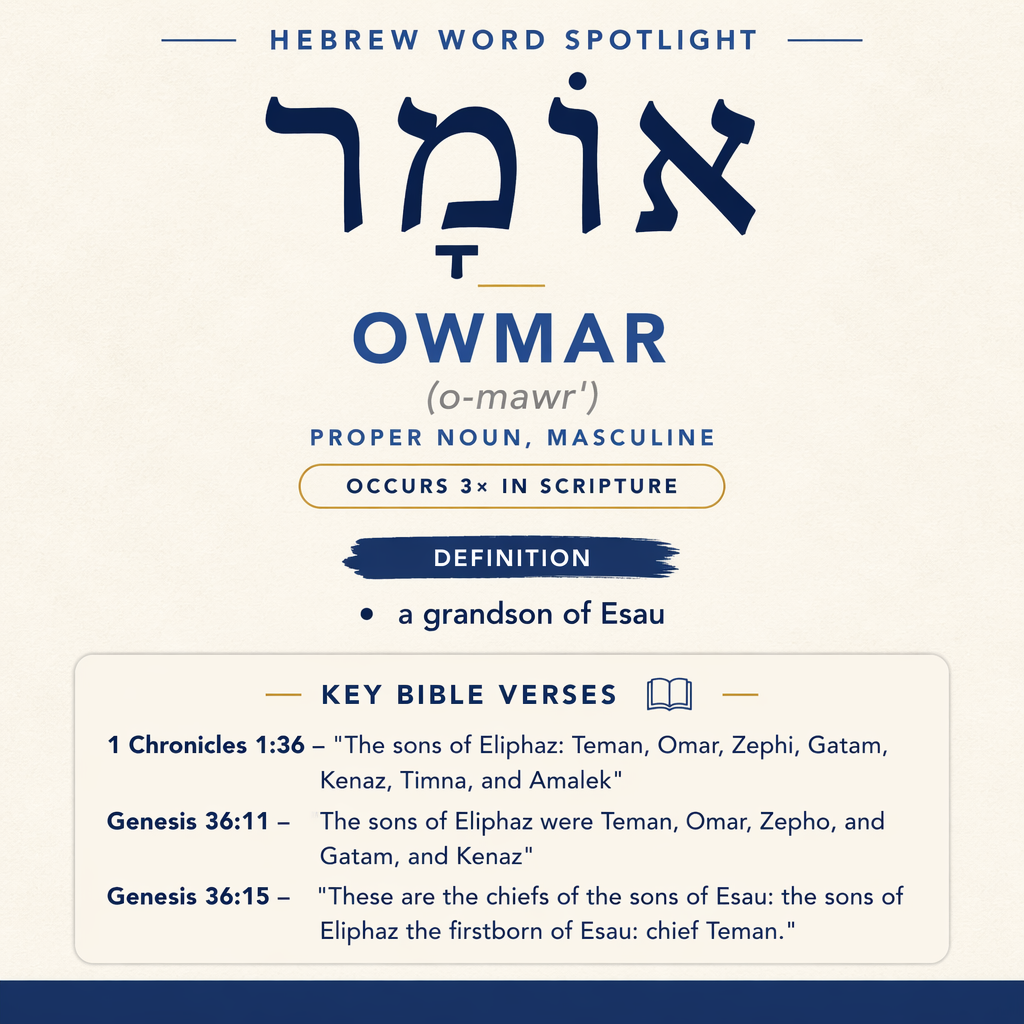
אוֹמָר means a grandson of Esau, appearing in Genesis 36:11, Genesis 36:15, and 1 Chronicles 1:36.
Identity
אוֹמָר names a grandson of Esau. He is listed among the sons of Eliphaz, Esau’s firstborn.
Learn More →Genealogy Lists
Genesis 36:11 includes Omar in the list of Eliphaz’s sons. 1 Chronicles 1:36 repeats this genealogy line.
Learn More →Chief of Edom
Genesis 36:15 identifies “chief Omar” among the chiefs from Esau’s line through Eliphaz.
Learn More →אוֹמָר (Owmar) refers to a grandson of Esau and appears in genealogical listings that trace Esau’s line through his firstborn son, Eliphaz. In these passages, the name functions as a stable marker within family structure and leadership designations.
Occurrences
“The sons of Eliphaz: Teman, Omar, Zephi, Gatam, Kenaz, Timna, and Amalek.” (1 Chronicles 1:36)
Here אוֹמָר (Owmar) appears as one item in a compact list of “The sons of Eliphaz.” The verse presents a set of names in a single syntactic unit, so Omar’s role is defined by placement: he is counted among Eliphaz’s sons and is named alongside Teman, Zephi, Gatam, Kenaz, Timna, and Amalek. The list format foregrounds lineage rather than narrative action; the name functions as a genealogical coordinate, anchoring a particular person within the descent from Eliphaz. By being recorded in sequence with other siblings, Omar is situated within a family group rather than isolated as an individual with separate deeds in this verse.
“The sons of Eliphaz were Teman, Omar, Zepho, and Gatam, and Kenaz.” (Genesis 36:11)
In Genesis 36:11, Omar again appears in a list of Eliphaz’s sons, framed by the summarizing clause “The sons of Eliphaz were…” The structure gives Omar a clear relational identity: he belongs to the next generation under Eliphaz. The narrower list (Teman, Omar, Zepho, Gatam, Kenaz) highlights a core set of sons without the additional names seen in the Chronicles passage. Within this verse, the contribution of Omar is to help define the composition of Eliphaz’s household, preserving the memory of who is included under that paternal line. The name carries the weight of record-keeping: it tells the reader that Omar is part of the recognized descent being enumerated.
“These are the chiefs of the sons of Esau: the sons of Eliphaz the firstborn of Esau: chief Teman, chief Omar, chief Zepho, chief Kenaz,” (Genesis 36:15)
Genesis 36:15 shifts from simple son-listing to a leadership register: “These are the chiefs of the sons of Esau.” Within that frame, Omar is not merely named as a son but is designated “chief Omar.” The repeated title “chief” applied to each name in the series (“chief Teman, chief Omar, chief Zepho, chief Kenaz”) gives Omar a public role within the clan structure associated with Esau’s descendants through Eliphaz, Esau’s firstborn. The verse’s wording ties together ancestry and authority: Omar is one of “the sons of Eliphaz” and simultaneously one of the “chiefs.” In this scene, the name functions as an identifier of a recognized leader within the listed group, indicating that Omar is remembered not only for descent but also for a status that organizes the community.

Sense and Usage
Across these occurrences, אוֹמָר (Owmar) operates as a personal name whose defining feature in Scripture’s presentation is kinship: he is a grandson of Esau, appearing under the heading of “The sons of Eliphaz” and within the broader category “the sons of Esau.” The passages do not develop Omar by narrative description; instead, they embed him in ordered lists that establish continuity between generations. In such lists, a name is more than a label—it fixes relationships: Eliphaz is the father named in both Genesis 36:11 and 1 Chronicles 1:36, and Esau is the ancestor invoked explicitly in Genesis 36:15 (“Eliphaz the firstborn of Esau”). Omar’s identity is therefore communicated by these relational links rather than by separate biography.
The genealogical contexts also show that a named descendant can be presented at more than one social level. Genesis 36:11 and 1 Chronicles 1:36 present Omar straightforwardly as one of the sons; Genesis 36:15 presents him as “chief Omar,” placing him in a roster of leaders (“chief Teman, chief Omar, chief Zepho, chief Kenaz”). The movement from “sons” to “chiefs” illustrates how a grandson of Esau may be recalled both as an individual within a family line and as a figure representing a subdivision of that line in communal organization. In the quoted text, the title “chief” is applied consistently across the set, implying that Omar’s significance in that verse is tied to a recognized status among peers rather than uniqueness of action. The name’s usage is thus stable—always the same person in the same ancestral branch—while the immediate framing (sons vs. chiefs) highlights different aspects of his remembered place.
Finally, the presence of Omar in both Genesis and Chronicles shows the name serving as a point of continuity when genealogies are recounted. In each case, Omar appears alongside a cluster of related names, which collectively define the line stemming from Eliphaz. The lists create a map of descent: by naming Omar as part of that map, the text locates him precisely within the family network that traces from Esau to Eliphaz to Eliphaz’s sons. The name’s primary function in these verses is therefore identificational and structural—helping the reader track lineage and, in Genesis 36:15, track leadership within that lineage.
Genealogical Imagery
Although the passages are not narrative scenes, they carry the imagery of ordered descent and inherited standing. “The sons of Eliphaz” evokes the household line as a growing branch, while “chief Omar” evokes the same branch taking shape in named leadership. In these verses, Omar is a fixed point in the chain: a grandson of Esau whose name helps the genealogical record distinguish both family membership and the arrangement of chiefs within Esau’s descendants.
Sources: Lexical data from Strong’s Exhaustive Concordance and the Open Scriptures Hebrew Lexicon. Occurrence data from the Westminster Leningrad Codex with STEPBible reference data (CC BY). Scripture quotations from the World English Bible (public domain).




