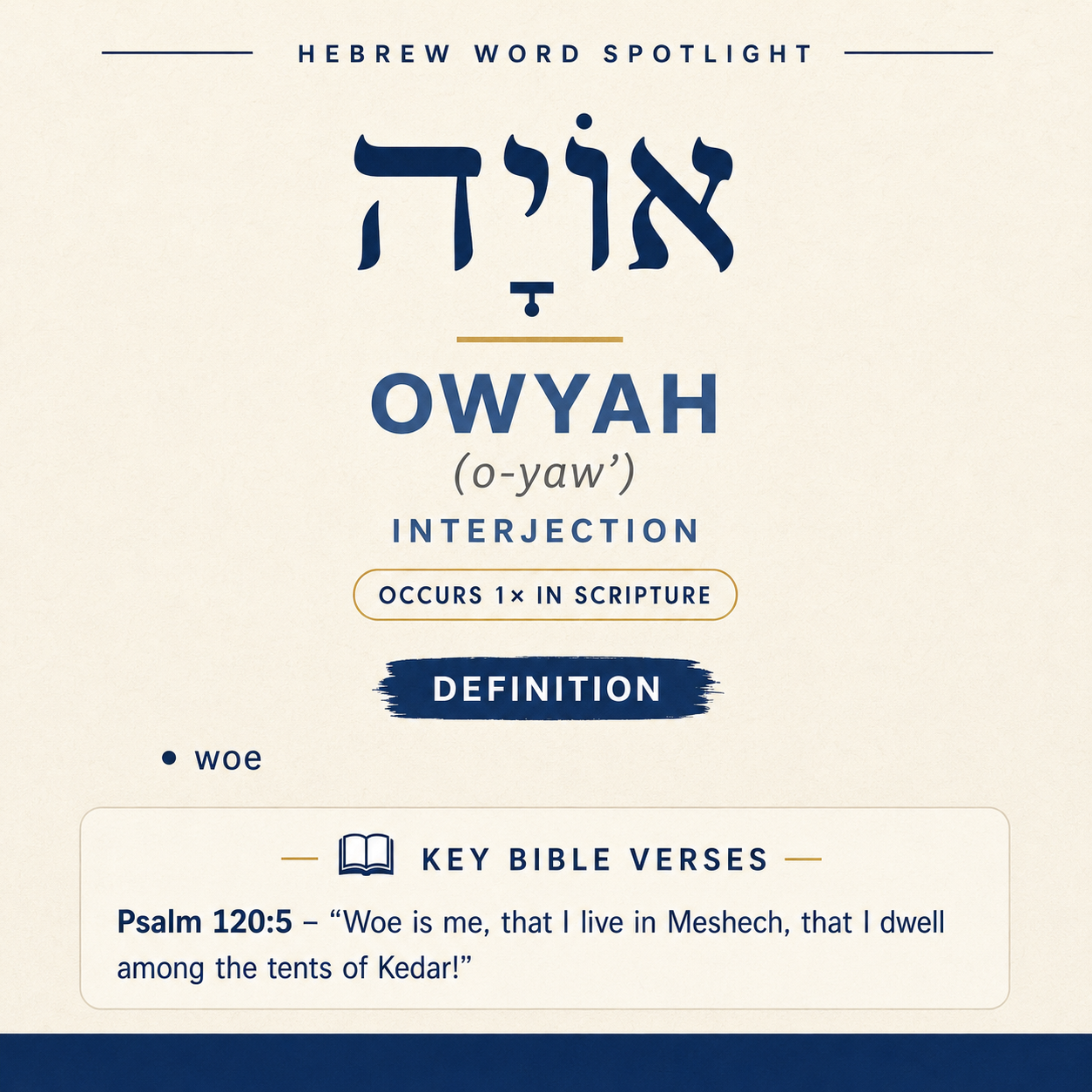
‘owyah

o-yaw’
Parts of Speech: Interjection

‘owyah Definition

NAS Word Usage – Total: 2

  1. woe!

Understanding the Meaning of ‘Owyah in Hebrew

Many individuals exploring the Hebrew language or studying the Bible come across different words and phrases that challenge their understanding. One such term is ‘Owyah (אוֹיָה), which is intriguing due to its sparse usage and deep meanings connected to Hebrew culture and values.

Books Worth Reading:
Sponsored
Book 3154Book 3131Book 3162Book 3129Book 3161

What Does ‘Owyah Mean?

In Hebrew, ‘‘Owyah‘ translates to “Oh, my!” or “Oh, woe!” It is an expression of distress or lamentation. The term is often used to communicate feelings of grief, sadness, or surprise. Although ‘Owyah is not found frequently in the Hebrew texts, the concept it carries is significant in many biblical passages and cultural contexts.

The Linguistic Roots of ‘Owyah

The word ‘Owyah can be traced back to its components in the Hebrew language. The prefix ‘o (אוֹ) can be thought of as an expression of emotion or an interjection, while the root word “yah” (יָה) is often associated with the name of God in Hebrew. This composition gives ‘Owyah a weighty emotional impact, which resonates strongly in biblical narratives.

Contextual Usage in the Bible

Even though ‘Owyah is not frequently mentioned in biblical texts, there are places where similar expressions of grief appear. For instance, in the Book of Lamentations, Jeremiah expresses immense sorrow over the destruction of Jerusalem, which captures the essence of ‘Owyah—the feeling of despair that this term conveys. Consider how the use of lamentation in these texts plays a role in understanding Hebrew culture as one that deeply respects emotions and expressions of sorrow.

Books Worth Reading:
Sponsored
Book 3154Book 3131Book 3162Book 3129Book 3161

Hypothetical Application

One might imagine a scenario in a gathering, where someone shares tragic news—perhaps a friend losing a loved one. In this situation, a direct expression of ‘Owyah could encapsulate the collective sorrow felt by everyone present, offering a sense of shared mourning through a single word. Such expressions not only relay feelings but also create a bond between those experiencing the grief together.

Cultural Significance of ‘Owyah

In Jewish tradition, expressions of grief play a vital role in communal life. The mourning period, known as Shiva, allows mourners to recite specific prayers and express deep sorrow. Within such settings, the word ‘Owyah would fit naturally, as it conveys the raw emotion associated with loss. This illustrates how language and expression are tightly woven into the fabric of cultural and religious practices.

Example from Jewish Mourning Practices

Consider a scenario in which a family is sitting shiva for a loved one. Friends and community members come to provide support, and sorrowful expressions fill the room. Someone might exclaim ‘Owyah as they recount memories of the deceased, capturing the emotional essence of the moment. This action not only embodies personal grief but also serves to unite the community, aligning with the values of empathy and compassion in Jewish tradition.

Books Worth Reading:
Sponsored
Book 3154Book 3131Book 3162Book 3129Book 3161

The Sound and Emotion of ‘Owyah

The phonetic sound of the word ‘Owyah itself evokes a poignant emotional response. The pronunciation carries an emotional weight, often drawing attention and drawing listeners into the moment of distress. This highlights the Hebrew language’s capacity to convey nuanced emotions through carefully selected sounds and syllables.

An Artistic Perspective

Imagine a painter capturing a funeral scene on canvas. The inclusion of figures with expressions of despair, accompanied by the word ‘Owyah looming above them as part of the painting, would amplify the profound grief felt. This paints a vivid picture of how a single word can resonate deeply, transforming emotions into visual art.

‘Owyah in Modern Hebrew

Though ‘Owyah may not be commonly used in everyday conversations today, it manifests in various expressions and phrases found in modern Hebrew. Its emotional resonance continues as people find new ways to express sorrow or surprise.

Books Worth Reading:
Sponsored
Book 3154Book 3131Book 3162Book 3129Book 3161

Example of a Contemporary Use

In a conversation discussing a beloved celebrity’s death, a younger Hebrew speaker may exclaim, “Owyah, did you hear about [the celebrity]? It’s so sad!” This modern application of ‘Owyah shows how its emotional roots remain relevant, adapting to contemporary contexts.

Comparing ‘Owyah to Similar Expressions

To better understand ‘Owyah, one can compare it with similar Hebrew expressions. For instance, terms like “Oy vey” or “Oy” are commonly used in everyday speech to convey frustration or lament. While ‘Owyah is more formal, these expressions carry similar emotional weight, illustrating how Hebrew speakers creatively express distress or exasperation through language.

Learning ‘Owyah and Its Contexts

For learners of Hebrew, grasping the meaning and significance of ‘Owyah can enhance their understanding of emotional expression in the language. The exploration of such terms can deepen one’s appreciation for Hebrew culture, encouraging further study of biblical texts and Jewish life.

Books Worth Reading:
Sponsored
Book 3154Book 3131Book 3162Book 3129Book 3161

A Classroom Opportunity

Imagine a Hebrew language classroom where students are instructed to create sentences incorporating the expression ‘Owyah into conversations about current events. This exercise would not only help them practice grammar but also encourage them to convey emotions in Hebrew—an essential part of authentic communication.

Conclusion of ‘Owyah in Expression

The expression ‘Owyah, while simple, serves as a powerful reminder of the emotional depths found within the Hebrew language. Its roots and cultural implications provide rich insights into how feelings of sorrow and lamentation are communicated. Recognizing such terms within the broader context of Hebrew enhances one’s appreciation for not only the language but also the shared human experience of grief.

Related Expressions and Phrases

To appreciate ‘Owyah fully, it could be useful to explore additional expressions that share similar sentiments. Phrases such as “Nebach,” conveying pity, or “Hayom” meaning “today,” which can carry desperation depending on context, are also valuable in enriching one’s understanding of emotional expression in Hebrew.

Books Worth Reading:
Sponsored
Book 3154Book 3131Book 3162Book 3129Book 3161

An Example Phrase Comparison

When someone says, “Nebach, that’s awful!” they acknowledge sadness for another’s experience. In contrast, someone using ‘Owyah evokes a direct personal reaction to the situation. This comparison illustrates how different phrases capture distinct emotional layers within conversations.

Exploring Emotional Resilience

The exploration of words like ‘Owyah also leads to the discussion of emotional resilience. Hebrew language and literature often tackle themes of grief and recovery, allowing speakers to navigate their emotions through both expression and community support. The study of such terms invites deeper engagement with the narratives of pain and hope present throughout biblical texts.

Case Study on Emotional Resilience

In modern therapy settings, professionals may turn to expressions like ‘Owyah to understand a client’s experience of loss. Engaging with the language grants a richer context to the emotions being expressed, allowing for meaningful dialogue and understanding. This therapeutic approach highlights how ancient words can bridge into contemporary discussions on mental health and emotional awareness.

Books Worth Reading:
Sponsored
Book 3154Book 3131Book 3162Book 3129Book 3161

Final Contextual Thoughts

Overall, ‘Owyah presents a unique opportunity for individuals to engage with the Hebrew language, exploring both its emotional breadth and its implications in modern life. Understanding expressions of grief, such as ‘Owyah, fosters a deeper connection to shared experiences across cultures. As language evolves, the essence of words like ‘Owyah remains integral in how communities express sorrow and solidarity.

Little Known Secrets

The Hebrew word ‘owyah might seem simple at first, but it holds deeper meanings and connections that many people overlook.

  • The word ‘owyah (אוֹיָה) is often linked to the theme of mourning, as it can mean “woe” or express sorrow in certain biblical contexts.
  • ‘Owyah appears in the Book of Lamentations, where the prophet Jeremiah uses it to convey deep grief over the destruction of Jerusalem and the suffering of its people.
  • The root of ‘owyah shares a connection with various Hebrew words related to anguish and lamentation, showcasing how language in the Bible often reflects emotional states.
  • In some interpretations, ‘owyah can represent a cry of despair that recognizes the severity of a situation, inviting listeners to reflect on their own challenges.
  • ‘Owyah is not a common term in modern Hebrew, making it a rich find for those studying ancient texts and the historical use of language.
  • The phonetic sound of ‘owyah can evoke an emotional reaction; the “o” sound is often associated with pain or distress in many cultures, highlighting the power of sound in conveying meaning.
  • Many scholars believe that the use of ‘owyah enhances the poetry of biblical texts, drawing readers into the emotional landscape of the characters involved.
  • The presence of ‘owyah in various prophetic writings emphasizes the importance of lamentation as a spiritual practice in the Hebrew Bible, inviting readers to engage with their own feelings of loss and sadness.
  • ‘Owyah can also encourage community solidarity, as lamenting together was a practice that strengthened social bonds among the people experiencing shared suffering.

Conclusion

In conclusion, the Hebrew word ‘owyah has a rich and meaningful background. It can be understood as an expression of longing or deep emotion, often related to feelings of sorrow or remembrance. By exploring this word, we see how language reflects the experiences and traditions of the Hebrew people. Understanding words like ‘owyah helps us connect more deeply with the culture and history of the Bible. Whether we encounter it in prayer or scripture, remembering its significance can enrich our appreciation for the Hebrew language and the stories it tells.

Books Worth Reading:
Sponsored
Book 3154Book 3131Book 3162Book 3129Book 3161

Common Questions Related to What Does ‘owyah Mean In Hebrew

Q. What does the Hebrew word ‘owyah mean?
A. The word ‘owyah means “lamentation” or “a cry of sorrow” in Hebrew.

Q. Where can ‘owyah be found in the Bible?
A. ‘owyah is often related to passages that discuss mourning or expressing grief, but it is not a very common word in the texts.

Q. How is ‘owyah used in a sentence?
A. You might say, “The people expressed their ‘owyah when they heard the sad news.”

Books Worth Reading:
Sponsored
Book 3154Book 3131Book 3162Book 3129Book 3161

Q. Is ‘owyah connected to any specific biblical characters?
A. While ‘owyah itself does not refer to a specific character, it can describe the emotions of many biblical figures during times of loss, like Job.

Q. What is the root word of ‘owyah in Hebrew?
A. The root of ‘owyah often connects to themes of wailing or crying, reflecting deep sadness.

Q. Can ‘owyah be used in modern Hebrew?
A. Yes, ‘owyah can still be understood in modern Hebrew, especially in discussions about grief and mourning.

Books Worth Reading:
Sponsored
Book 3154Book 3131Book 3162Book 3129Book 3161

Q. Are there other Hebrew words related to ‘owyah?
A. Yes, words like ‘evel (mourning) and tza’ar (sorrow) are related in expressing similar feelings.

Q. How does ‘owyah relate to Jewish customs?
A. ‘owyah reflects the customs of mourning in Judaism, where expressing grief is an important part of the healing process.

Q. Is there a different meaning for ‘owyah in other contexts?
A. Generally, ‘owyah retains its meaning of lamentation and does not change significantly in different contexts.

Books Worth Reading:
Sponsored
Book 3154Book 3131Book 3162Book 3129Book 3161

Q. Why is understanding ‘owyah important in studying the Bible?
A. Understanding ‘owyah helps us grasp the emotional depth of biblical stories and the experiences of individuals facing loss.

About the Author

Ministry Voice

{"email":"Email address invalid","url":"Website address invalid","required":"Required field missing"}

Want More Great Content?

Check Out These Articles 

mba ads=78