
Discovering the Meaning of ‘owy in Hebrew
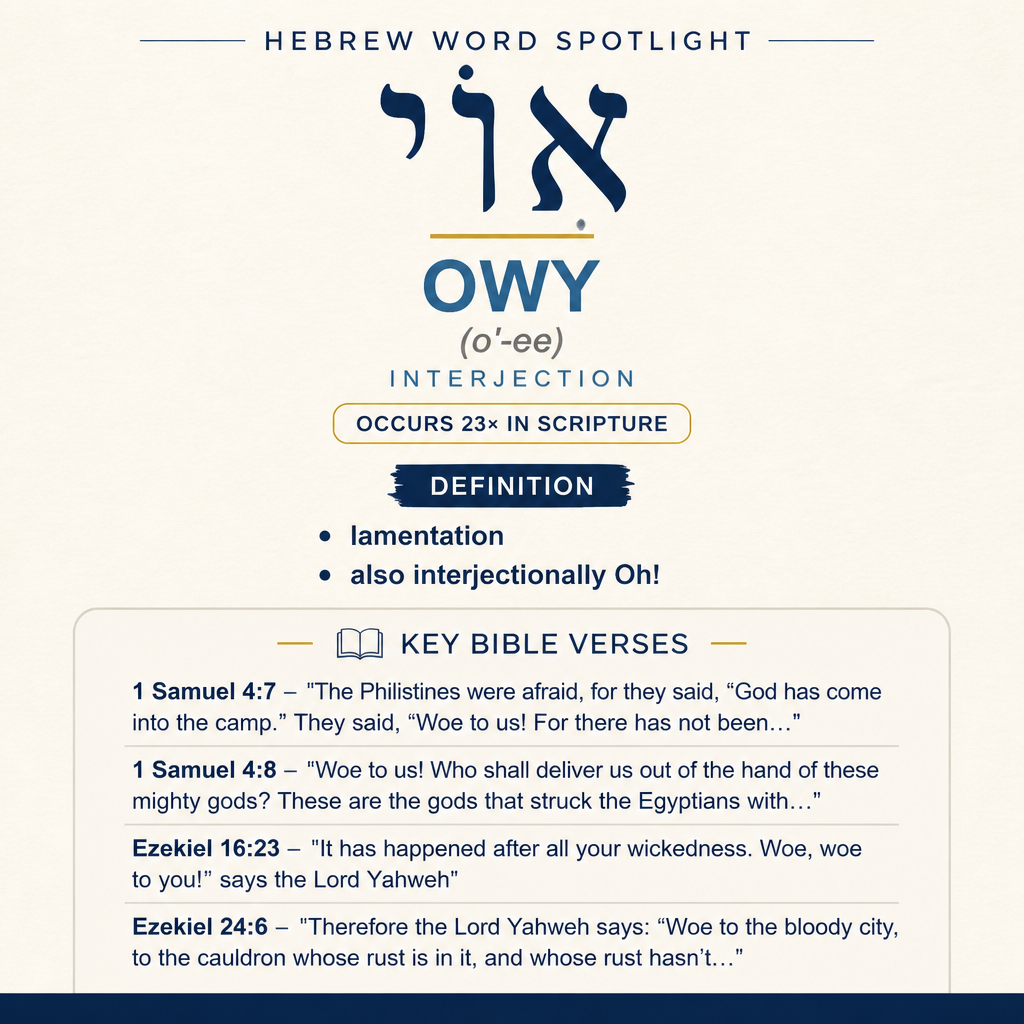
אוֹי means “lamentation,” used as “Oh!/Woe,” appearing 23 times, including 1 Samuel 4:7–8; Ezekiel 16:23; 24:6,9; Hosea 7:13; 9:12; Isaiah 3:9.
Core Meaning
אוֹי expresses lamentation and can function as an interjection “Oh!” or “Woe!” in English rendering.
Learn More →Sample Occurrences
In 1 Samuel 4:7–8 it is cried out: “Woe to us!” It also appears in prophetic judgments such as Ezekiel 16:23 and Hosea 7:13.
Learn More →Judgment Oracles
Ezekiel uses it repeatedly in denunciations, including “Woe, woe to you!” (Ezekiel 16:23) and “Woe to the bloody city!” (Ezekiel 24:6,9).
Learn More →אוֹי (owy) expresses lamentation and can function as an interjection (“Oh!”). In the passages where it appears here, it punctuates fear, impending ruin, prophetic denunciation, and personal undoing in the face of guilt or divine presence.

Occurrences
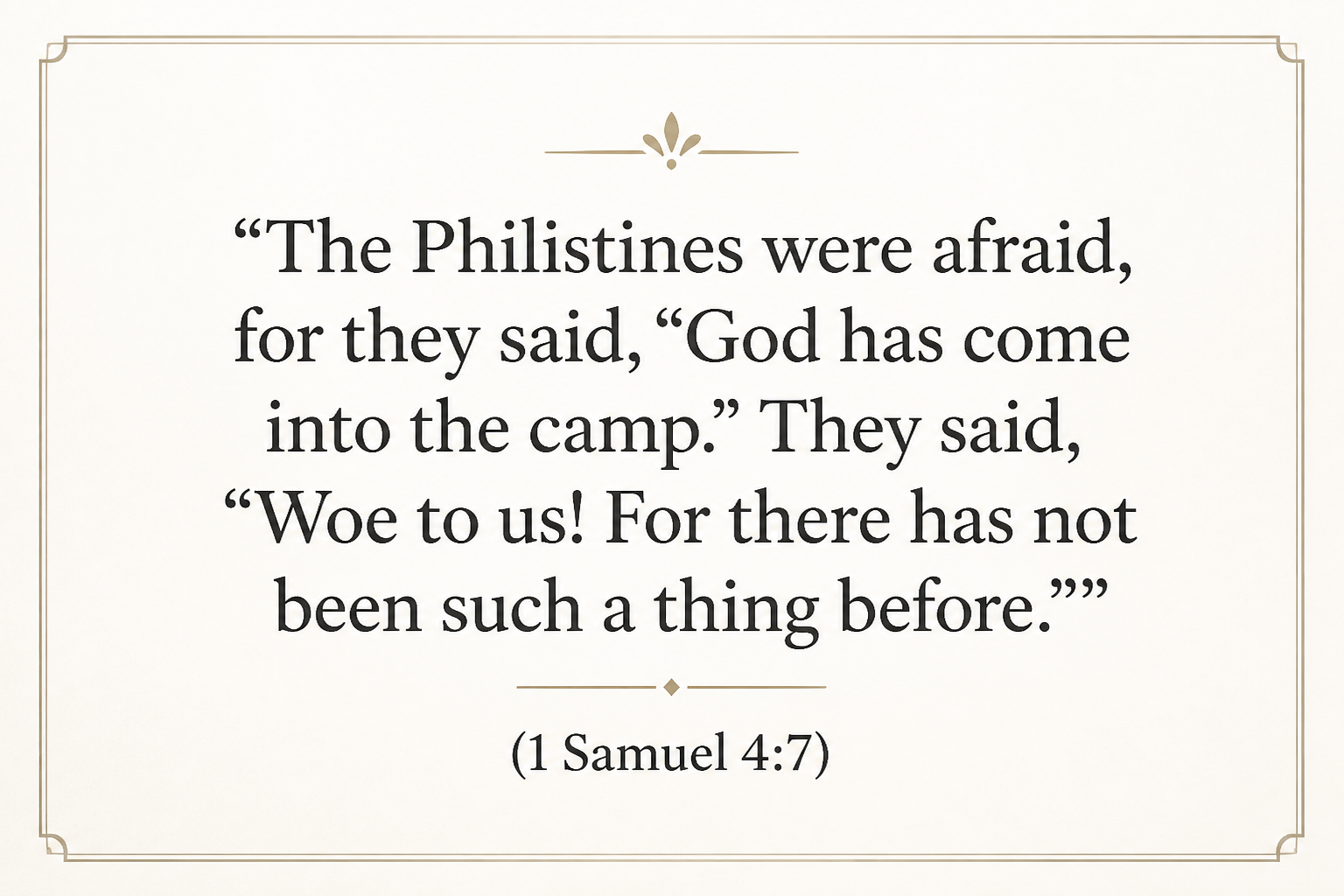
“The Philistines were afraid, for they said, “God has come into the camp.” They said, “Woe to us! For there has not been such a thing before.”” (1 Samuel 4:7)
Here אוֹי voices the Philistines’ sudden dread at what they perceive as an unprecedented arrival of divine power “into the camp.” The cry frames their situation as alarming and without precedent—an immediate, emotional alarm that something disastrous may follow.
“Woe to us! Who shall deliver us out of the hand of these mighty gods? These are the gods that struck the Egyptians with all kinds of plagues in the wilderness.” (1 Samuel 4:8)
The interjection is repeated, intensifying the panic. It is followed by urgent questions and a recollection of plagues, so the lament is not abstract; it is tied to a feared inability to be “deliver[ed]” from “the hand of these mighty gods.” In this setting, אוֹי marks an anticipated calamity grounded in remembered acts of overwhelming power.
““ ‘ “It has happened after all your wickedness. Woe, woe to you!” says the Lord Yahweh,” (Ezekiel 16:23)
In this prophetic declaration, אוֹי is doubled (“Woe, woe”) and directed at the addressee as a response “after all your wickedness.” The repetition functions like a drumbeat of lament over moral ruin and its consequences, and the divine speech (“says the Lord Yahweh”) gives the cry formal, judicial weight.
““ ‘Therefore the Lord Yahweh says: “Woe to the bloody city, to the cauldron whose rust is in it, and whose rust hasn’t gone out of it! Take out of it piece after piece. No lot is fallen on it.” (Ezekiel 24:6)
Here the lamenting “Woe” targets “the bloody city,” pictured as a “cauldron” with stubborn “rust.” The interjection introduces a vivid indictment and sets the tone for the harsh imperatives that follow (“Take out of it piece after piece”). In this scene, אוֹי is the doorway into an image of corruption that will not be cleansed by ordinary means.
““ ‘Therefore the Lord Yahweh says: “Woe to the bloody city! I also will make the pile great.” (Ezekiel 24:9)
The same target (“the bloody city”) receives the same lament, but now it is paired with an announced escalation: “I also will make the pile great.” The cry does not merely mourn; it signals that judgment will intensify. Its emotional force helps carry the threat from accusation into action.
“Woe to them! For they have wandered from me. Destruction to them! For they have trespassed against me. Though I would redeem them, yet they have spoken lies against me.” (Hosea 7:13)
In Hosea, the lament “Woe to them!” introduces a causal explanation: “For they have wandered from me.” The verse pairs the cry with explicit consequence (“Destruction to them!”) and with relational language (“from me,” “against me”). Within this short unit, אוֹי functions as a sorrowful pronouncement over a people described as wandering, trespassing, and lying, even in the face of potential redemption.
“Though they bring up their children, yet I will bereave them, so that not a man shall be left. Indeed, woe also to them when I depart from them!” (Hosea 9:12)
Here “woe” is linked to the terror of loss (“I will bereave them”) and to abandonment (“when I depart from them”). The placement of the interjection near the departure heightens the sense that the deepest lament is not only the bereavement itself but the relational severing implied by “I depart.”
“The look of their faces testify against them. They parade their sin like Sodom. They don’t hide it. Woe to their soul! For they have brought disaster upon themselves.” (Isaiah 3:9)
Isaiah’s use aims inward: “Woe to their soul!” The lament is anchored in visible, unabashed wrongdoing (“They don’t hide it”) and culminates in self-caused ruin (“they have brought disaster upon themselves”). Here אוֹי is not simply pity; it is a mournful verdict on a community whose guilt is public and whose outcome is portrayed as self-inflicted.
“Woe to the wicked! Disaster is upon them; for the deeds of his hands will be paid back to him.” (Isaiah 3:11)
This instance is pointed and categorical: “Woe to the wicked!” The lament is immediately equated with impending “Disaster,” and the reason given is retribution—“the deeds of his hands will be paid back to him.” In this scene, אוֹי introduces an ethical cause-and-effect: wrongdoing and the return of consequences.
“Then I said, “Woe is me! For I am undone, because I am a man of unclean lips, and I dwell among a people of unclean lips: for my eyes have seen the King, Yahweh of Armies!”” (Isaiah 6:5)
Here the cry becomes first-person: “Woe is me!” It is paired with self-description (“I am undone”) and a confession focused on speech (“unclean lips”), both personal and communal (“I dwell among a people of unclean lips”). The lament arises specifically in reaction to a vision: “my eyes have seen the King, Yahweh of Armies.” In this context, אוֹי is the immediate sound of disintegration and grief when impurity is exposed in the presence of divine kingship.
“From the uttermost part of the earth have we heard songs. Glory to the righteous! But I said, “I pine away! I pine away! woe is me!” The treacherous have dealt treacherously. Yes, the treacherous have dealt very treacherously.” (Isaiah 24:16)
Isaiah places the lament amid a striking contrast: songs and “Glory to the righteous!” on the one hand, and the speaker’s collapse on the other (“I pine away! I pine away! woe is me!”). The reason given is social and moral breakdown—“The treacherous have dealt treacherously,” repeated and intensified. Here אוֹי becomes the cry of a witness who cannot celebrate because treachery dominates the scene.
“Behold, he will come up as clouds, and his chariots will be as the whirlwind. His horses are swifter than eagles. Woe to us! For we are ruined.” (Jeremiah 4:13)
Jeremiah sets the interjection against a picture of irresistible approach: clouds, whirlwind chariots, and horses “swifter than eagles.” “Woe to us!” is the collective lament of a people facing an overwhelming force, and it ends with a stark assessment: “For we are ruined.” In this use, אוֹי compresses terror and resignation into a single communal outcry.
Sense and Usage
Across these occurrences, אוֹי consistently marks lamentation as a spoken eruption at the moment danger, guilt, or judgment becomes unavoidable. It can be communal (“Woe to us!” in 1 Samuel 4:7–8; Jeremiah 4:13), directed toward others as an indictment (“Woe, woe to you!” in Ezekiel 16:23; “Woe to the bloody city” in Ezekiel 24:6, 24:9; “Woe to them!” in Hosea 7:13; “Woe also to them” in Hosea 9:12; “Woe to the wicked!” in Isaiah 3:11), or intensely personal (“Woe is me!” in Isaiah 6:5; Isaiah 24:16). The word often stands at the head of a sentence, then yields to explanation (“For…” clauses appear repeatedly), so the lament does not float free; it is tied to stated causes such as wickedness, wandering, trespass, lies, visible sin, treachery, and the arrival of ruin. Repetition (“Woe, woe”; “I pine away! I pine away!”) heightens the emotional pressure and can signal that what follows is not a mild warning but an intensified grief over consequences already unfolding or certain to come.
Imagery and Tone
The imagery that surrounds אוֹי ranges from battlefield panic to prophetic metaphors and cosmic-scale dread. It can accompany concrete pictures of threat (“he will come up as clouds,” “chariots… as the whirlwind,” “horses… swifter than eagles” in Jeremiah 4:13) and equally concrete pictures of corruption (“the cauldron whose rust is in it” in Ezekiel 24:6). It also fits moments where the crisis is moral and spiritual rather than military, as when sin is paraded openly (Isaiah 3:9) or when the speaker is undone by seeing “the King, Yahweh of Armies” (Isaiah 6:5). In each setting, the interjection carries the sound of a breaking point—lament spoken aloud when fear, culpability, and impending disaster press into speech.
Sources: Lexical data from Strong’s Exhaustive Concordance and the Open Scriptures Hebrew Lexicon. Occurrence data from the Westminster Leningrad Codex with STEPBible reference data (CC BY). Scripture quotations from the World English Bible (public domain).




