
Exploring the Meaning of ‘Owb in Hebrew
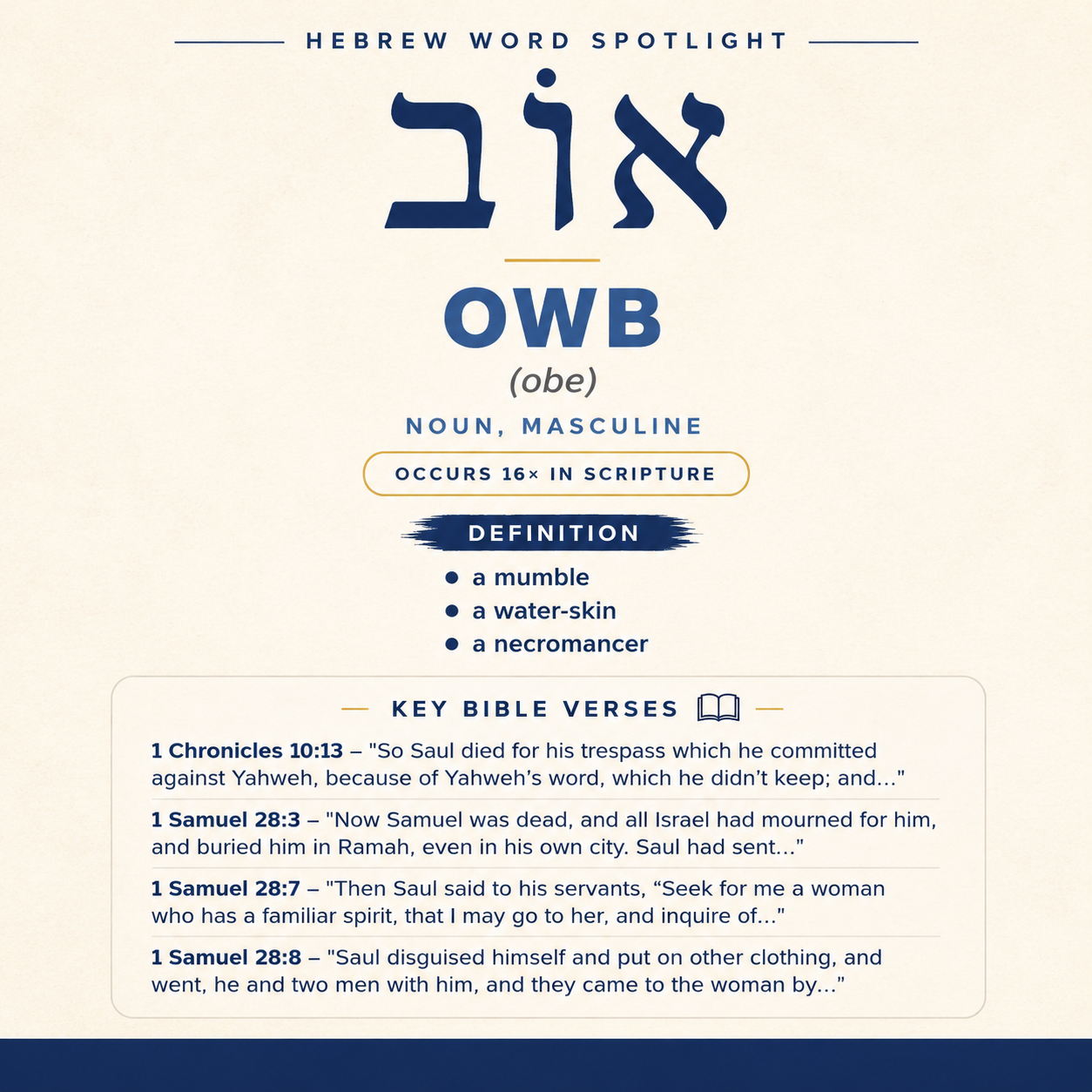
אוֹב means a mumble, a water-skin, or a necromancer, occurring 16 times in Scripture, including 1 Samuel 28 and 2 Kings 23.
Scripture Occurrences
This word occurs 16 times in Scripture. Listed references include 1 Chronicles 10:13 and 1 Samuel 28:3, 7–9.
Learn More →Narrative Contexts
It appears in Saul’s account in 1 Samuel 28. It also appears in kingly summaries in 2 Kings 21:6; 23:24 and 2 Chronicles 33:6.
Learn More →אוֹב (owb) names (1) a kind of low vocalization (“a mumble”), (2) a “water-skin,” and (3) a “necromancer.” In Scripture it appears especially in scenes that condemn seeking hidden counsel through forbidden sources, and it also supplies a striking image for degraded speech that seems to come from the dust.

Occurrences
So Saul died for his trespass which he committed against Yahweh, because of Yahweh’s word, which he didn’t keep; and also because he asked counsel of one who had a familiar spirit, to inquire, (1 Chronicles 10:13)
Here אוֹב functions within a summary of Saul’s failure: alongside not keeping “Yahweh’s word,” he “asked counsel” from a forbidden source. The phrase “one who had a familiar spirit” places the term in the sphere of illicit inquiry, and the narrative frame treats this act as part of the trespass associated with his death.
Now Samuel was dead, and all Israel had mourned for him, and buried him in Ramah, even in his own city. Saul had sent away those who had familiar spirits and the wizards out of the land. (1 Samuel 28:3)
In this setting of national bereavement and the loss of prophetic guidance (“Samuel was dead”), אוֹב appears in a policy statement: Saul “had sent away” such people from the land. The term is grouped with “the wizards,” marking it as a recognized category of prohibited religious practitioner within the community.
Then Saul said to his servants, “Seek for me a woman who has a familiar spirit, that I may go to her, and inquire of her.” His servants said to him, “Behold, there is a woman who has a familiar spirit at Endor.” (1 Samuel 28:7)
The word now re-enters as a target of Saul’s urgent search. The phrase “that I may go to her, and inquire of her” shows the expected function: a channel for obtaining counsel. The servants’ reply identifies a specific location (“at Endor”), turning the term from an abstract prohibition into a concrete, discoverable role in the land.
Saul disguised himself and put on other clothing, and went, he and two men with him, and they came to the woman by night. Then he said, “Please consult for me by the familiar spirit, and bring me up whomever I shall name to you.” (1 Samuel 28:8)
In a clandestine scene (“disguised,” “by night”), Saul explicitly requests the act associated with אוֹב: “consult for me by the familiar spirit.” His further demand, “bring me up whomever I shall name,” ties the term to a practice aimed at accessing a person beyond ordinary reach, aligning with the definition’s necromantic sense.
The woman said to him, “Behold, you know what Saul has done, how he has cut off those who have familiar spirits, and the wizards, out of the land. Why then do you lay a snare for my life, to cause me to die?” (1 Samuel 28:9)
The woman frames her fear in legal and political terms: the king “has cut off” such practitioners. By pairing “those who had familiar spirits” with “the wizards” again, the text reinforces that אוֹב belongs to a class of activities subject to enforcement. Her question about a “snare” and death shows the peril attached to this role within Israel’s own governance.
He also made his children to pass through the fire in the valley of the son of Hinnom. He practiced sorcery, divination, and witchcraft, and dealt with those who had familiar spirits and with wizards. He did much evil in Yahweh’s sight, to provoke him to anger. (2 Chronicles 33:6)
Here אוֹב appears in a catalog of condemned practices, placed after “sorcery, divination, and witchcraft.” The wording “dealt with those who had familiar spirits” presents involvement with such practitioners as a deliberate policy or habit, not a momentary lapse, and the evaluation “much evil in Yahweh’s sight” supplies the theological judgment attached to it in this historical recounting.
He made his son to pass through the fire, practiced sorcery, used enchantments, and dealt with those who had familiar spirits, and with wizards. He did much evil in Yahweh’s sight, to provoke him to anger. (2 Kings 21:6)
This parallel description likewise locates אוֹב among royal sins and courtly religious corruption. The repeated structure (“practiced… used… dealt with…”) depicts sustained engagement; “dealt with those who had familiar spirits” makes the term denote a recognized kind of specialist with whom a king could maintain contact, and that contact is assessed as provoking Yahweh’s anger.
Moreover Josiah removed those who had familiar spirits, the wizards, and the teraphim, and the idols, and all the abominations that were seen in the land of Judah and in Jerusalem, that he might confirm the words of the law which were written in the book that Hilkiah the priest found in Yahweh’s house. (2 Kings 23:24)
In Josiah’s reforms, אוֹב is included among items and persons purged from Judah and Jerusalem. The verb “removed” shows the term’s social reality—people identifiable as “those who had familiar spirits”—and the phrase “all the abominations that were seen” places them in a broader landscape of objectionable religious objects and practices (“teraphim… idols”). The purpose clause connects the removal to “confirm the words of the law,” linking this category of practitioner to disobedience against written instruction.
or a charmer, or someone who consults with a familiar spirit, or a wizard, or a necromancer. (Deuteronomy 18:11)
Within a list of prohibited roles, אוֹב appears in the description “someone who consults with a familiar spirit,” immediately followed by “a necromancer.” This pairing tightens the association between consultation through an אוֹב and communication with the dead, matching the definitional component “a necromancer” and showing how the term fits into a taxonomy of forbidden specialists.
When they tell you, “Consult with those who have familiar spirits and with the wizards, who chirp and who mutter,” shouldn’t a people consult with their God? Should they consult the dead on behalf of the living? (Isaiah 8:19)
Isaiah places אוֹב in a direct quotation of popular advice: “Consult with those who have familiar spirits.” The following description, “who chirp and who mutter,” aligns with the definitional note “a mumble,” portraying the characteristic sound of such consultation as small, eerie, and indistinct rather than clear proclamation. The prophet’s rhetorical questions contrast this practice with seeking God and explicitly frames the practice as “consult[ing] the dead on behalf of the living.”
The spirit of Egypt will fail within it. I will destroy its counsel. They will seek the idols, the charmers, those who have familiar spirits, and the wizards. (Isaiah 19:3)
Here אוֹב is one of several sources of guidance pursued when national “counsel” collapses: “The spirit of Egypt will fail within it… I will destroy its counsel.” The sequence “idols… charmers… those who have familiar spirits… wizards” presents the term as part of a desperate turn to alternative authorities for direction when ordinary wisdom and stability disintegrate.
You will be brought down, and will speak out of the ground. Your speech will mumble out of the dust. Your voice will be as of one who has a familiar spirit, out of the ground, and your speech will whisper out of the dust. (Isaiah 29:4)
In this vivid image of humiliation, the term contributes both sound and location. The text repeats the lowered setting—“out of the ground… out of the dust”—and explicitly uses “mumble” and “whisper” to depict the speech. Saying the voice will be “as of one who has a familiar spirit” uses אוֹב as an auditory comparison: the kind of faint, subterranean-sounding utterance associated with that practitioner becomes a metaphor for abasement.
Sense and Usage
Across these passages, אוֹב most often appears in the social-religious sense of a practitioner connected with forbidden consultation—frequently coordinated with “wizards” and set beside other condemned practices such as sorcery and divination. The narratives use it to describe both policy (sending them away; cutting them off; removing them) and violation (asking counsel; consulting by it), indicating that the term could name a known role within the community and a known temptation for leaders seeking guidance in crisis.
Isaiah’s usage highlights how the word’s association with sound (“chirp… mutter… mumble… whisper”) reinforces the portrait of such consultation as low, secretive speech in contrast to open counsel. Deuteronomy’s listing sets the term within a broader set of illicit mediating practices and places it next to “necromancer,” clarifying the direction of the consultation as oriented toward the dead rather than toward God.
Imagery
The strongest recurring image attached to אוֹב in these texts is the voice that seems to rise from below: “out of the ground” and “out of the dust” (Isaiah 29:4). That imagery matches the clandestine settings in which the practice is sought (1 Samuel 28:8) and the repeated biblical portrayal of it as counsel pursued when rightful counsel is rejected or has failed (1 Chronicles 10:13; Isaiah 19:3).
Sources: Lexical data from Strong’s Exhaustive Concordance and the Open Scriptures Hebrew Lexicon. Occurrence data from the Westminster Leningrad Codex with STEPBible reference data (CC BY). Scripture quotations from the World English Bible (public domain).




