Discovering the Meaning of ‘edre`iy in Hebrew
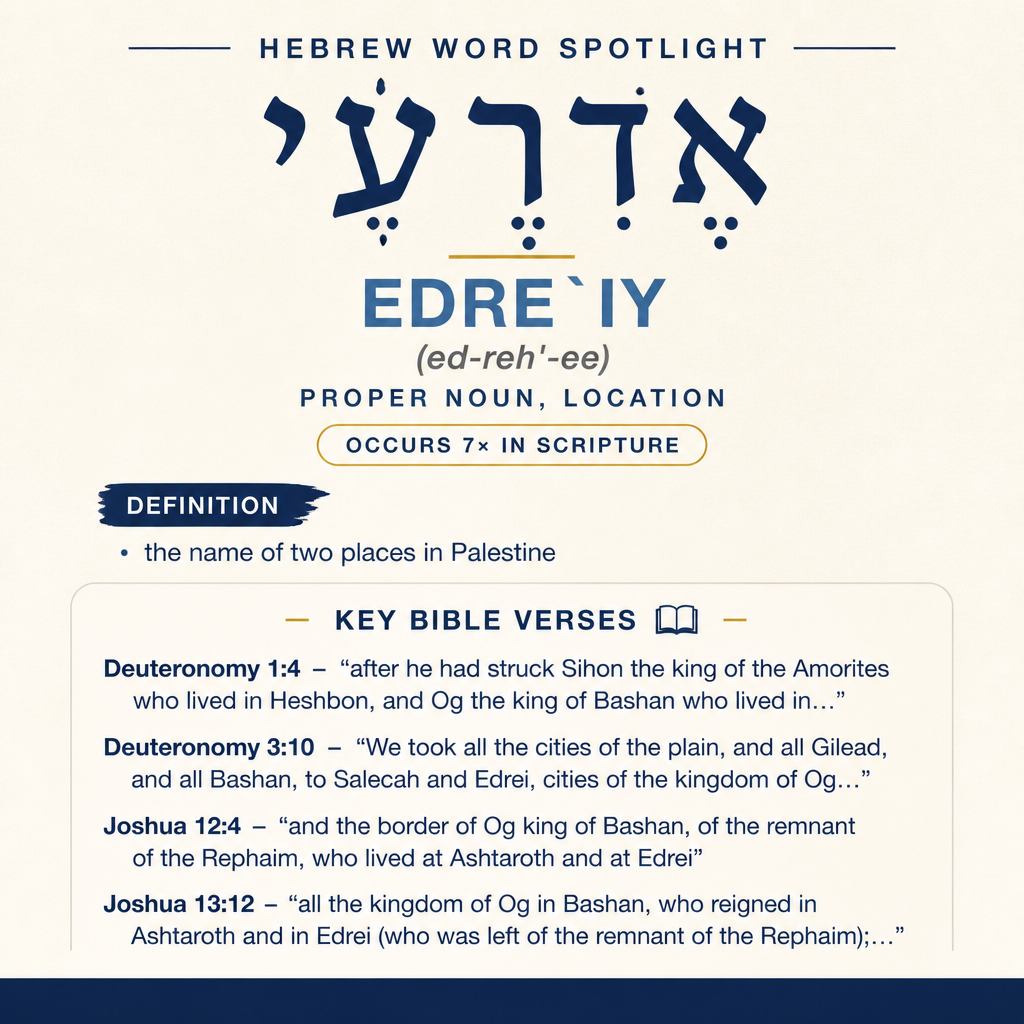
אֶדְרֶעִי means “the name of two places in Palestine” and appears in Deuteronomy, Numbers, and Joshua.
Bashan Setting
Several occurrences place Edrei with Ashtaroth in Bashan, tied to Og king of Bashan (Deut 1:4; Josh 12:4; 13:12; 13:31).
Learn More →List Mentions
Edrei also appears in territorial and city lists (Deut 3:10; Josh 19:37).
Learn More →אֶדְרֶעִי names two places in Palestine. In Scripture it appears in narratives and lists that locate battles, royal residences, and territorial holdings, and it functions as a fixed geographic point by which events and borders are described.
Occurrences
Deuteronomy 1:4 — “after he had struck Sihon the king of the Amorites who lived in Heshbon, and Og the king of Bashan who lived in Ashtaroth, at Edrei.”
Here Edrei stands in parallel with Ashtaroth as a place associated with Og king of Bashan. The verse uses “who lived in Ashtaroth, at Edrei” to anchor Og’s domain to identifiable locations, so that the defeat mentioned is not abstract but tied to a known seat or setting.
Deuteronomy 3:10 — “We took all the cities of the plain, and all Gilead, and all Bashan, to Salecah and Edrei, cities of the kingdom of Og in Bashan.”
Edrei appears as a boundary marker in a summary of conquest: “to Salecah and Edrei” frames the extent of what was taken. The phrase “cities of the kingdom of Og in Bashan” places Edrei within the political geography of Bashan and uses the city’s name to make the scope of control concrete and measurable.
Joshua 12:4 — “and the border of Og king of Bashan, of the remnant of the Rephaim, who lived at Ashtaroth and at Edrei,”
In this description of Og’s border, Edrei again pairs with Ashtaroth as a residence location: “who lived at Ashtaroth and at Edrei.” The word functions as one of the place-names that define the king’s territory, contributing to how the border is presented as a lived, inhabited region rather than a mere line.
Joshua 13:12 — “all the kingdom of Og in Bashan, who reigned in Ashtaroth and in Edrei (who was left of the remnant of the Rephaim); for Moses attacked these, and drove them out.”
Edrei is named as one of the centers where Og “reigned,” along with Ashtaroth. The statement “for Moses attacked these, and drove them out” treats these locations as representative nodes of royal power; Edrei is not only a spot on a map but part of the structure of rule that was confronted and displaced.
Joshua 13:31 — “Half Gilead, Ashtaroth, and Edrei, the cities of the kingdom of Og in Bashan, were for the children of Machir the son of Manasseh, even for the half of the children of Machir according to their families.”
This verse places Edrei within an allotment: it is counted among “the cities of the kingdom of Og in Bashan” that became the inheritance of “the children of Machir.” Edrei’s mention shows how a location previously tied to Og’s kingdom is now cataloged as part of a new distribution, emphasizing continuity of the place itself across a change in ownership and administration.
Joshua 19:37 — “Kedesh, Edrei, En Hazor,”
Edrei appears in a short list of towns, set among other place-names. In this context the word contributes by serving as a stable toponym within a regional inventory: the verse does not narrate events at Edrei but includes it as one of the named localities that belong together in a territorial grouping.
Numbers 21:33 — “They turned and went up by the way of Bashan. Og the king of Bashan went out against them, he and all his people, to battle at Edrei.”
Here Edrei is the stated site of a battle: “to battle at Edrei.” The narrative uses the place-name to locate the confrontation with Og and “all his people,” giving the encounter a specific setting and connecting the clash to the geography of Bashan introduced in the same verse (“by the way of Bashan”).

Sense and Usage
Across these passages, Edrei functions as a place-name with two principal roles. First, it serves as a royal and administrative point associated with Og king of Bashan, repeatedly linked with Ashtaroth in formulas of residence (“lived… at Edrei”) and rule (“reigned… in Edrei”). This repeated coupling gives Edrei a consistent profile as one of the locations that characterize Og’s realm; the text uses the name to express where the king’s presence and authority were situated.
Second, Edrei operates as a geographic marker within broader territorial descriptions. In Deuteronomy 3:10 it appears at the edge of a conquest summary (“to Salecah and Edrei”), providing a recognizable endpoint that helps define the range of captured cities and land. In Joshua 13:31 it becomes part of an allotment description, its inclusion in “the cities of the kingdom of Og in Bashan” highlighting the transition from one kingdom’s holdings to another group’s inheritance. In Joshua 19:37 it is used purely in list form, showing that the place-name is not limited to narrative scenes but also serves the practical purpose of cataloging settlements.
The passages also display how a toponym can carry narrative weight without any added description. Numbers 21:33 uses Edrei to fix the location of battle; later summaries and border statements revisit the same place-name to anchor memory, territory, and political change. In this way Edrei’s function is cumulative: each appearance strengthens its role as a reference point for where rule was exercised, where conflict occurred, and how lands were described and divided.
Imagery
The imagery attached to Edrei in these verses is the imagery of named ground: a city or locality that can be approached “by the way of Bashan,” contested “to battle at Edrei,” and afterward spoken of as a seat of rule and a unit in an allotment. The word evokes the concrete feel of place within the texts—where kings live and reign, where borders are traced, and where communities can be assigned “according to their families.”
Sources: Lexical data from Strong’s Exhaustive Concordance and the Open Scriptures Hebrew Lexicon. Occurrence data from the Westminster Leningrad Codex with STEPBible reference data (CC BY). Scripture quotations from the World English Bible (public domain).