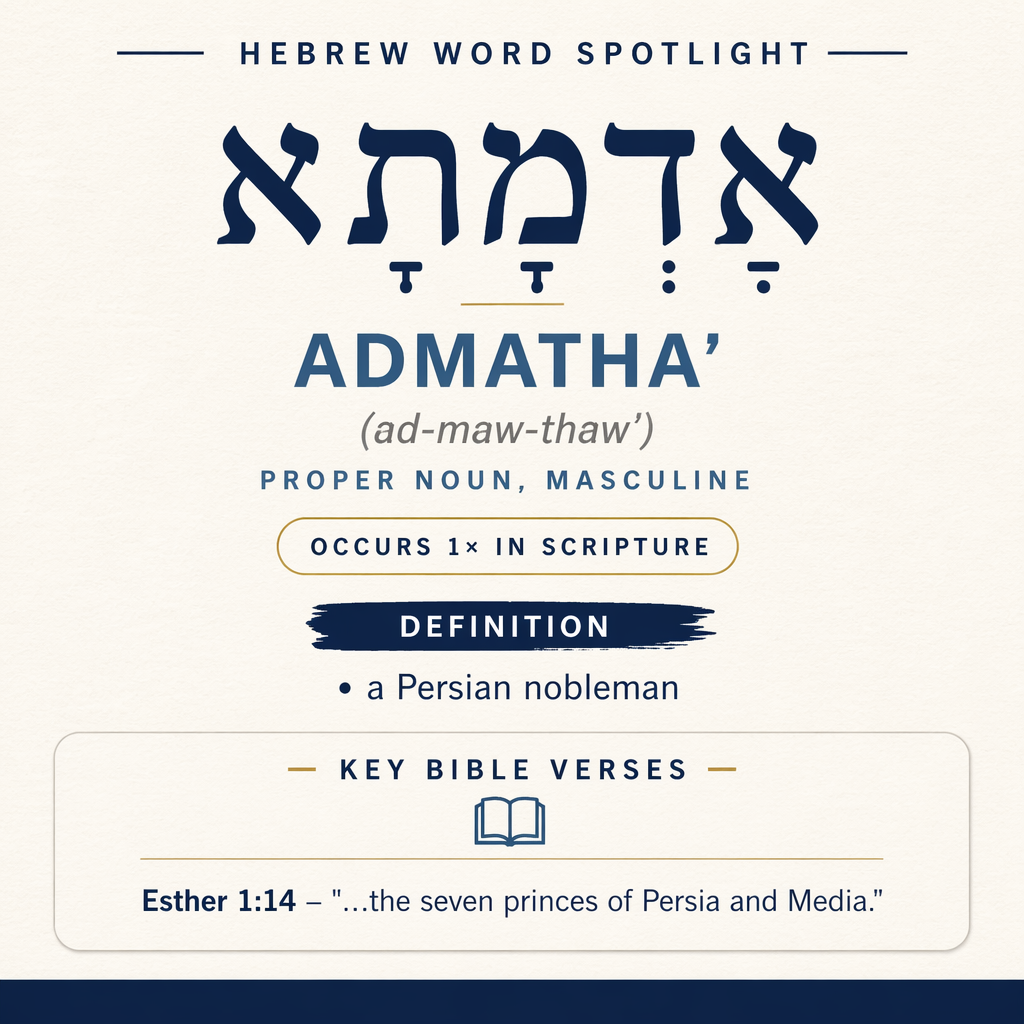
‘Admatha’

ad-maw-thaw’
Parts of SpeechProper Name Masculine

‘Admatha’ Definition

NAS Word Usage – Total: 1
Admatha = “a testimony to them”

  1. prince of Persia in reign of Ahasuerus (Xerxes)

Understanding the Meaning of Admatha in Hebrew

When studying the Hebrew language, one may encounter various words with intricate meanings and historical backgrounds. One such term is “Admatha” (אֲדְמֳתָא). This word appears in ancient texts and carries important implications. The following discussion will delve into the meaning, historical context, and applications of the term “Admatha” in Hebrew scripture.

Books Worth Reading:
Sponsored
Book 3161Book 3154Book 3162Book 3129Book 3131

What Does Admatha Mean?

“Admatha” essentially translates to “earth” or “land” in Hebrew. It signifies a specific region, often relating to physical territory. The use of this term in Hebrew literature goes beyond mere geography; it encompasses themes of inheritance, belonging, and even spirituality. Understanding “Admatha” invites exploration into not just the physical landscape, but also the cultural and emotional connections that people have to the land.

In biblical writings, particularly in the books of the Old Testament, the concept of land is central to the narrative. Many pivotal stories revolve around territory, inheritance, and the relationship between God and His people concerning the land.

Historical Context of Admatha

“Admatha” is a term rooted in ancient Hebrew texts, appearing in various contexts throughout scripture. The word, derived from the root “adamah,” means “soil” or “ground.” In fact, “adamah” appears frequently in Genesis, where it is described as the material from which God created Adam, the first human. This connection emphasizes not only the physicality of the land but also the deep ties to human identity and existence.

Books Worth Reading:
Sponsored
Book 3161Book 3154Book 3162Book 3129Book 3131

For instance, in Genesis 2:7, it states that God formed man from the dust of the ground (adamah) and breathed life into him. Therefore, the concept of “Admatha” extends beyond a mere location. It symbolizes a relationship with nature and creation, reminding us that humanity is intertwined with the earth.

Admatha in Jewish Tradition

In Jewish tradition, the land is regarded as a sacred gift from God. “Admatha” takes on an even deeper significance when considering the Jewish people’s narrative, particularly during the Exodus. This journey towards the Promised Land, often referred to in Hebrew as “Eretz Yisrael,” exemplifies the struggle for land and belonging.

Take for example the story of the Israelites wandering in the desert, longing to return to Admatha, their promised home. The rich symbolism surrounding this land reflects themes of yearning, struggle, and divine promise. Admatha, as more than just physical territory, represents the hope for a future, a place of safety and abundance.

Books Worth Reading:
Sponsored
Book 3161Book 3154Book 3162Book 3129Book 3131

Examples of Admatha in Scripture

The term “Admatha” appears in different forms in various Hebrew manuscripts. For instance, in the genealogies of the Tribes of Israel, land allocations to different tribes often include this term, emphasizing the importance of each portion of land as an inheritance.

One notable mention is in the book of Numbers (34:3), which talks about the borders of the Promised Land. Here “Admatha” signifies specific regions being allocated to the tribes. These descriptions were crucial for establishing territory and communal identity.

A hypothetical illustration can help visualize this concept: Imagine a young girl named Miriam living in a small village in Israel. Whenever her grandfather recounts the history of their people, the stories always return to Admatha—the land of her ancestors. For Miriam, Admatha is not just a place on a map; it’s where her identity is rooted, representing everything her family has fought for over generations.

Books Worth Reading:
Sponsored
Book 3161Book 3154Book 3162Book 3129Book 3131

Admatha as Symbol of Heritage

The significance of Admatha transcends geographical boundaries. In Jewish culture, the ties to land often invoke notions of heritage and ancestry. Each family has its story, deeply embedded in the land they occupy.

Consider how family heritage is often marked by specific locations. In the case of Miriam, her family might celebrate festivals or important milestones, such as a wedding or Bar Mitzvah, chosen specifically for their connection to Admatha. These celebrations often involve recalling stories of ancestors who once walked the very ground they now inhabit. Such events reinforce the notion that Admatha is much more than a physical space, but rather a vital part of identity.

Spiritual Interpretations of Admatha

Admatha has spiritual connotations in Hebrew scripture. Many scholars interpret the connection between God and land as a reflection of divine presence. In Jewish thought, land is often seen as a participant in the spiritual journey of a community and individual.

Books Worth Reading:
Sponsored
Book 3161Book 3154Book 3162Book 3129Book 3131

Take for instance Isaiah 1:19-20, where the grace of the land is promised to those who adhere to God’s commandments. In this verse, Admatha symbolizes a place of blessing, where obedience leads to abundance. This interweaving of spirituality with the land reveals how essential Admatha is not only for practical living but for a thriving spiritual life.

Modern-Day Relevance of Admatha

The themes associated with Admatha continue to resonate today. Land disputes, environmental concerns, and cultural ties to territory are still relevant topics of discussion in contemporary society. Understanding the depth of what “Admatha” means can encourage conversations around identity, justice, and stewardship of the earth.

For example, consider a community garden established in an urban area. Local residents might refer to it as their Admatha, a sacred space that connects them to the earth and to one another. This garden becomes a symbol of collaboration, identity, and care for the environment, echoing ancient traditions.

Books Worth Reading:
Sponsored
Book 3161Book 3154Book 3162Book 3129Book 3131

Connection to Community and Nature

Admatha can also be viewed through the lens of community connection. The word nurtures a sense of collective identity tied to the land. In ancient times, communities would gather to work the fields together, a practice that still occurs today in various forms. The way people engage with Admatha remains significant for maintaining relationships and nurturing communal life.

Imagine a local festival celebrating the harvest. This gathering represents a modern reflection of ancient agricultural practices, where people would come together to honor the earth. The festival may include singing, dancing, and sharing meals, all in reverence of Admatha—their land that sustains them. Each element of the celebration underscores the importance of land in nurturing not just physical needs but also social bonds.

Language and the Evolution of Admatha

The language surrounding “Admatha” has evolved, impacting how language shapes understanding. In modern Hebrew, the word may still connote the idea of land or territory. Still, its rich historical layers continue to provide depth to both spoken language and written texts.

Books Worth Reading:
Sponsored
Book 3161Book 3154Book 3162Book 3129Book 3131

Consider how language influences cultural identity. For native Hebrew speakers, terms like “Admatha” carry with them centuries of meaning. When artists, poets, and writers incorporate this word into their works, they participate in a legacy that connects them to their history, values, and memories.

Admatha and Environmental Responsibility

As humanity faces environmental challenges, reflecting on the significance of Admatha becomes even more paramount. The respect and stewardship of land resonate deeply in biblical teachings. This proactive attitude towards the earth can inspire today’s society to cultivate a more sustainable future.

For example, organizations focusing on sustainable agriculture or conservation efforts often reference the idea of nurturing the land. By adopting methods that respect the earth and its resources, they uphold the principles underlying “Admatha”: the sacredness of land and the relationships formed through it.

Books Worth Reading:
Sponsored
Book 3161Book 3154Book 3162Book 3129Book 3131

Admatha in Comparative Contexts

The idea of Admatha as “land” isn’t unique to Hebrew; many cultures have terms that reflect the same values associated with land and home. For instance, in indigenous cultures worldwide, the connection to land often embodies spiritual significance. The parallels between these cultural understandings highlight a universal theme of heritage and interconnectedness with the earth.

In summary, the exploration of “Admatha” reveals its multifaceted significance in Hebrew culture and tradition. The implications of land, identity, community, and spirituality breathe life into this seemingly simple term. Embracing the complexities surrounding Admatha leads to a deeper appreciation of its meaning, relevance, and importance in both ancient and modern contexts.

Little Known Secrets

Admatha is a term found in the Hebrew Bible that many may overlook, but it carries some interesting meanings and associations.

Books Worth Reading:
Sponsored
Book 3161Book 3154Book 3162Book 3129Book 3131
  1. Meaning and Roots: The name Admatha (אדמתה) can be associated with the Hebrew word “adamah,” meaning “earth” or “ground.” This connection emphasizes a link to land, fertility, and the material world.
  2. Biblical Context: Admatha appears in the Book of Esther (Esther 1:1) as one of the satrapies (provinces) under King Ahasuerus, showcasing the vastness of his empire, which stretched from India to Cush.
  3. Symbolism of Land: In ancient Hebrew culture, land is often seen as a symbol of identity and belonging. Admatha, as a province, reflects the importance of the land in the lives of its inhabitants, emphasizing their relationship to their environment.
  4. Connection to Growth: The idea of “ground” in its root form connects to growth and sustenance, suggesting that places like Admatha might symbolize thriving communities with rich agricultural potential.
  5. Name Variations: The suffix “-ta” in Admatha might be indicative of a place or region’s characteristics, suggesting that the land was known for something specific, like richness or beauty.
  6. Lesser-Known Mentions: While often forgotten, Admatha can help illustrate the geographic and political landscape of the time, allowing for a deeper understanding of the social dynamics during the Persian period.
  7. Cultural Significance: The mention of specific provinces like Admatha reveals how the Hebrew Bible records historical realities, connecting the faithful’s understanding of God with the places they lived and the cultures they interacted with.
  8. Influence on Other Languages: The root of Admatha has influenced modern Hebrew and other languages in the region, where terms related to earth and land are critical in various cultural contexts.
  9. Historical Research: Scholars often delve into the historical significance of Admatha, exploring its connections to ancient empires and the impact of geography on biblical narratives.
  10. Linguistic Variations: The phonetics of Admatha might differ among translations, leading to varied interpretations that can enrich discussions on the text and its meaning through time.

Conclusion

In conclusion, the Hebrew word “Admatha” holds a significant meaning related to the concept of “earth” or “ground.” Its roots provide insight into how ancient cultures viewed their surroundings and the importance of land in everyday life. Understanding this word helps us appreciate the rich language of Hebrew and how it connects to the themes of nature and foundation in the Bible. By exploring terms like “Admatha,” we gain a deeper understanding of the relationship between language and culture in biblical times.

Common Questions Related to What Does Admatha Mean In Hebrew

Q. What does the word “Admatha” mean in Hebrew?
A. “Admatha” means “earth” or “land” in Hebrew. It is sometimes used to refer specifically to a region or territory.

Q. Is “Admatha” used in the Hebrew Bible?
A. Yes, “Admatha” appears in the context of geographical names and descriptions in the Hebrew Bible.

Books Worth Reading:
Sponsored
Book 3161Book 3154Book 3162Book 3129Book 3131

Q. How is “Admatha” pronounced in Hebrew?
A. In Hebrew, “Admatha” is pronounced like “ad-MAH-tha.”

Q. Does “Admatha” have any other meanings besides “earth” or “land”?
A. While “Admatha” primarily means “earth” or “land,” it can also symbolize stability or a foundation in a more metaphorical sense.

Q. Can “Admatha” be found in modern Hebrew?
A. Yes, “Admatha” is still recognized in modern Hebrew, often used in discussions about geography or land.

Books Worth Reading:
Sponsored
Book 3161Book 3154Book 3162Book 3129Book 3131

Q. Are there similar words to “Admatha” in Hebrew?
A. Yes, similar words include “adamah,” which also means “earth” or “ground,” and “eretz,” which means “land” or “country.”

Q. In what contexts might “Admatha” be used?
A. “Admatha” can be used in religious texts, poetry, or discussions about land in Israel and its geography.

Q. Is “Admatha” associated with any specific locations in the Bible?
A. Yes, “Admatha” is often mentioned in connection with regions or cities in biblical accounts, particularly in relation to the land of Israel.

Books Worth Reading:
Sponsored
Book 3161Book 3154Book 3162Book 3129Book 3131

Q. How does “Admatha” relate to the creation story in Genesis?
A. “Admatha,” meaning “earth,” is essential in the creation story because it describes the physical foundation upon which God creates life.

Q. What is the significance of “Admatha” in Hebrew culture?
A. In Hebrew culture, “Admatha” represents a connection to the land, which is vital for identity and heritage, especially in relation to the Promised Land.

About the Author

Ministry Voice

{"email":"Email address invalid","url":"Website address invalid","required":"Required field missing"}

Want More Great Content?

Check Out These Articles 

mba ads=84