What Does Admah Mean in Hebrew?
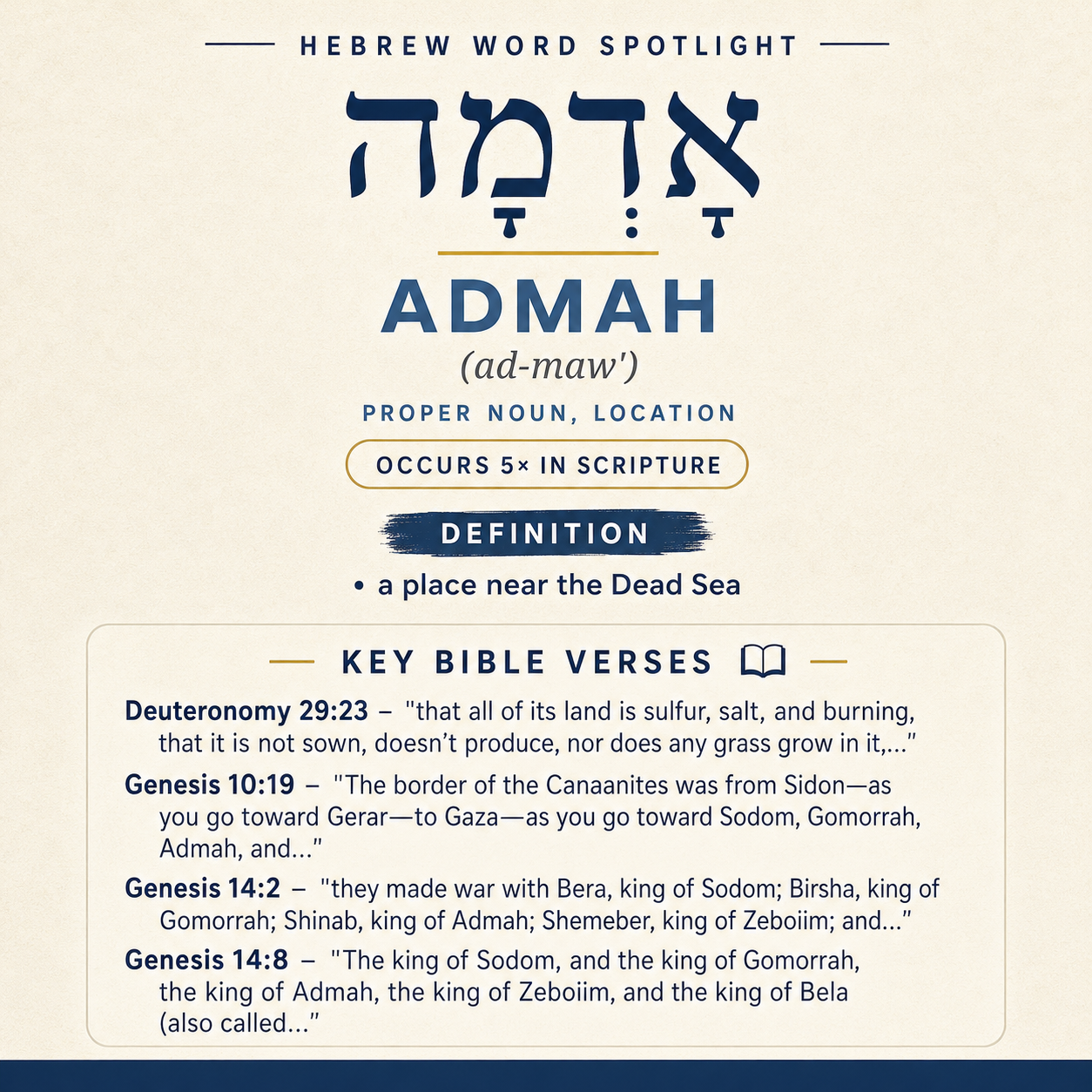
אַדְמָה (Admah) is a place near the Dead Sea, appearing in Genesis 10:19; Genesis 14:2, 14:8; Deuteronomy 29:23; and Hosea 11:8.
Meaning
Admah names a place near the Dead Sea. Scripture references it as a specific location among other places.
Learn More →Biblical Usage
Genesis 10:19 lists Admah with Sodom and Gomorrah in describing Canaanite borders. Genesis 14:2 and 14:8 mention the king of Admah in a war account.
Learn More →Prophetic Reference
Deuteronomy 29:23 describes land marked by sulfur, salt, and burning, with no growth. Hosea 11:8 uses Admah as a comparison in a divine appeal concerning Ephraim and Israel.
Learn More →Admah names a place near the Dead Sea. Scripture uses it both as a point on a regional border and as a remembered site of catastrophic overthrow, and it also becomes a comparison-point for threatened judgment.
Occurrences
“The border of the Canaanites was from Sidon—as you go toward Gerar—to Gaza—as you go toward Sodom, Gomorrah, Admah, and Zeboiim—to Lasha.” (Genesis 10:19)
Here Admah functions as a landmark within a string of place-names that trace “the border of the Canaanites.” The verse sets Admah in a geographic list alongside coastal and southern points (“Sidon… Gerar… Gaza”) and then among cities grouped together (“Sodom, Gomorrah, Admah, and Zeboiim”), before finishing “to Lasha.” In this scene Admah’s contribution is spatial: it helps describe extent and direction by anchoring the reader’s sense of where a boundary runs.
“they made war with Bera, king of Sodom; Birsha, king of Gomorrah; Shinab, king of Admah; Shemeber, king of Zeboiim; and the king of Bela (also called Zoar).” (Genesis 14:2)
Admah appears as a city with its own ruler (“Shinab, king of Admah”) in a coalition listed city by city. The structure of the verse, naming each king with his city, presents Admah as politically organized and aligned with neighboring city-states in a conflict setting. In this narrative moment, Admah is not merely a location on a map but a polity represented by its “king,” participating in war alongside Sodom, Gomorrah, Zeboiim, and Bela/Zoar.
“The king of Sodom, and the king of Gomorrah, the king of Admah, the king of Zeboiim, and the king of Bela (also called Zoar) went out; and they set the battle in array against them in the valley of Siddim” (Genesis 14:8)
This verse returns to the same grouping, but now the emphasis is movement and military posture: the kings “went out” and “set the battle in array… in the valley of Siddim.” Admah’s name again signals membership in a regional cluster of cities acting in concert. The word locates Admah’s king among those who take the field, and thus ties Admah to the valley where the battle lines are drawn.
“that all of its land is sulfur, salt, and burning, that it is not sown, doesn’t produce, nor does any grass grow in it, like the overthrow of Sodom, Gomorrah, Admah, and Zeboiim, which Yahweh overthrew in his anger, and in his wrath.” (Deuteronomy 29:23)
Admah is invoked as part of a remembered pattern of devastation: “the overthrow of Sodom, Gomorrah, Admah, and Zeboiim.” The verse paints a landscape of total ruin—“sulfur, salt, and burning,” land that “is not sown,” that “doesn’t produce,” where “nor does any grass grow in it.” Against that imagery, Admah functions as an exemplar of irreversible collapse, a name that intensifies the comparison: the desolation described is “like” what happened to those cities, and the overthrow is attributed to Yahweh’s “anger” and “wrath.”
““How can I give you up, Ephraim? How can I hand you over, Israel? How can I make you like Admah? How can I make you like Zeboiim? My heart is turned within me, my compassion is aroused.” (Hosea 11:8)
In Hosea, Admah becomes a benchmark for what it would mean to “give you up” or “hand you over.” The rhetorical questions—“How can I make you like Admah?”—assume that Admah represents a known outcome, severe enough that the speaker recoils from carrying it out. Within the verse’s emotional tension (“My heart is turned within me, my compassion is aroused”), Admah supplies the concrete comparison that sharpens the threat while also heightening the pathos of restraint.
Sense and Usage
Across these passages, Admah consistently works as a fixed place-name, but its function shifts with genre and context. In the boundary description of Genesis 10:19, Admah’s value lies in orientation: it is one of several points that allow a reader to follow the contour of territory. In the war account of Genesis 14:2 and 14:8, Admah is a city capable of representation and action through its king; the name carries political weight, identifying a participant in coalition and conflict and connecting that city to shared regional fate.
Deuteronomy 29:23 and Hosea 11:8 draw on Admah not to locate the reader geographically, but to summon an image of destruction and its moral force. Deuteronomy explicitly frames Admah within “the overthrow” that produced a landscape where agriculture and even wild growth fail. The description is sensory and agricultural—sulfur, salt, burning; unsown soil; no produce; no grass—so Admah’s name comes to stand for a kind of wasteland outcome rather than for civic life. Hosea then uses that same remembered outcome as a comparison for what could be done to a people: making Israel “like Admah” evokes an extreme judgment, yet the verse places this possibility within a struggle of compassion. In that way Admah’s sense in these later texts includes not only the event of overthrow but also the emotional and rhetorical power of the name as a warning-example.
When these uses are read together, Admah moves from being one city among other cities to being a shorthand for a specific kind of end. Genesis presents Admah in a network: it sits among other named places, and it stands shoulder to shoulder with its neighbors under a “king.” Deuteronomy and Hosea keep Admah paired with other names (“Sodom, Gomorrah… Zeboiim”), but the pairing serves a different purpose: the list becomes a set of exemplars that intensify a comparison (“like the overthrow…”) or a threat (“make you like Admah”). Thus the place near the Dead Sea is treated both as a concrete dot in regional space and as a remembered symbol of ruin that later speech can call up with a single word.
Imagery and Resonance
The strongest imagery attached to Admah in these passages is the land left after overthrow: “sulfur, salt, and burning,” ground that “doesn’t produce,” with “nor does any grass grow in it” (Deuteronomy 29:23). Hosea’s use of Admah draws that image into a personal address—“How can I make you like Admah?”—so the place-name resonates not only with a ruined landscape but also with the moral seriousness of judgment and the emotional intensity of compassion held back (Hosea 11:8). Alongside these, Genesis keeps Admah grounded in ordinary geopolitical realities: borders traced by known points (Genesis 10:19) and kings marching out to “set the battle in array” (Genesis 14:8). The combined effect is a place-name that can speak both of location and of remembered catastrophe, depending on the speaker’s aim.
Sources: Lexical data from Strong’s Exhaustive Concordance and the Open Scriptures Hebrew Lexicon. Occurrence data from the Westminster Leningrad Codex with STEPBible reference data (CC BY). Scripture quotations from the World English Bible (public domain).