
Understanding the Meaning of ‘Adam in Hebrew
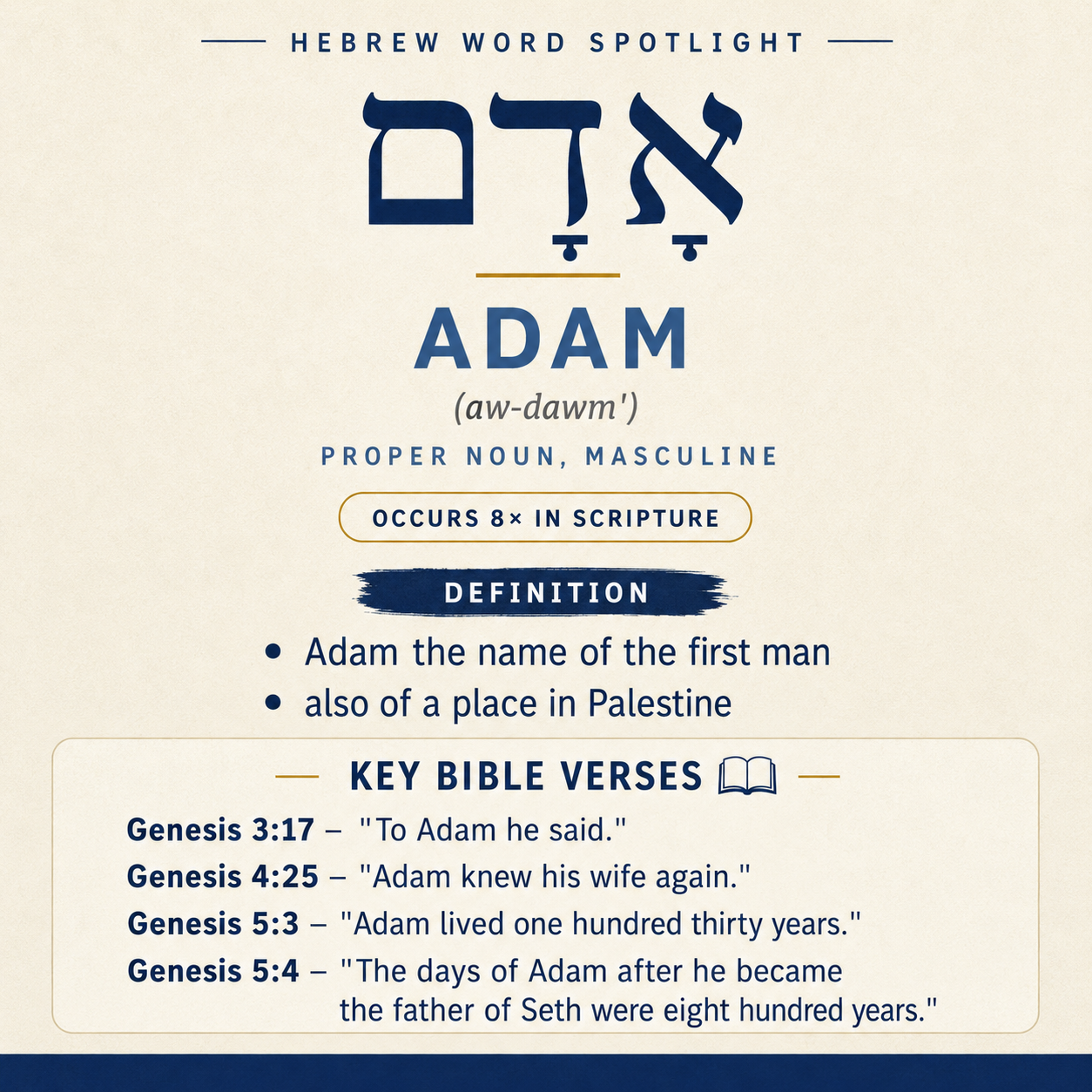
אָדָם (Adam) names the first man and also a place in Palestine, appearing in Genesis, Joshua, Job, and Hosea.
Core Definition
אָדָם (Adam) is the name of the first man. It is also used as the name of a place in Palestine.
Learn More →Where It Appears
This word occurs 8 times in Scripture. It appears in Genesis 3:17; 4:25; 5:3–5; Joshua 3:16; Job 31:33; and Hosea 6:7.
Learn More →Usage Examples
In Genesis it names the first man across several narratives and genealogical notes. In Joshua 3:16 it refers to "Adam, the city" beside Zarethan.
Learn More →אָדָם (Adam) names the first man and also a place in Palestine. In the passages where it appears, the word anchors pivotal moments of judgment, family line, moral comparison, and geographical reference.
Occurrences
To Adam he said, “Because you have listened to your wife’s voice, and ate from the tree, about which I commanded you, saying, ‘You shall not eat of it,’ the ground is cursed for your sake. You will eat from it with much labor all the days of your life. (Genesis 3:17)
Here Adam is directly addressed as the one held accountable for a decisive act: listening to his wife’s voice and eating from the commanded tree. Naming him focuses the speech on a particular person as the recipient of a consequence that reaches beyond himself: “the ground is cursed for your sake.” In this scene, Adam functions as the individual whose action and ensuing judgment define the character of everyday life: labor over “all the days of your life.”
Adam knew his wife again. She gave birth to a son, and named him Seth, saying, “for God has given me another child instead of Abel, for Cain killed him.” (Genesis 4:25)
Adam appears as husband and father within a renewed moment of family life (“knew his wife again”) after loss and violence in the immediate family context (“instead of Abel, for Cain killed him”). The use of Adam here ties the birth of Seth to the first man’s household and establishes the continuity of that household through a new child described as given by God.
Adam lived one hundred thirty years, and became the father of a son in his own likeness, after his image, and named him Seth. (Genesis 5:3)
In this genealogical statement Adam is the starting point for a measured, chronological account of descent. The naming of Adam frames Seth’s birth not only as an event but as the formation of a line marked by resemblance: the son is “in his own likeness, after his image.” Adam thus serves as the reference point for both time (“one hundred thirty years”) and identity (likeness and image) as a father who names his son.
The days of Adam after he became the father of Seth were eight hundred years, and he became the father of other sons and daughters. (Genesis 5:4)
Adam is again placed within the structured reporting of lifespan and offspring. The phrase “after he became the father of Seth” uses Seth’s birth as a hinge in Adam’s life, and the continuing years are counted. Adam functions here as the ancestor whose life extends into further generations (“other sons and daughters”), emphasizing breadth of progeny without detailing each child.
All the days that Adam lived were nine hundred thirty years, then he died. (Genesis 5:5)
This occurrence closes the lifespan notice with finality: Adam’s total years are summed and then his death is stated. The mention of Adam is not incidental; it marks the end of the first man’s earthly life within the same careful register of counting days. The simple conclusion “then he died” makes Adam’s mortality the last word in this notice.
But they, like Adam, have broken the covenant. They were unfaithful to me, there. (Hosea 6:7)
Adam here serves as a point of comparison for covenant-breaking. The line does not narrate Adam’s story but invokes his name as a known example: “like Adam.” The force of the comparison falls on the actions described—“have broken the covenant” and “were unfaithful to me”—so Adam’s name becomes a benchmark for treachery against a binding commitment.
if like Adam I have covered my transgressions, by hiding my iniquity in my heart, (Job 31:33)
In Job’s self-examination, Adam is again used in a comparison, this time concerning concealment of wrongdoing. The wording “if like Adam I have covered my transgressions” places Adam as a recognizable example of someone associated with hiding iniquity. Adam’s name strengthens the moral probing of the statement: Job frames concealment as a pattern that can be named and measured against an archetypal figure.
the waters which came down from above stood, and rose up in one heap a great way off, at Adam, the city that is beside Zarethan; and those that went down toward the sea of the Arabah, even the Salt Sea, were wholly cut off. Then the people passed over near Jericho. (Joshua 3:16)
Here Adam refers to a city, and the name functions as a geographic marker in a description of halted waters. The text locates the piling up of the waters “at Adam, the city that is beside Zarethan,” distinguishing this Adam from the personal name by explicitly calling it “the city.” In the narrative logic of the verse, the city-name helps map the event: waters gather at a defined point upstream while the people “passed over near Jericho.”

Sense and Usage
Across these occurrences, Adam operates in two distinct reference patterns already signaled by the definition: (1) a personal name, “the name of the first man,” and (2) a place-name, “a place in Palestine.” When used as the personal name, Adam is not a generic label but a specific individual whose life is presented in multiple genres: direct address in a judicial pronouncement (Genesis 3:17), terse family narrative (Genesis 4:25), formal genealogical notice (Genesis 5:3–5), and later moral analogy (Hosea 6:7; Job 31:33). These contexts show how the same name can carry narrative weight (a person spoken to, a husband, a father, one who lives and dies) and also function as an established reference point for ethical reflection (“like Adam”).
In Genesis 3:17, the name anchors responsibility: the speech is aimed at Adam as the one who listened and ate, and the consequences touch his relation to the ground and the shape of his days. In Genesis 4:25, the name sits quietly inside domestic life yet holds the memory of tragedy in the background; the mention of Abel and Cain’s killing of Abel makes Seth’s birth read as a replacement within Adam’s family. In Genesis 5:3–5, repeated uses of the name create a deliberate cadence: Adam’s age, Adam’s fatherhood, Adam’s remaining years, Adam’s total years, and Adam’s death. The name thus becomes the heading under which a life is measured and concluded.
The later comparisons in Hosea and Job show Adam as a figure whose actions are sufficiently well-known to function as shorthand. Hosea uses Adam to characterize covenant-breaking—an act described as being “unfaithful.” Job uses Adam to characterize covering transgressions by inward concealment—“hiding my iniquity in my heart.” In both, Adam is not simply a historical label but a moral reference, allowing the speaker to compress an entire pattern of wrongdoing into a single name.
Joshua 3:16 demonstrates the second sense: Adam as a place-name. The verse itself clarifies this usage by apposition (“Adam, the city that is beside Zarethan”), keeping the geographic Adam distinct from the personal Adam. Here the name’s function is locational and descriptive rather than moral or genealogical; it helps the reader track where the waters “stood” and “rose up in one heap,” enabling the passage “near Jericho.” Thus, within Scripture’s narrative flow, Adam can name both a person at the head of human genealogy and a city serving as a coordinate in a national crossing.
Imagery in Context
These passages attach Adam to concrete scenes: cursed ground and lifelong labor (Genesis 3:17), the bearing and naming of children (Genesis 4:25; Genesis 5:3–4), the counting of years ending in death (Genesis 5:5), the language of covenant faithfulness and betrayal (Hosea 6:7), inner concealment of wrongdoing (Job 31:33), and a river’s waters heaping up at a named city (Joshua 3:16). Taken together, the name Adam moves from garden-like judgment language into household continuity and then into public moral analogy, while also appearing as a fixed point on the land in a moment when waters stop and people cross.
Sources: Lexical data from Strong’s Exhaustive Concordance and the Open Scriptures Hebrew Lexicon. Occurrence data from the Westminster Leningrad Codex with STEPBible reference data (CC BY). Scripture quotations from the World English Bible (public domain).





