Discovering the Meaning of ‘aggan in Hebrew
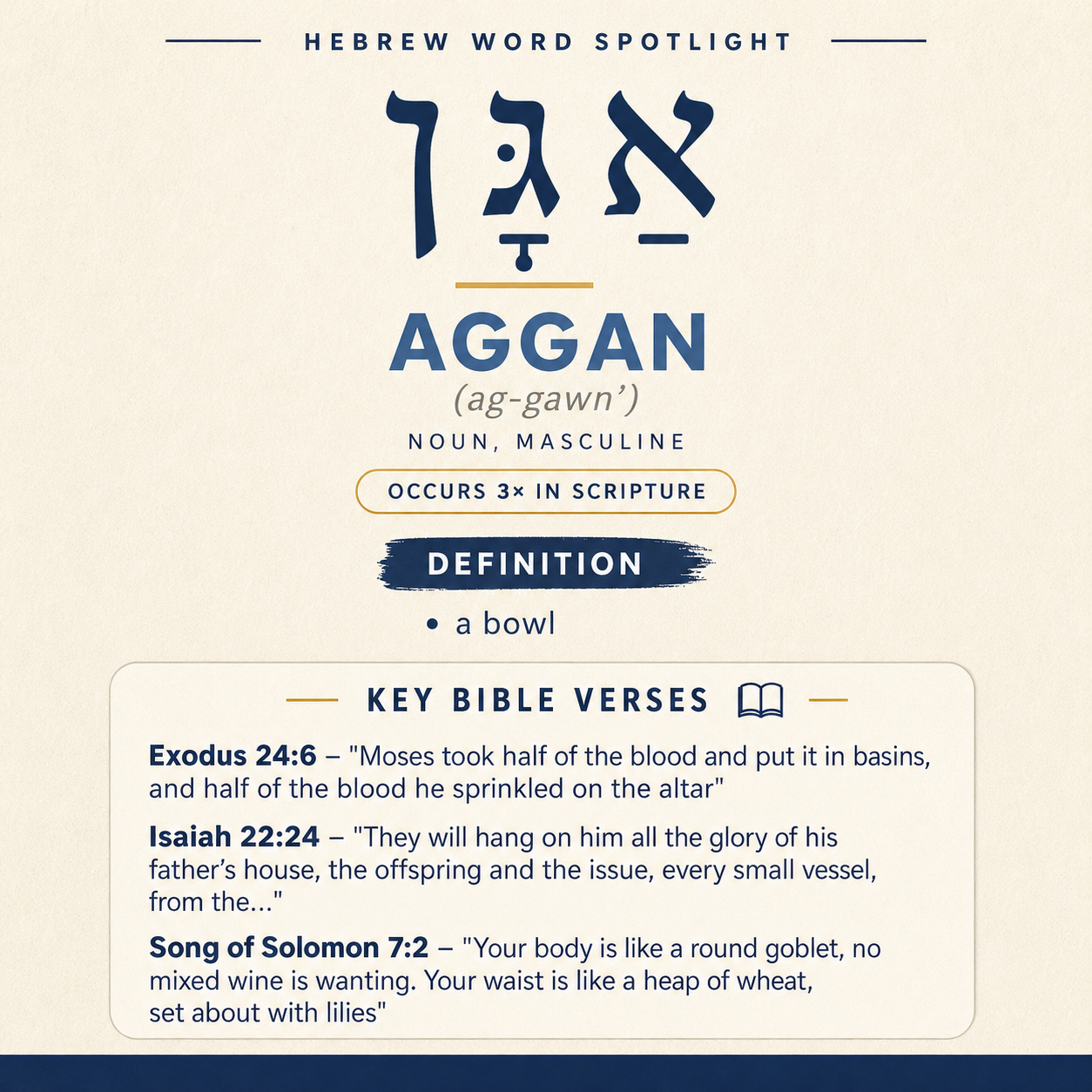
אַגָּן (aggan) means “a bowl” and appears in Exodus 24:6, Isaiah 22:24, and Song of Solomon 7:2.
Core Meaning
אַגָּן is a Hebrew noun meaning “a bowl.” It occurs three times in Scripture.
Learn More →Ritual Context
In Exodus 24:6, Moses put half of the blood in basins. The remaining half he sprinkled on the altar.
Learn More →Figurative Imagery
In Isaiah 22:24 it appears among “every small vessel, from the cup.” In Song of Solomon 7:2 it is used in a poetic description like a round goblet.
Learn More →אַגָּן (aggan) denotes a bowl. In Scripture it appears in a ritual setting with blood, in a prophetic image of household vessels, and in love poetry as a metaphor drawn from drinking ware.
Occurrences
“Moses took half of the blood and put it in basins, and half of the blood he sprinkled on the altar.” (Exodus 24:6)
In this scene the bowl is a container for “half of the blood,” set in deliberate contrast with the other half that is “sprinkled on the altar.” The vessel’s role is practical and controlled: it receives and holds a measured portion so that blood can be managed rather than immediately dispersed. Because the verse places the bowl alongside the altar action, the bowl participates in the ordered handling of a sacred substance—receiving it, separating it into portions, and preserving it for a distinct purpose within the ceremony described.
“They will hang on him all the glory of his father’s house, the offspring and the issue, every small vessel, from the cups even to all the pitchers.” (Isaiah 22:24)
Here the bowl belongs to a catalog of household items framed as “every small vessel,” with examples stretching “from the cups even to all the pitchers.” The imagery emphasizes comprehensiveness: the statement reaches from one kind of container to another, sweeping up even the modest, everyday pieces of a household’s equipment. Within the verse’s picture of items being “hang[ed] on him,” bowls are treated as part of the weight of “all the glory of his father’s house,” not as isolated objects but as elements of a household’s tangible honor and dependence. By grouping the bowl with cups and pitchers, the verse locates it among common vessels associated with serving and storing liquids, while the phrase “every small vessel” suggests it can represent the smallest and most ordinary end of domestic material culture.
“Your body is like a round goblet, no mixed wine is wanting. Your waist is like a heap of wheat, set about with lilies.” (Song of Solomon 7:2)
In this poetic comparison, the bowl is transformed into an image for the beloved’s body: “like a round goblet.” The vessel’s rounded shape is the point of contact for the metaphor, and its intended contents are made explicit: “no mixed wine is wanting.” The bowl thus contributes not only shape but also the idea of being filled—complete, supplied, lacking nothing in what is appropriate to it. Within the couplet, the bowl image is set beside agricultural fullness (“a heap of wheat”) and floral beauty (“lilies”), so the bowl participates in a larger cluster of abundance and attractiveness. The line’s force depends on the bowl’s recognizability as a container whose beauty and purpose come to expression when it is well-formed and well-filled.

Sense and Usage
Across these passages, the bowl functions as a defined container whose significance shifts with context. In Exodus 24:6 the bowl’s defining feature is its capacity to receive and hold blood in a controlled way, enabling a division of portions and an orderly sequence of actions. The verse highlights containment and separation: one portion is held, another is applied elsewhere. In Isaiah 22:24 the bowl stands within a range of “small vessel[s],” helping to paint a picture of domestic or administrative dependence in which even minor items are included. Its sense there is not tied to a particular content but to its identity as a piece of a household’s equipment—one of the many objects that can be counted, grouped, and borne as part of a larger burden. In Song of Solomon 7:2 the bowl’s capacity and shape become the ground of metaphor; the vessel is imagined as filled suitably (“no mixed wine is wanting”), so the bowl conveys wholeness and adequacy as well as form.
These uses show the bowl as a versatile object in Israel’s verbal world: it can be a working implement in a solemn rite, an item among other vessels that together represent a household’s possessions, and an aesthetic object whose curves and fullness offer language for admiration. Even when the term is placed among other containers (cups, pitchers), it retains its own conceptual center: a distinct receptacle, small enough to belong to “every small vessel,” yet important enough to appear in a scene where blood is carefully handled. The poetic use in Song of Solomon does not require the bowl to be large or elaborate; the image depends on the bowl being recognizable as rounded and suited to holding drink, so that fullness can be expressed as the absence of any lack.
Imagery
Taken together, these verses let the bowl carry two complementary kinds of imagery. It can evoke careful handling—blood placed into basins as part of a measured ritual act (Exodus 24:6). It can also evoke the small, ordinary objects through which “all the glory of his father’s house” is pictured as concrete, enumerable, and even hangable—“every small vessel” alongside cups and pitchers (Isaiah 22:24). Finally, it can evoke beauty and satisfaction in the language of desire: a “round goblet” with wine in sufficient supply (Song of Solomon 7:2). The same basic object thus supports scenes of solemn order, household totality, and intimate admiration.
Sources: Lexical data from Strong’s Exhaustive Concordance and the Open Scriptures Hebrew Lexicon. Occurrence data from the Westminster Leningrad Codex with STEPBible reference data (CC BY). Scripture quotations from the World English Bible (public domain).