
Discovering the Meaning of ‘Abiyb in Hebrew
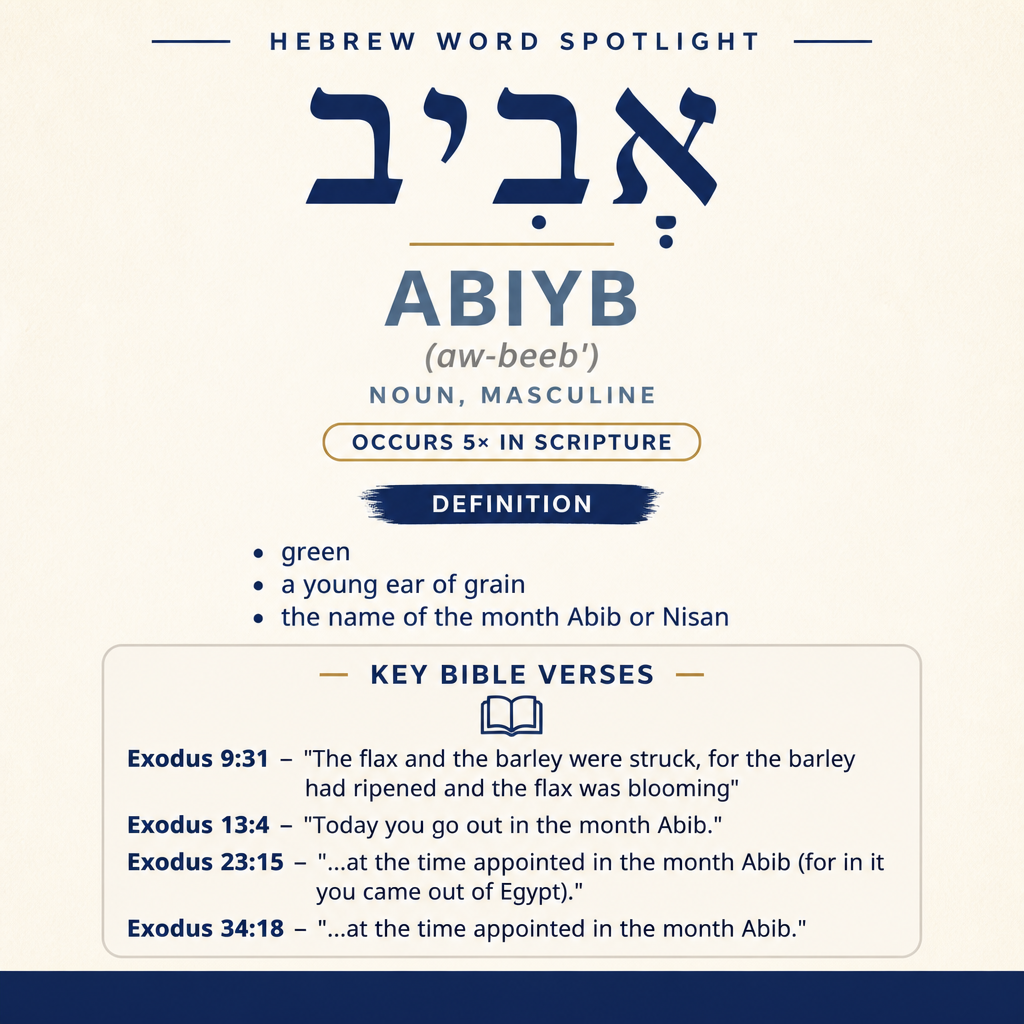
אָבִיב means “green,” “a young ear of grain,” and the month-name Abib (Nisan), appearing five times in Exodus and Leviticus.
Core Meaning
אָבִיב refers to what is green, especially a young ear of grain. It also names the month Abib (Nisan).
Learn More →Exodus Usage
In Exodus 9:31 it describes barley that had ripened. In Exodus 13:4, 23:15, and 34:18 it names the month Abib in connection with Israel’s calendar.
Learn More →Leviticus Usage
In Leviticus 2:14 it appears in instructions about offering first fruits to Yahweh.
Learn More →אָבִיב (abiyb) refers to “green; a young ear of grain,” and it is also used as the name of the month “Abib” (also called “Nisan”). It appears in a small cluster of passages that connect the early stage of grain to Israel’s calendar and worship.

Occurrences
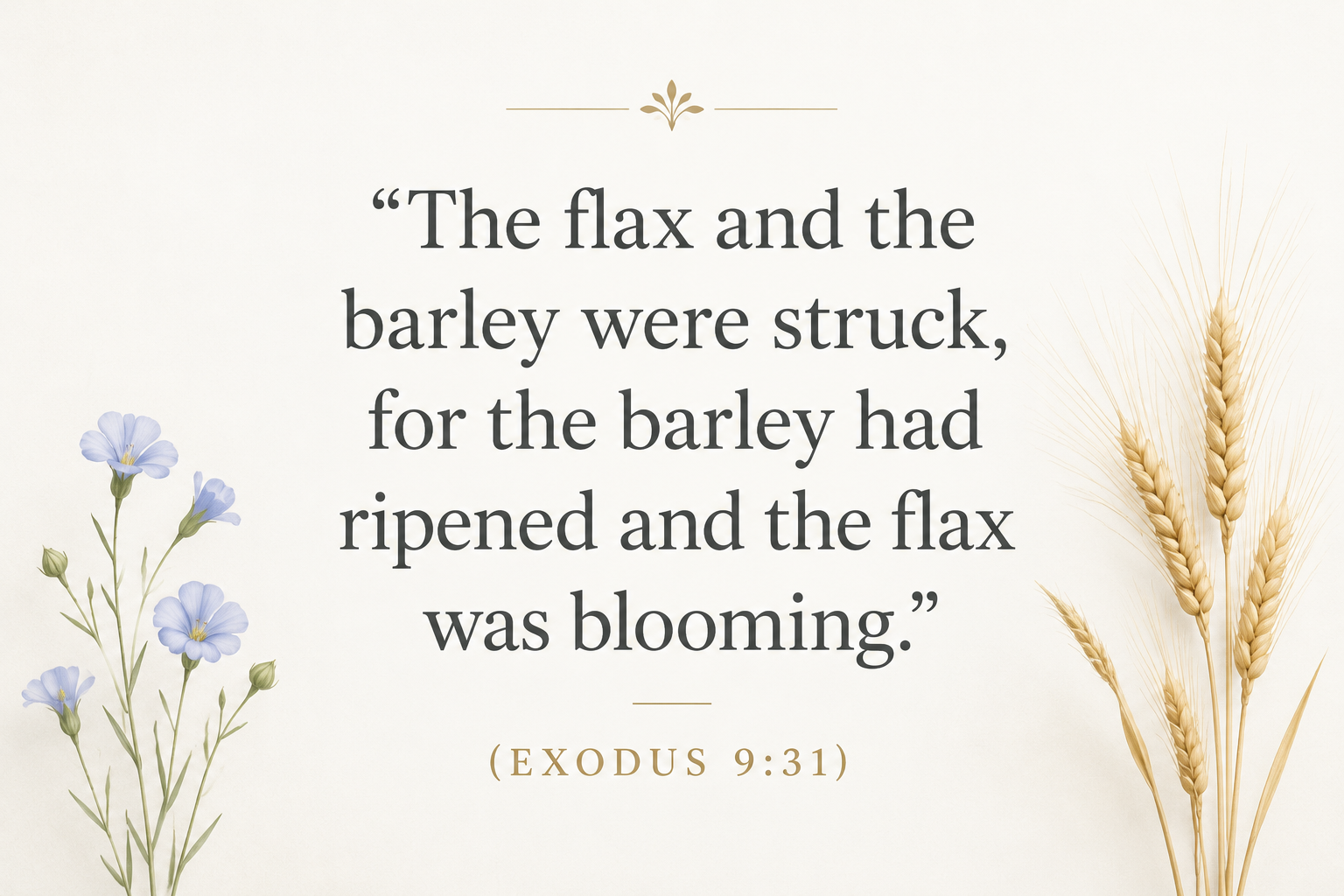
“The flax and the barley were struck, for the barley had ripened and the flax was blooming.” (Exodus 9:31)
In this description of crop damage, אָבִיב is tied to barley at a particular point in its development: the barley is at the stage where it “had ripened,” alongside flax that “was blooming.” The term therefore contributes a concrete agricultural marker within the sentence, anchoring the scene in the visible condition of the plants. The verse uses plant-state language to explain why the strike mattered: the barley is not merely present in the field; it has reached a vulnerable or notable point of growth described in the text as ripened.
“Today you go out in the month Abib.” (Exodus 13:4)
Here אָבִיב functions as a month-name, locating the timing of going out (“Today you go out”) within Israel’s calendrical framework. The verse is terse, and the word’s main work is chronological: it fixes the day’s significance within a named month. By using “the month Abib,” the text treats time as something publicly recognizable and speakable—an appointed segment of the year rather than a vague season.
“You shall observe the feast of unleavened bread. Seven days you shall eat unleavened bread, as I commanded you, at the time appointed in the month Abib (for in it you came out of Egypt), and no one shall appear before me empty.” (Exodus 23:15)
In this instruction, אָבִיב again names the month, but now as the setting for a commanded festival with a defined duration (“Seven days”). The parenthetical explanation—“for in it you came out of Egypt”—attaches the month to the memory of departure, so the month-name becomes a handle for collective remembrance as well as scheduling. The word also frames obligation: the feast is not left to personal preference; it is kept “at the time appointed in the month Abib,” and the closing requirement (“no one shall appear before me empty”) places the month’s observance in the context of appearing before God with appropriate seriousness.
““You shall keep the feast of unleavened bread. Seven days you shall eat unleavened bread, as I commanded you, at the time appointed in the month Abib; for in the month Abib you came out of Egypt.” (Exodus 34:18)
This passage repeats the month-language with an emphasis on the command’s stability: “as I commanded you” and “at the time appointed.” The repetition of “in the month Abib” reinforces that the month-name is not incidental but integral to the ordinance. The verse explicitly ties the feast to the historical moment of leaving Egypt (“for in the month Abib you came out of Egypt”), so the calendar term carries narrative weight: it marks time in a way that holds past deliverance and present practice together.
““ ‘If you offer a meal offering of first fruits to Yahweh, you shall offer for the meal offering of your first fruits fresh heads of grain parched with fire and crushed.” (Leviticus 2:14)
This instruction uses the agricultural sense of אָבִיב, expressed here in the offering’s required material: “fresh heads of grain.” The word’s contribution is tactile and specific, pointing to grain that is still young and newly formed rather than fully processed. The verse then adds preparation details—“parched with fire and crushed”—which shows that the offering moves from the field’s fresh growth into a prepared gift. In this setting the term stands at the intersection of harvest life and worship practice: the offering is made from early produce, handled in a defined way, and presented “to Yahweh.”
Sense and Usage
Across its occurrences, אָבִיב moves between two closely connected domains: the state of grain in the field and the naming of time in the communal calendar. In Exodus 9:31 and Leviticus 2:14, the word belongs to the world of crops and their stages. The verses do not treat plant growth as a background detail; instead, they make it explanatory and prescriptive. In Exodus 9:31 the condition of barley and flax provides the stated reason for the severity of what happened to them (“were struck, for…”). In Leviticus 2:14 the condition of the grain determines what qualifies as an acceptable offering: the first-fruits gift is to be made from “fresh heads of grain,” then intentionally transformed by parching and crushing.
In Exodus 13:4, 23:15, and 34:18, the same term functions as the name of a month—“Abib”—and in those places time is not abstract. “The month Abib” is the time of going out, and it is the appointed time for the feast of unleavened bread. The calendar use is therefore not merely a label; it is a means of ordering memory and obedience. The festival is bound to a fixed month and a fixed length (“Seven days”), and that stability supports the text’s emphasis on command (“as I commanded you”) and appointment (“at the time appointed”). When the month is explicitly linked to the exodus (“for in it you came out of Egypt”), the month-name becomes a recurring annual pointer to a decisive event, making the passage from Egypt something that is not only remembered verbally but also enacted through time-bound practice.
These two uses—young grain and named month—sit naturally together in the passages as given. The month is identified by a term that can also describe early grain, and the legal material in Exodus and Leviticus places communal worship within the rhythms of the year and the produce of the land. Even without additional explanation in these verses, the linkage is clear at the level of imagery: the same word can point either to what is happening in the fields (“barley had ripened,” “fresh heads of grain”) or to when the community is to act (“the month Abib,” “time appointed”).
Imagery
In these texts, אָבִיב carries the feel of early-season life: barley that has reached a notable stage, “fresh heads of grain” suitable for first fruits, and a month that frames departure and festival. The word therefore gathers together sight (ripened barley, blooming flax), food practice (unleavened bread for seven days), and gift-giving (“meal offering of first fruits to Yahweh”) into a single vocabulary of time and growth.
Sources: Lexical data from Strong’s Exhaustive Concordance and the Open Scriptures Hebrew Lexicon. Occurrence data from the Westminster Leningrad Codex with STEPBible reference data (CC BY). Scripture quotations from the World English Bible (public domain).




