
Understanding the Meaning of Adikos in Greek
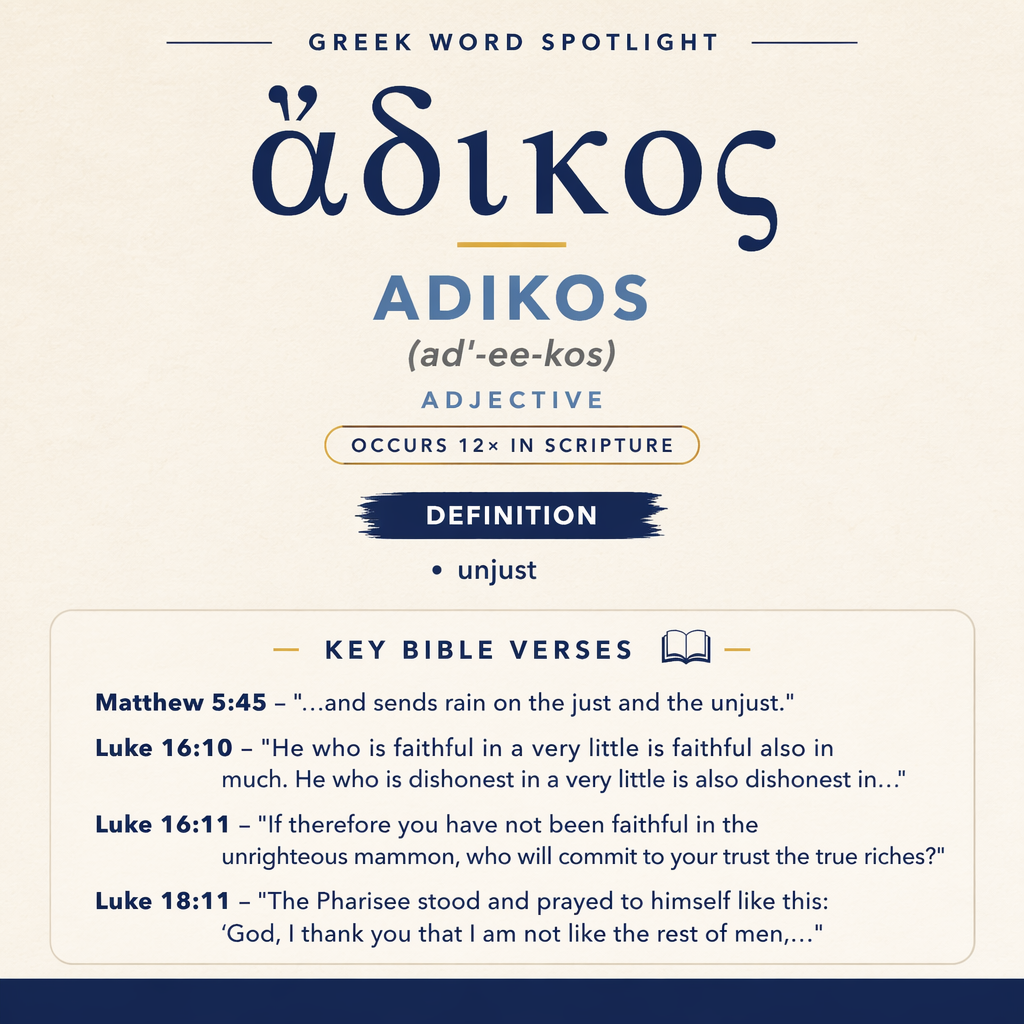
ἄδικος means “unjust” and occurs 12 times in Scripture, including Matthew 5:45, Luke 16:10–11, Luke 18:11, Acts 24:15, Romans 3:5, and 1 Corinthians 6:1, 6:9.
Core Meaning
ἄδικος is defined as “unjust.” It describes what is unrighteous or dishonest in the cited passages.
Learn More →Scripture Occurrences
The word occurs 12 times in Scripture. Listed examples include Matthew 5:45; Luke 16:10–11; Luke 18:11; Acts 24:15; Romans 3:5; and 1 Corinthians 6:1, 6:9.
Learn More →Context Snapshots
In Luke 16:10 it contrasts faithfulness with being dishonest. In 1 Corinthians 6:9 it appears in a warning that the unrighteous will not inherit God’s Kingdom.
Learn More →ἄδικος describes what is “unjust,” appearing in teachings of Jesus, apostolic instruction, and passages that contrast the just with the unjust. In these contexts it marks people, actions, or situations viewed through the lens of justice, whether in daily conduct, legal disputes, or final judgment.
Root and Related Words
ἄδικος is connected with dike (δίκη), “condemnation” (Strong’s G1349). Strong’s also associates it with Alpha, A (α, Ἀλφα) (Strong’s G1).

Occurrences
Matthew 5:45: “that you may be children of your Father who is in heaven. For he makes his sun to rise on the evil and the good, and sends rain on the just and the unjust.”
Here ἄδικος stands in a paired contrast: “the just and the unjust.” The verse places both groups under the same ordinary gifts of creation—sunrise and rain—so the word helps name one side of humanity’s moral divide while also showing that God’s providence is not restricted only to the just.
Luke 16:10: “He who is faithful in a very little is faithful also in much. He who is dishonest in a very little is also dishonest in much.”
In this saying, ἄδικος characterizes a person as “dishonest” in small matters, with the point that the pattern carries into larger responsibilities. The word functions diagnostically: it labels the kind of character revealed by how someone handles “a very little.”
Luke 16:11: “If therefore you have not been faithful in the unrighteous mammon, who will commit to your trust the true riches?”
Here ἄδικος modifies “mammon,” giving the phrase “the unrighteous mammon.” Within the logic of the sentence, being unfaithful with that sphere disqualifies someone from being entrusted with “the true riches.” The word thus helps frame money as a realm where faithfulness is tested, and where failure exposes a lack of trustworthiness.
Luke 18:11: “The Pharisee stood and prayed to himself like this: ‘God, I thank you that I am not like the rest of men, extortionists, unrighteous, adulterers, or even like this tax collector.”
In the Pharisee’s prayer, ἄδικος appears as one label in a list of others from which he distances himself: “extortionists, unrighteous, adulterers.” The word contributes to a self-portrait drawn by contrast; it is part of the Pharisee’s boundary line between himself and “the rest of men,” including “this tax collector.”
Acts 24:15: “having hope toward God, which these also themselves look for, that there will be a resurrection of the dead, both of the just and unjust.”
As in Matthew 5:45, ἄδικος is paired with “just,” but here the shared horizon is not daily providence; it is “a resurrection of the dead.” The word names one group included in the universal scope of resurrection, setting up a comprehensive view of humanity’s future that includes both moral categories.
Romans 3:5: “But if our unrighteousness commends the righteousness of God, what will we say? Is God unrighteous who inflicts wrath? I speak like men do.”
In this argument, ἄδικος is used in a question about God: “Is God unrighteous who inflicts wrath?” The verse puts the term under pressure in a rhetorical form—raising the possibility and rejecting it by the framing (“I speak like men do”). The word is therefore applied to God only within the logic of a disputed inference, serving to highlight the moral stakes of how one reasons about divine judgment and human wrongdoing.
1 Corinthians 6:1: “Dare any of you, having a matter against his neighbor, go to law before the unrighteous, and not before the saints?”
Here ἄδικος identifies the forum before which disputes are being taken: “before the unrighteous.” The contrast is explicit—“and not before the saints?”—so the word helps mark a mismatch between the community’s identity and the kind of judges or setting they are choosing for settling “a matter against his neighbor.”
1 Corinthians 6:9: “Or don’t you know that the unrighteous will not inherit God’s Kingdom? Don’t be deceived. Neither the sexually immoral, nor idolaters, nor adulterers, nor male prostitutes, nor homosexuals,”
In this warning, ἄδικος names the group excluded from inheriting “God’s Kingdom.” The verse then begins a concrete list introduced with “Neither…,” placing “the unrighteous” as an umbrella category connected to specific kinds of conduct. The word thus functions as a moral classification with an eschatological consequence.
Hebrews 6:10: “For God is not unrighteous, so as to forget your work and the labor of love which you showed toward his name, in that you served the saints, and still do serve them.”
Here ἄδικος is negated of God: “God is not unrighteous.” The immediate explanation is ethical and relational: God will not “forget your work and the labor of love,” especially as shown in service to “the saints.” The term therefore frames divine remembrance and reward as consistent with justice.
1 Peter 3:18: “Because Christ also suffered for sins once, the righteous for the unrighteous, that he might bring you to God, being put to death in the flesh, but made alive in the Spirit,”
In this statement about Christ’s suffering, ἄδικος names those for whom the “righteous” one suffers: “the righteous for the unrighteous.” The word identifies the beneficiaries as belonging to the unjust side of the moral contrast, and it heightens the asymmetry of the exchange described, with the aim “that he might bring you to God.”
2 Peter 2:9: “the Lord knows how to deliver the godly out of temptation and to keep the unrighteous under punishment for the day of judgment,”
Here ἄδικος again stands opposite a positive group, this time “the godly.” The verse portrays ongoing divine governance: deliverance for one group, and being “kept… under punishment” for the unjust, oriented toward “the day of judgment.” The word thus participates in a moral partition tied to accountability.
Sense and Usage
Across these passages, ἄδικος consistently serves as a moral descriptor that divides persons (and once a sphere of trust, “mammon”) into a category characterized as unjust. The contrasts are often explicit and paired: “the just and the unjust” (Matthew 5:45; Acts 24:15), “the godly” versus “the unrighteous” (2 Peter 2:9), and “the saints” versus “the unrighteous” in the context of legal disputes (1 Corinthians 6:1). This repeated pattern makes the word function as a boundary marker—useful for identifying which side of a moral distinction is in view.
The word also operates at multiple scales. At the level of ordinary life and character formation, it labels the person whose behavior in “a very little” reveals a settled kind of unreliability (Luke 16:10), and it qualifies “mammon” as a realm where faithfulness is tested (Luke 16:11). At the level of public standing, it becomes a label that can be claimed or denied in social comparison, as in the Pharisee’s prayer that distinguishes himself from “extortionists, unrighteous, adulterers” (Luke 18:11). At the level of ultimate outcomes, it designates those who “will not inherit God’s Kingdom” (1 Corinthians 6:9), those included in the scope of resurrection (“both of the just and unjust,” Acts 24:15), and those kept for “the day of judgment” (2 Peter 2:9).
Two passages apply ἄδικος directly to God, but in opposite rhetorical postures. Romans 3:5 raises the question “Is God unrighteous who inflicts wrath?” as part of a human line of reasoning being probed, while Hebrews 6:10 asserts plainly, “God is not unrighteous,” and ties that assertion to God’s faithful regard for “your work and the labor of love.” Together these uses show that the term can bear heavy theological weight in argument and reassurance, because it touches the core claim that God’s actions are consistent with justice.
Finally, 1 Peter 3:18 places ἄδικος within the concentrated contrast “the righteous for the unrighteous,” setting the unjust as the recipients of a saving movement (“that he might bring you to God”). In that setting the word is not merely diagnostic but relational: it names the condition of those for whom Christ suffered, clarifying the moral distance bridged in the act described.
Imagery
In these texts ἄδικος gathers its imagery from concrete scenes: rain and sun falling on “the unjust” along with the just (Matthew 5:45); courtroom choices about where to take a dispute (1 Corinthians 6:1); the future horizon of “a resurrection of the dead” (Acts 24:15); and the stark picture of being “kept… under punishment for the day of judgment” (2 Peter 2:9). Even when used in brief labels—“the unrighteous will not inherit God’s Kingdom” (1 Corinthians 6:9)—the term evokes a whole moral landscape in which justice is not an abstraction but a lived reality with communal and final consequences.
Sources: Lexical data from Strong’s Exhaustive Concordance and the Translators Brief Lexicon of Extended Strongs for Greek (STEPBible, CC BY). Occurrence data from the Translators Amalgamated Greek New Testament (STEPBible, CC BY). Scripture quotations from the World English Bible (public domain).




