
Understanding the Meaning of Adikema in Greek
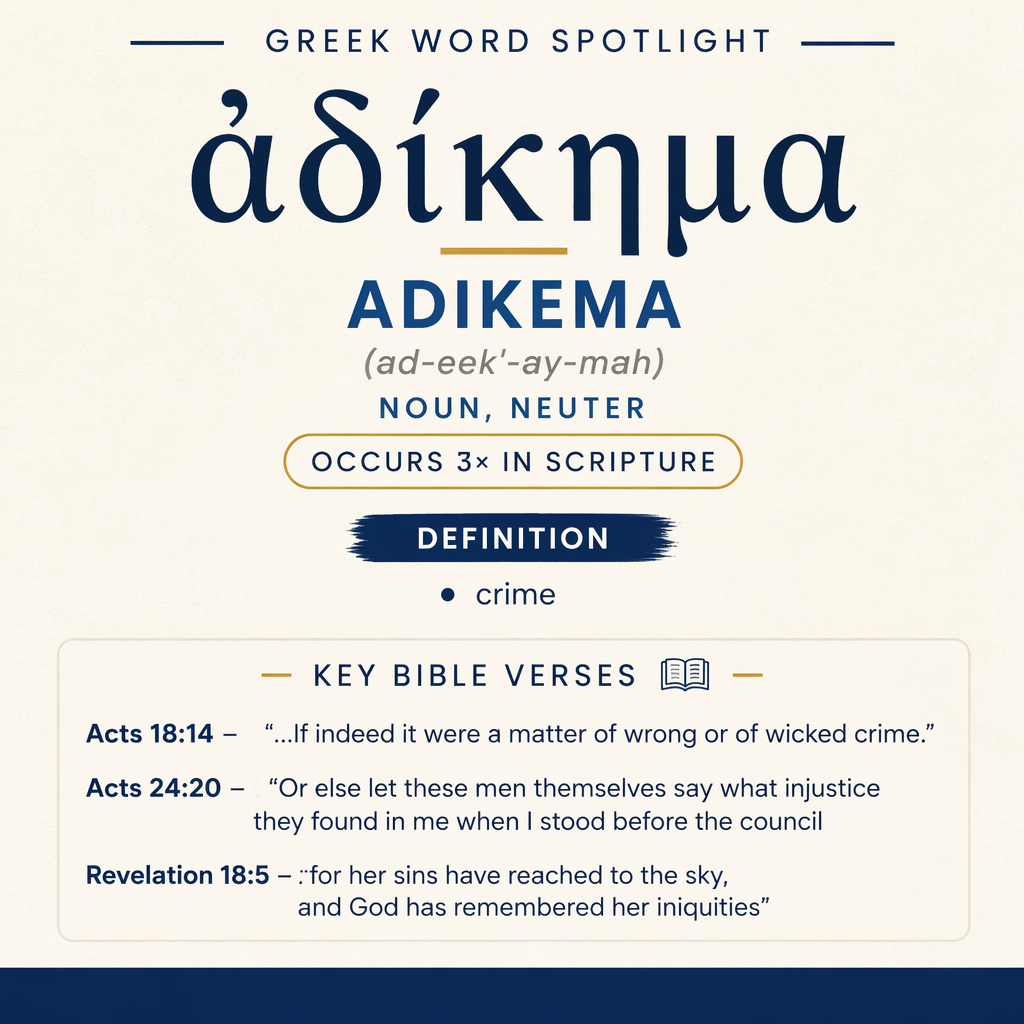
ἀδίκημα means “crime” and appears three times in Scripture: Acts 18:14; Acts 24:20; Revelation 18:5.
New Testament Occurrences
It occurs in Acts 18:14 and Acts 24:20. In both, it is used in legal accusations and defenses.
Learn More →Revelation Usage
It occurs in Revelation 18:5. There it is associated with remembered iniquities alongside sins.
Learn More →ἀδίκημα denotes a crime, appearing in two scenes from Acts and once in Revelation. In each setting it marks wrongdoing viewed in public, judicial, or divine reckoning.
Root and Related Words
ἀδίκημα corresponds to the verb adikeō (ἀδικέω), “to harm” (Strong’s G91).

Occurrences
Acts 18:14 — “But when Paul was about to open his mouth, Gallio said to the Jews, “If indeed it were a matter of wrong or of wicked crime, you Jews, it would be reasonable that I should bear with you;”
Here ἀδίκημα is placed on the lips of Gallio as he frames the kind of charge that would warrant his attention. The statement is conditional—“If indeed it were a matter…”—and ἀδίκημα names the kind of wrongdoing that would make it “reasonable” for him to “bear with” the accusers. In the scene, the term functions as a category in a governor’s judgment: it is the sort of actionable offense that could justify hearing a complaint. The pairing “wrong or of wicked crime” puts ἀδίκημα in a legal setting where the question is whether the dispute rises to the level of something a civil authority should handle.
Acts 24:20 — “Or else let these men themselves say what injustice they found in me when I stood before the council,”
In this defense setting, ἀδίκημα appears in a challenge to produce a concrete accusation. The speaker points away from general suspicion and toward something identifiable: “what injustice they found in me.” The word marks an alleged offense that could be “found” through inquiry and testimony, and it is tied to a specific venue—“when I stood before the council.” The scene presses the question of evidence: if there was a crime, it should be articulable, nameable, and witnessed in the public proceedings of the council. Thus ἀδίκημα serves to narrow the debate from rhetoric to a demonstrable charge.
Revelation 18:5 — “for her sins have reached to the sky, and God has remembered her iniquities.”
In this pronouncement, ἀδίκημα is set alongside “sins” in a statement of accumulation and remembrance. The imagery is vertical and expansive—“have reached to the sky”—conveying an overwhelming pile-up of offenses. The second clause shifts from quantity to accounting: “God has remembered her iniquities.” Within this line, ἀδίκημα belongs to the record of wrongdoing that stands before God’s memory; it is not a disputed allegation but part of what is recalled for judgment. The term therefore contributes to the picture of crimes as countable realities that can mount up and be called to mind.
Sense and Usage
Across these passages, ἀδίκημα works as a word for crime that can be weighed in a forum of judgment. In Acts 18:14 the emphasis falls on jurisdiction and plausibility: a crime would make it “reasonable” for Gallio to entertain the matter, implying that crime is the sort of wrongdoing that fits a magistrate’s remit. In Acts 24:20 the emphasis is investigatory: a crime is something that can be located in a defendant’s conduct—“found in me”—especially in connection with formal proceedings. Revelation 18:5, by contrast, uses the word in a sweeping, corporate indictment: crimes accumulate to an extreme measure (“reached to the sky”) and stand within divine recollection (“God has remembered”).
Because the word is related to adikeō (ἀδικέω), “to harm,” these uses naturally fit contexts where wrongdoing is not merely an inward fault but an act with impact—something that can bring injury, generate a case, or summon judgment. Yet the scenes show that “crime” is not limited to one arena: it may be the charge debated before civil officials (Acts 18), the allegation scrutinized in religious-legal examination (Acts 24), or the catalog of offenses held in divine memory (Revelation 18). In each case ἀδίκημα represents wrongdoing as an accountable item—capable of being alleged, examined, dismissed as outside a court’s concern, or remembered for judgment.
Imagery
Revelation 18:5 supplies the strongest visual: crimes pictured as a towering heap “reached to the sky,” matched by the sobering image of God “remembering” them. In Acts the imagery is courtroom realism rather than height and scale—the word sits in the mouth of officials and defendants as they ask what kind of wrongdoing is truly at issue, and whether any crime can be established in a public hearing.
Sources: Lexical data from Strong’s Exhaustive Concordance and the Translators Brief Lexicon of Extended Strongs for Greek (STEPBible, CC BY). Occurrence data from the Translators Amalgamated Greek New Testament (STEPBible, CC BY). Scripture quotations from the World English Bible (public domain).





