Who was Zia in the bible?
Zia (Ziya’) is an Israelite named in a Gadite genealogy in 1 Chronicles 5:13.

Where Mentioned
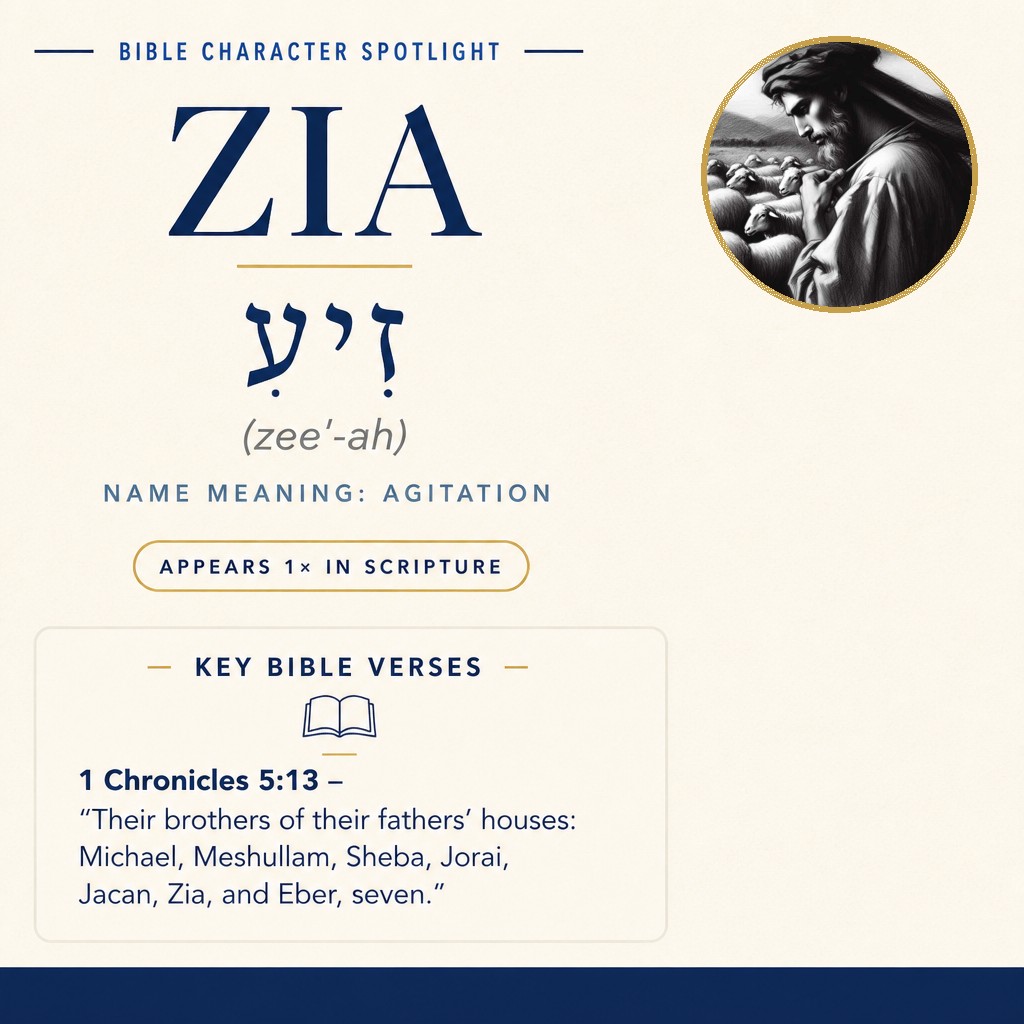
He appears once in Scripture in a list of seven names: “Michael, Meshullam, Sheba, Jorai, Jacan, Zia, and Eber, seven” (1 Chronicles 5:13).
Learn More →Name Meaning
Strong’s gloss derives Zia’s name from a root associated with agitation or shaking off.
Learn More →Zia (Ziyaʾ) is named once in Scripture as an Israelite listed among “brothers of their fathers’ houses” in a genealogy connected with the sons of Gad. The name is associated (by lexicon derivation) with the idea of agitation, from a root sense of shaking off.
Zia in Scripture
Zia appears in a genealogical setting in 1 Chronicles 5, within a section that describes where the sons of Gad lived and then names leading figures and their related households in the region.
“The sons of Gad lived beside them, in the land of Bashan to Salecah:” (1 Chronicles 5:11, WEB)
The chapter’s narrative frame places the sons of Gad in “the land of Bashan,” and then names chiefs and prominent men “in Bashan.”
“Joel the chief, Shapham the second, Janai, and Shaphat in Bashan.” (1 Chronicles 5:12, WEB)
Within that same setting, Zia is included in a group identified as “Their brothers of their fathers’ houses,” and the verse counts the group as seven.
“Their brothers of their fathers’ houses: Michael, Meshullam, Sheba, Jorai, Jacan, Zia, and Eber, seven.” (1 Chronicles 5:13, WEB)
The genealogy then continues by tracing a line of descent, connecting “These” to “the sons of Abihail,” and moving through multiple named ancestors.
“These were the sons of Abihail, the son of Huri, the son of Jaroah, the son of Gilead, the son of Michael, the son of Jeshishai, the son of Jahdo, the son of Buz;” (1 Chronicles 5:14, WEB)
The passage also identifies a chief figure related to this broader genealogical description.
“Ahi the son of Abdiel, the son of Guni, chief of their fathers’ houses.” (1 Chronicles 5:15, WEB)
Finally, the chapter returns to the geographical description of the group’s residence and borders, again using the regions named earlier.
“They lived in Gilead in Bashan, and in its towns, and in all the pasture lands of Sharon, as far as their borders.” (1 Chronicles 5:16, WEB)
In this context, Zia is not singled out with an individual action or title; he is presented as one name within the seven “brothers of their fathers’ houses,” placed among the Gadite settlements and genealogical lines described in the surrounding verses.
Name and Meaning
The name is written in Hebrew as זִיעַ and transliterated Ziyaʾ, pronounced “zee’-ah.” Lexicon derivation links it to a Hebrew root (from H2111) expressing “agitation,” with a component word zuwaʿ (זוּעַ) carrying the basic sense “to shake off” (figuratively extended).
Observation
Zia’s sole biblical mention places him firmly within a counted list—“Zia, and Eber, seven” (1 Chronicles 5:13)—embedded in a larger record that situates these households in “Gilead in Bashan” (1 Chronicles 5:16).
Frequently Asked Questions
What does the name Zia mean?
Zia means “agitation.”
How many times does Zia appear in the Bible?
Zia appears 1 time.
Who was Zia?
Zia is identified as an Israelite.
Where is Zia mentioned?
Zia is mentioned in a list of brothers in 1 Chronicles 5:13.
Explore Further
If you found this page about Zia interesting and would like to discover more about other biblical characters, explore our comprehensive Encyclopedia of Biblical Characters. For those looking to delve deeper into the Greek origins of these names and terms, our Greek Lexicon is an invaluable resource.
Sources: Name and occurrence data from Strong’s Exhaustive Concordance and STEPBible reference data (CC BY). Scripture quotations from the World English Bible (public domain).