
Who was Zerah in the bible?
Zerah is a name shared by multiple figures in Scripture, appearing in genealogies in Genesis 36 and 1 Chronicles, and as “Zerah the Ethiopian” in 2 Chronicles 14:9.

Edomite Zerah
In Esau’s line, “These are the sons of Reuel: Nahath, Zerah, Shammah, and Mizzah” (Genesis 36:13; cf. 1 Chronicles 1:37).
Learn More →Other References
One Zerah is linked to Judah’s family: “Tamar his daughter-in-law bore him Perez and Zerah” (1 Chronicles 2:4), and another is named in conflict: “Zerah the Ethiopian came out against them” (2 Chronicles 14:9).
Learn More →Zerah (זֶרַח, Zerach) is a biblical name associated with several different people in Scripture, including Israelites and also figures connected with Edom and with Ethiopia. The name is derived from a Hebrew term connected with “a rising of light.”
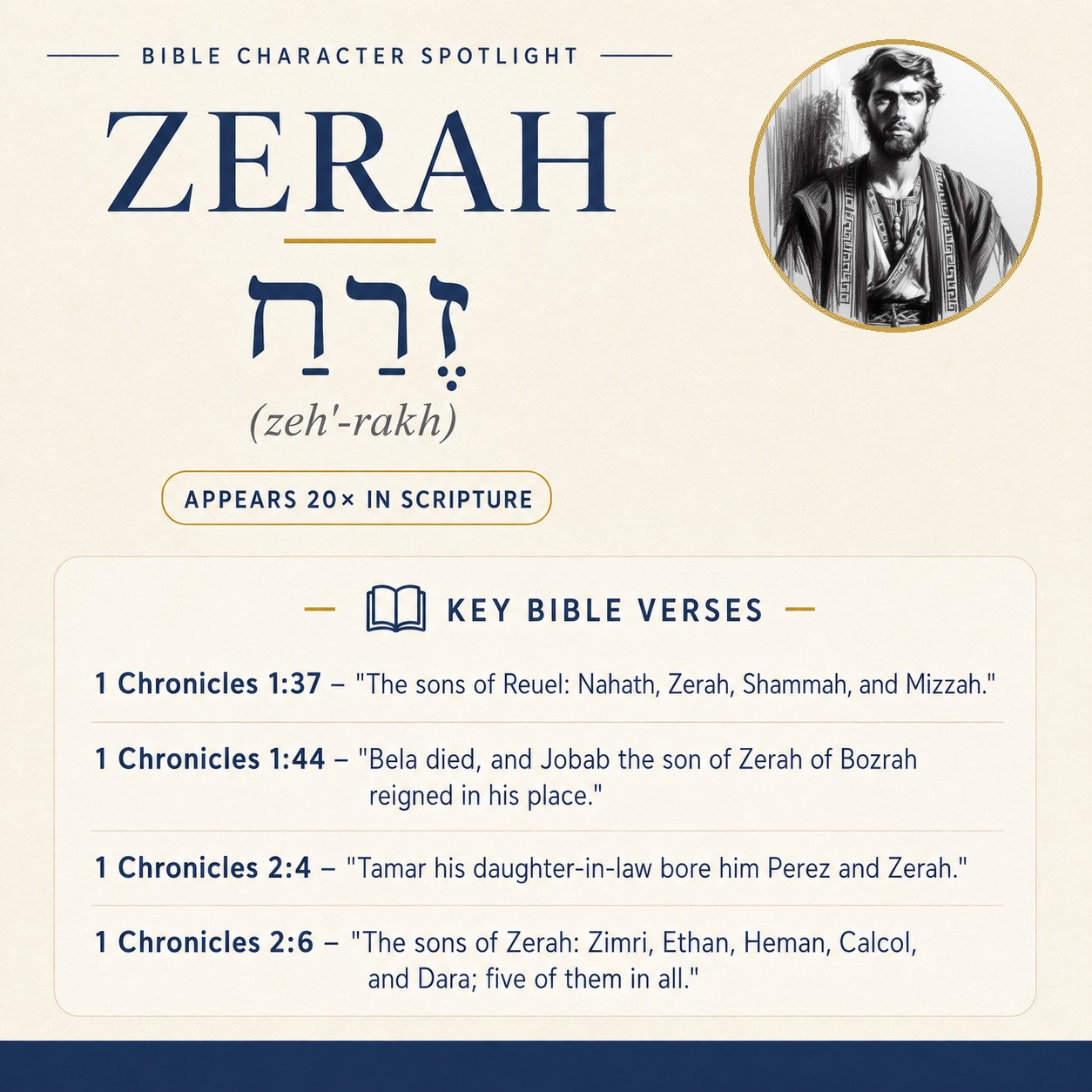
Zerah in Scripture
In Genesis 36, Zerah appears within the genealogy and leadership lists connected to Esau (Edom). The chapter introduces its setting and purpose:
“Now this is the history of the generations of Esau (that is, Edom).” (Genesis 36:1)
Esau’s household is outlined, including the line through Basemath and her son Reuel:
“Adah bore to Esau Eliphaz. Basemath bore Reuel.” (Genesis 36:4)
Within Reuel’s descendants, Zerah is named as one of his sons, and this line is explicitly linked to Basemath:
“These are the sons of Reuel: Nahath, Zerah, Shammah, and Mizzah. These were the descendants of Basemath, Esau’s wife.” (Genesis 36:13)
Later in the chapter, these same sons are also listed as “chiefs” who came from Reuel “in the land of Edom,” placing Zerah among Edomite leaders in that presentation:
“These are the sons of Reuel, Esau’s son: chief Nahath, chief Zerah, chief Shammah, chief Mizzah. These are the chiefs who came of Reuel in the land of Edom. These are the sons of Basemath, Esau’s wife.” (Genesis 36:17)
Genesis 36 then moves from chiefs to a sequence of kings who “reigned in the land of Edom,” and within that list a separate Zerah is mentioned as the father of a king named Jobab:
“These are the kings who reigned in the land of Edom, before any king reigned over the children of Israel.” (Genesis 36:31)
“Bela died, and Jobab, the son of Zerah of Bozrah, reigned in his place.” (Genesis 36:33)
First Chronicles preserves parallel and additional genealogical notices that include Zerah in different tribal and family settings. In the Chronicler’s list corresponding to Esau’s line, Zerah again appears as a son of Reuel:
“The sons of Reuel: Nahath, Zerah, Shammah, and Mizzah.” (1 Chronicles 1:37)
And the same succession notice about Jobab appears in Chronicles as well:
“Bela died, and Jobab the son of Zerah of Bozrah reigned in his place.” (1 Chronicles 1:44)
Within Judah’s line, a Zerah is named as one of two sons born to Tamar:
“Tamar his daughter-in-law bore him Perez and Zerah. All the sons of Judah were five.” (1 Chronicles 2:4)
That Zerah is then shown as the ancestor of a small family list of five:
“The sons of Zerah: Zimri, Ethan, Heman, Calcol, and Dara; five of them in all.” (1 Chronicles 2:6)
In the tribe of Simeon, Zerah appears again in a straightforward list of sons:
“The sons of Simeon: Nemuel, Jamin, Jarib, Zerah, Shaul;” (1 Chronicles 4:24)
The name also appears in a genealogical line connected to Levitical descent as recorded in Chronicles:
“Joah his son, Iddo his son, Zerah his son, and Jeatherai his son.” (1 Chronicles 6:21)
“the son of Ethni, the son of Zerah, the son of Adaiah,” (1 Chronicles 6:41)
In a later community listing, “sons of Zerah” are counted among a group with named leaders and a total:
“Of the sons of Zerah: Jeuel and their brothers, six hundred ninety.” (1 Chronicles 9:6)
Finally, in 2 Chronicles, Zerah is named as an Ethiopian military leader who advanced against Asa with an immense force and approached Mareshah:
“Zerah the Ethiopian came out against them with an army of a million troops and three hundred chariots, and he came to Mareshah.” (2 Chronicles 14:9)
Multiple bearers of the name
The biblical name Zerah is borne by multiple individuals in these passages, and the references distinguish them by lineage, tribal setting, or description.
Zerah in Esau’s (Edom’s) line. Genesis places a Zerah among “the sons of Reuel,” within “the history of the generations of Esau (that is, Edom)” (Genesis 36:1). The text identifies him in the list: “Nahath, Zerah, Shammah, and Mizzah” (Genesis 36:13), and later calls him “chief Zerah” among the “chiefs who came of Reuel in the land of Edom” (Genesis 36:17). A Zerah is also associated with Bozrah as the father of Jobab, who became king after Bela: “Jobab, the son of Zerah of Bozrah, reigned in his place” (Genesis 36:33; cf. 1 Chronicles 1:44). The passages do not explicitly state whether the Zerah who is Reuel’s son is the same Zerah connected with Bozrah, and so the identification remains limited to what is written.
Zerah in Judah’s line. In 1 Chronicles 2, Zerah is named in connection with Tamar’s children: “Tamar his daughter-in-law bore him Perez and Zerah” (1 Chronicles 2:4). This Zerah is then presented as the ancestor of five sons: “Zimri, Ethan, Heman, Calcol, and Dara” (1 Chronicles 2:6).
Zerah in Simeon’s list. Another Zerah appears among “The sons of Simeon,” listed alongside other names: “Nemuel, Jamin, Jarib, Zerah, Shaul” (1 Chronicles 4:24). No further detail is given in the provided verses.
Zerah in a Levitical genealogy. In 1 Chronicles 6, Zerah appears within a line of descent: “Joah his son, Iddo his son, Zerah his son, and Jeatherai his son” (1 Chronicles 6:21). Elsewhere in the same chapter another notice includes Zerah as an ancestor: “the son of Ethni, the son of Zerah, the son of Adaiah” (1 Chronicles 6:41). The verses present Zerah as a link in a genealogical chain without additional narrative.
Zerah as an ancestral group name in a census-like notice. 1 Chronicles 9 counts “sons of Zerah,” naming Jeuel and giving a total: “Of the sons of Zerah: Jeuel and their brothers, six hundred ninety” (1 Chronicles 9:6). The text does not connect this statement, in the provided material, to the Judahite Zerah or any other specific Zerah, beyond the shared name.
Zerah the Ethiopian. 2 Chronicles describes a Zerah identified by origin or title: “Zerah the Ethiopian,” who “came out against them with an army of a million troops and three hundred chariots, and he came to Mareshah” (2 Chronicles 14:9). In the provided citation, his role is that of a military opponent advancing with a very large force.
Name and Meaning
The name is written in Hebrew as זֶרַח, transliterated Zerach and pronounced zeh’-rakh. Its derivation is given as the same as H2225, with a component zerach (זֶרַח) meaning “a rising of light.”
Observation
Across genealogies and narratives, the name Zerah is applied to people in notably different settings—Edomite lists (Genesis 36:13, 17), Judahite descent (1 Chronicles 2:4, 6), other tribal and Levitical genealogies (1 Chronicles 4:24; 6:21, 41; 9:6), and a military figure described as “the Ethiopian” (2 Chronicles 14:9).
Frequently Asked Questions
What does the name Zerah mean?
Zerah is used as the name of three Israelites, and also of an Idumaean and an Ethiopian prince.
How many times does Zerah appear in the Bible?
Zerah occurs 20 times.
Who was Zerah in the Bible?
Zerah is the name of multiple individuals: three Israelites, an Idumaean, and an Ethiopian prince. The name appears for example in genealogies and royal listings such as Genesis 36:33 and 1 Chronicles 2:4.
What did Zerah the Ethiopian do in 2 Chronicles?
Zerah the Ethiopian came out against Asa with an army of a million troops and three hundred chariots, and came to Mareshah (2 Chronicles 14:9).
Explore Further
If you found this page about Zerah interesting and would like to discover more about other biblical characters, explore our comprehensive Encyclopedia of Biblical Characters. For those looking to delve deeper into the Greek origins of these names and terms, our Greek Lexicon is an invaluable resource.
Sources: Name and occurrence data from Strong’s Exhaustive Concordance and STEPBible reference data (CC BY). Scripture quotations from the World English Bible (public domain).





