
Who was Zalmon in the bible?
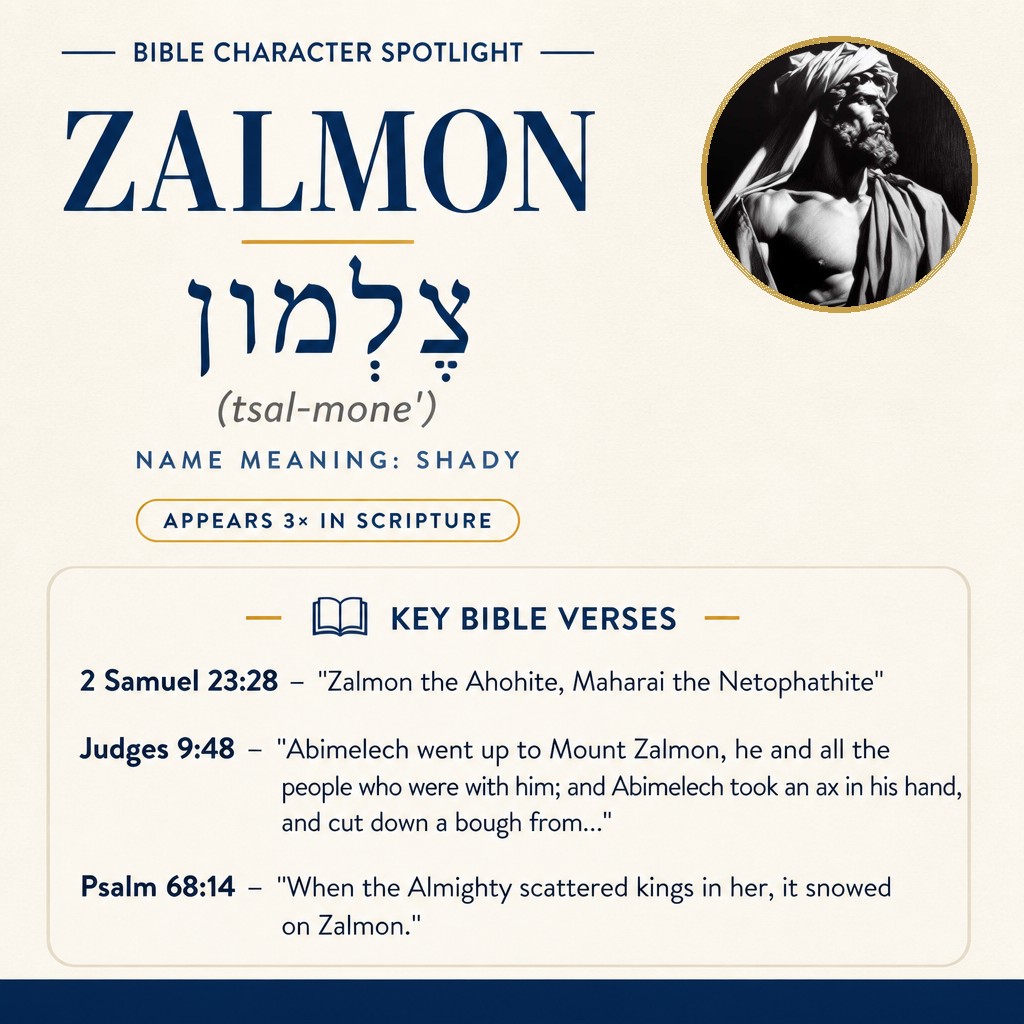
Zalmon is the name of an Ahohite listed in 2 Samuel 23:28 and also a place-name appearing in Judges 9:48 and Psalm 68:14.

Zalmon as Place
“Abimelech went up to Mount Zalmon” during the events at the tower of Shechem (Judges 9:48).
Learn More →Poetic Mention
In Psalm 68, a victory scene includes the line, “it snowed on Zalmon” (Psalm 68:14).
Learn More →Zalmon (Tsalmon) is a biblical name that refers to both a place in Palestine and an Israelite. In Scripture, the name appears as Mount Zalmon in a narrative about Abimelech, as “Zalmon the Ahohite” in a list of men, and as “Zalmon” in a poetic line about snow.
Zalmon in Scripture
The name first appears in Judges in connection with a specific mountain. In the surrounding narrative, “all the men of the tower of Shechem” gather in “the stronghold of the house of Elberith” (Judges 9:46–47). Then the account moves to Mount Zalmon:
“Abimelech went up to Mount Zalmon, he and all the people who were with him; and Abimelech took an ax in his hand, and cut down a bough from the trees, and took it up, and laid it on his shoulder. Then he said to the people who were with him, ‘What you have seen me do, make haste, and do as I have done.’” (Judges 9:48)
The narrative continues immediately by describing the people imitating Abimelech’s action, using the cut branches against the stronghold:
“All the people likewise each cut down his bough, followed Abimelech, and put them at the base of the stronghold, and set the stronghold on fire over them, so that all the people of the tower of Shechem died also, about a thousand men and women.” (Judges 9:49)
In this account, Mount Zalmon functions as the wooded location where Abimelech and his followers obtain boughs, which they then use to burn the stronghold where the tower’s people have taken refuge. After this event, the narrative notes that Abimelech continues on to another target: “Then Abimelech went to Thebez and encamped against Thebez, and took it” (Judges 9:50), with the surrounding verses describing the presence of “a strong tower within the city” where the city’s people flee (Judges 9:51).
The next appearance of the name is in a list in 2 Samuel. Zalmon is identified as an individual among others named in sequence:
“Zalmon the Ahohite, Maharai the Netophathite,” (2 Samuel 23:28)
The immediate surrounding context shows this line is part of a broader list of names with descriptive identifiers attached to several of them:
“Helez the Paltite, Ira the son of Ikkesh the Tekoite,” (2 Samuel 23:26)
“Abiezer the Anathothite, Mebunnai the Hushathite,” (2 Samuel 23:27)
“Zalmon the Ahohite, Maharai the Netophathite,” (2 Samuel 23:28)
“Heleb the son of Baanah the Netophathite, Ittai the son of Ribai of Gibeah of the children of Benjamin,” (2 Samuel 23:29)
“Benaiah a Pirathonite, Hiddai of the brooks of Gaash.” (2 Samuel 23:30)
“Abialbon the Arbathite, Azmaveth the Barhumite,” (2 Samuel 23:31)
Within these verses, the only direct information supplied about this individual is the designation “Zalmon the Ahohite” (2 Samuel 23:28), set alongside other persons named with family connections (“Ira the son of Ikkesh,” “Heleb the son of Baanah,” “Ittai the son of Ribai”) and place or group identifiers (for example, “of Gibeah of the children of Benjamin”) (2 Samuel 23:26–31).
The third appearance is in Psalm 68, where “Zalmon” is mentioned in poetic language amid lines describing kings and military flight. The immediate context says:
“‘Kings of armies flee! They flee!’ She who waits at home divides the plunder,” (Psalm 68:12)
“while you sleep among the camp fires, the wings of a dove sheathed with silver, her feathers with shining gold.” (Psalm 68:13)
“When the Almighty scattered kings in her, it snowed on Zalmon.” (Psalm 68:14)
This reference presents “Zalmon” as the place associated with the line “it snowed on Zalmon” (Psalm 68:14). The psalm continues immediately with language about mountains—“The mountains of Bashan are majestic mountains. The mountains of Bashan are rugged” (Psalm 68:15)—and then speaks of “the mountain where God chooses to reign” and of Yahweh dwelling there (Psalm 68:16). Within the provided verses, Zalmon is not further described beyond the mention of snow connected with the scattering of kings (Psalm 68:14).
Multiple bearers of the name
The name “Zalmon” refers to more than one referent in the provided passages. First, it is a geographical name: “Mount Zalmon” is the setting where Abimelech cuts down a bough and directs his people to do the same (Judges 9:48–49), and “Zalmon” is the place named in the psalmic line, “it snowed on Zalmon” (Psalm 68:14). Second, it is a personal name: “Zalmon the Ahohite” appears as an Israelite named in a list (2 Samuel 23:28).
Name and Meaning
The Hebrew form is צַלְמוֹן, transliterated Tsalmown and pronounced tsal-mone’. The name is derived from a Hebrew root associated with being “shady,” and it is linked by derivation to a component term tselem (צֶלֶם), glossed as “a phantom,” used figuratively for “illusion.” In the biblical passages cited, the name is borne by both a place (including Mount Zalmon) and an Israelite called “Zalmon the Ahohite” (Judges 9:48; 2 Samuel 23:28; Psalm 68:14).
Brief observation
Across the passages, Zalmon is tied to concrete imagery: in narrative, Mount Zalmon supplies the “bough from the trees” carried on Abimelech’s shoulder (Judges 9:48), and in poetry, it is remembered with the striking line, “it snowed on Zalmon” (Psalm 68:14).
Frequently Asked Questions
What does the name Zalmon mean?
Zalmon means “shady.”
How many times does Zalmon appear in the Bible?
Zalmon appears 3 times.
Who was Zalmon in the Bible?
Zalmon is used as the name of a place in Palestine and also of an Israelite. One reference mentions “Zalmon the Ahohite” (2 Samuel 23:28).
What happened at Mount Zalmon?
Abimelech went up to Mount Zalmon with the people who were with him and cut down a bough from the trees (Judges 9:48).
Explore Further
If you found this page about Zalmon interesting and would like to discover more about other biblical characters, explore our comprehensive Encyclopedia of Biblical Characters. For those looking to delve deeper into the Greek origins of these names and terms, our Greek Lexicon is an invaluable resource.
Sources: Name and occurrence data from Strong’s Exhaustive Concordance and STEPBible reference data (CC BY). Scripture quotations from the World English Bible (public domain).





