
Who was Uzziah in the bible?
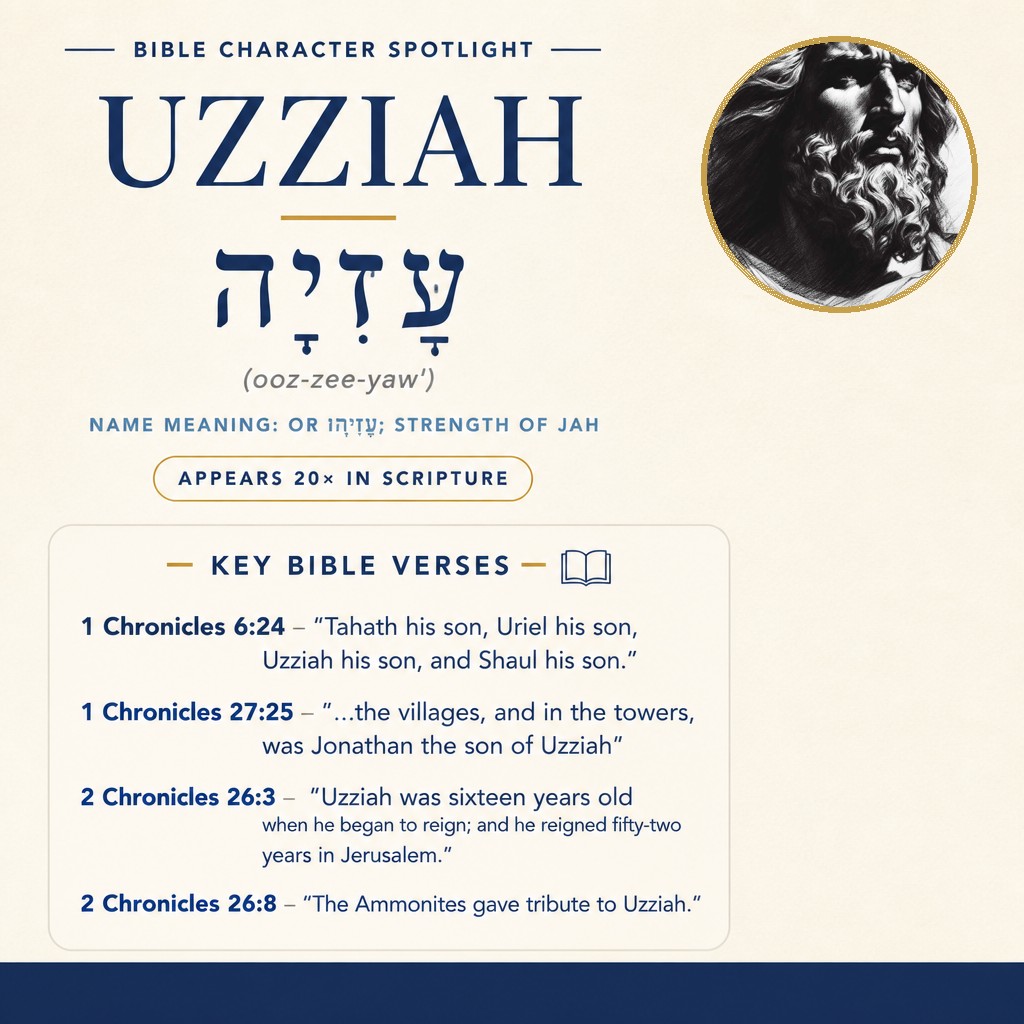
Uzziah is a biblical name borne by multiple Israelites, including a king of Judah described in 2 Chronicles 26 and individuals mentioned in 1 Chronicles 6:24 and 1 Chronicles 27:25.

King of Judah
“All the people of Judah took Uzziah, who was sixteen years old, and made him king” (2 Chronicles 26:1). “He reigned fifty-two years in Jerusalem” (2 Chronicles 26:3).
Learn More →Other Bearers
In a genealogy: “Tahath his son, Uriel his son, Uzziah his son” (1 Chronicles 6:24). In an administrative note: “Jonathan the son of Uzziah” (1 Chronicles 27:25).
Learn More →Uzziah (a name meaning “strength of Jah”) is the name of five Israelites in Scripture; one prominent bearer is Uzziah king of Judah, whose reign and downfall are narrated in 2 Chronicles 26.
Uzziah in Scripture
One Uzziah appears in a genealogical line in Chronicles:
“Tahath his son, Uriel his son, Uzziah his son, and Shaul his son.” (1 Chronicles 6:24, WEB)
Another Uzziah is named as the father of Jonathan, who had oversight of certain royal storehouses:
“Over the king’s treasures was Azmaveth the son of Adiel: and over the treasures in the fields, in the cities, and in the villages, and in the towers, was Jonathan the son of Uzziah;” (1 Chronicles 27:25, WEB)
The most detailed account concerns Uzziah king of Judah. He became king by the action of the people, and his reign is described with length and specificity.
“All the people of Judah took Uzziah, who was sixteen years old, and made him king in the place of his father Amaziah.” (2 Chronicles 26:1, WEB)
“Uzziah was sixteen years old when he began to reign; and he reigned fifty-two years in Jerusalem. His mother’s name was Jechiliah, of Jerusalem.” (2 Chronicles 26:3, WEB)
Uzziah is initially characterized by faithful conduct and purposeful devotion, and his prosperity is explicitly linked to seeking Yahweh.
“He did that which was right in Yahweh’s eyes, according to all that his father Amaziah had done.” (2 Chronicles 26:4, WEB)
“He set himself to seek God in the days of Zechariah, who had understanding in the vision of God; and as long as he sought Yahweh, God made him prosper.” (2 Chronicles 26:5, WEB)
His reign includes military campaigns and territorial actions against neighboring peoples, described as successful with divine help. He fought Philistines and took down walls, established cities, and received aid against other groups.
“He went out and fought against the Philistines, and broke down the wall of Gath, the wall of Jabneh, and the wall of Ashdod; and he built cities in the country of Ashdod, and among the Philistines.” (2 Chronicles 26:6, WEB)
“God helped him against the Philistines, and against the Arabians who lived in Gur Baal, and the Meunim.” (2 Chronicles 26:7, WEB)
Uzziah’s growing strength becomes widely known, and tribute is paid to him:
“The Ammonites gave tribute to Uzziah. His name spread abroad even to the entrance of Egypt; for he grew exceedingly strong.” (2 Chronicles 26:8, WEB)
His building projects and fortifications receive substantial attention. In Jerusalem, he builds and strengthens towers and walls, and beyond the city he develops infrastructure tied to agriculture and livestock.
“Moreover Uzziah built towers in Jerusalem at the corner gate, at the valley gate, and at the turning of the wall, and fortified them.” (2 Chronicles 26:9, WEB)
“He built towers in the wilderness, and dug out many cisterns, for he had much livestock; in the lowland also, and in the plain. He had farmers and vineyard keepers in the mountains and in the fruitful fields, for he loved farming.” (2 Chronicles 26:10, WEB)
Chronicles also emphasizes the organization, scale, and equipment of his army. The record names officials involved in military administration, gives the number of leading family heads, and states the size of the fighting force.
“Moreover Uzziah had an army of fighting men, who went out to war by bands, according to the number of their reckoning made by Jeiel the scribe and Maaseiah the officer, under the hand of Hananiah, one of the king’s captains.” (2 Chronicles 26:11, WEB)
“The whole number of the heads of fathers’ households, even the mighty men of valor, was two thousand six hundred.” (2 Chronicles 26:12, WEB)
“Under their hand was an army, three hundred seven thousand five hundred, who made war with mighty power, to help the king against the enemy.” (2 Chronicles 26:13, WEB)
“Uzziah prepared for them, even for all the army, shields, spears, helmets, coats of mail, bows, and stones for slinging.” (2 Chronicles 26:14, WEB)
His ingenuity in Jerusalem’s defenses is highlighted, along with the spread of his reputation and the stated reason for it.
“In Jerusalem, he made devices, invented by skillful men, to be on the towers and on the battlements, with which to shoot arrows and great stones. His name spread far abroad, because he was marvelously helped until he was strong.” (2 Chronicles 26:15, WEB)
The narrative then turns sharply. After becoming strong, Uzziah’s inner posture changes, and this leads to an act defined as trespass against Yahweh. The text states both the cause (“his heart was lifted up”) and the specific deed (entering the temple to burn incense).
“But when he was strong, his heart was lifted up, so that he did corruptly, and he trespassed against Yahweh his God; for he went into Yahweh’s temple to burn incense on the altar of incense.” (2 Chronicles 26:16, WEB)
Priestly opposition is immediate, led by Azariah and accompanied by eighty priests. Their words to the king frame the matter as unauthorized worship service reserved for consecrated priests, and they warn him about the outcome.
“Azariah the priest went in after him, and with him eighty priests of Yahweh, who were valiant men.” (2 Chronicles 26:17, WEB)
“They resisted Uzziah the king, and said to him, “It isn’t for you, Uzziah, to burn incense to Yahweh, but for the priests the sons of Aaron, who are consecrated to burn incense. Go out of the sanctuary, for you have trespassed. It will not be for your honor from Yahweh God.”” (2 Chronicles 26:18, WEB)
Uzziah reacts with anger while holding the censer, and in that moment he is afflicted. The account locates the event “in Yahweh’s house” and specifies where the leprosy appears.
“Then Uzziah was angry. He had a censer in his hand to burn incense, and while he was angry with the priests, the leprosy broke out on his forehead before the priests in Yahweh’s house, beside the altar of incense.” (2 Chronicles 26:19, WEB)
The priests see the leprosy, remove him quickly, and Uzziah himself hurries out. The reason given is direct: “Yahweh had struck him.”
“Azariah the chief priest, and all the priests, looked at him, and behold, he was leprous in his forehead, and they thrust him out quickly from there. Yes, he himself also hurried to go out, because Yahweh had struck him.” (2 Chronicles 26:20, WEB)
The consequence lasts for the remainder of his life. Uzziah lives isolated, “cut off from Yahweh’s house,” while administration of the king’s house and judgment of the people is handled by his son Jotham.
“Uzziah the king was a leper to the day of his death, and lived in a separate house, being a leper; for he was cut off from Yahweh’s house. Jotham his son was over the king’s house, judging the people of the land.” (2 Chronicles 26:21, WEB)
The record also states that Isaiah the prophet wrote the rest of Uzziah’s acts “first and last,” and it reports Uzziah’s burial and the public explanation attached to it.
“Now the rest of the acts of Uzziah, first and last, Isaiah the prophet, the son of Amoz, wrote.” (2 Chronicles 26:22, WEB)
“So Uzziah slept with his fathers; and they buried him with his fathers in the field of burial which belonged to the kings, for they said, “He is a leper.” Jotham his son reigned in his place.” (2 Chronicles 26:23, WEB)
Multiple bearers
Scripture uses the name Uzziah for more than one person. One Uzziah is listed within a genealogical sequence: “Tahath his son, Uriel his son, Uzziah his son, and Shaul his son” (1 Chronicles 6:24, WEB). Another Uzziah is identified as the father of Jonathan, an administrator “over the treasures in the fields, in the cities, and in the villages, and in the towers” (1 Chronicles 27:25, WEB). A further bearer is Uzziah king of Judah, who “reigned fifty-two years in Jerusalem” and whose reign is narrated in 2 Chronicles 26 (2 Chronicles 26:3, WEB).
Name and Meaning
In Hebrew script the name is עֻזִּיָּה (transliterated ‘Uzziyah, pronounced ooz-zee-yaw). Its sense is given as “strength of Jah,” derived from elements meaning “strength” (from ‘oz, עֹז) and “Jah” (Yahh, יָהּ), the sacred name.
Observation
The account of the king holds together both remarkable prosperity—“God made him prosper” (2 Chronicles 26:5, WEB) and “he was marvelously helped until he was strong” (2 Chronicles 26:15, WEB)—and a severe turning point when “his heart was lifted up” and he “trespassed against Yahweh his God” (2 Chronicles 26:16, WEB).
Frequently Asked Questions
What does the name Uzziah mean?
Uzziah means “strength of Jah.”
How many times does Uzziah appear in the Bible?
Uzziah appears 20 time(s).
Who was Uzziah?
Uzziah (Uzzijah) is the name of five Israelites. One Uzziah was a king who began to reign at sixteen years old and reigned fifty-two years in Jerusalem (2 Chronicles 26:3).
What happened to Uzziah when he tried to burn incense?
Priests resisted him, saying it was not for him to burn incense to Yahweh (2 Chronicles 26:18). While he was angry with the priests, leprosy broke out on his forehead (2 Chronicles 26:19), and he was a leper to the day of his death (2 Chronicles 26:21).
Explore Further
If you found this page about Uzziah interesting and would like to discover more about other biblical characters, explore our comprehensive Encyclopedia of Biblical Characters. For those looking to delve deeper into the Greek origins of these names and terms, our Greek Lexicon is an invaluable resource.
Sources: Name and occurrence data from Strong’s Exhaustive Concordance and STEPBible reference data (CC BY). Scripture quotations from the World English Bible (public domain).





