Who was Shomer in the bible?
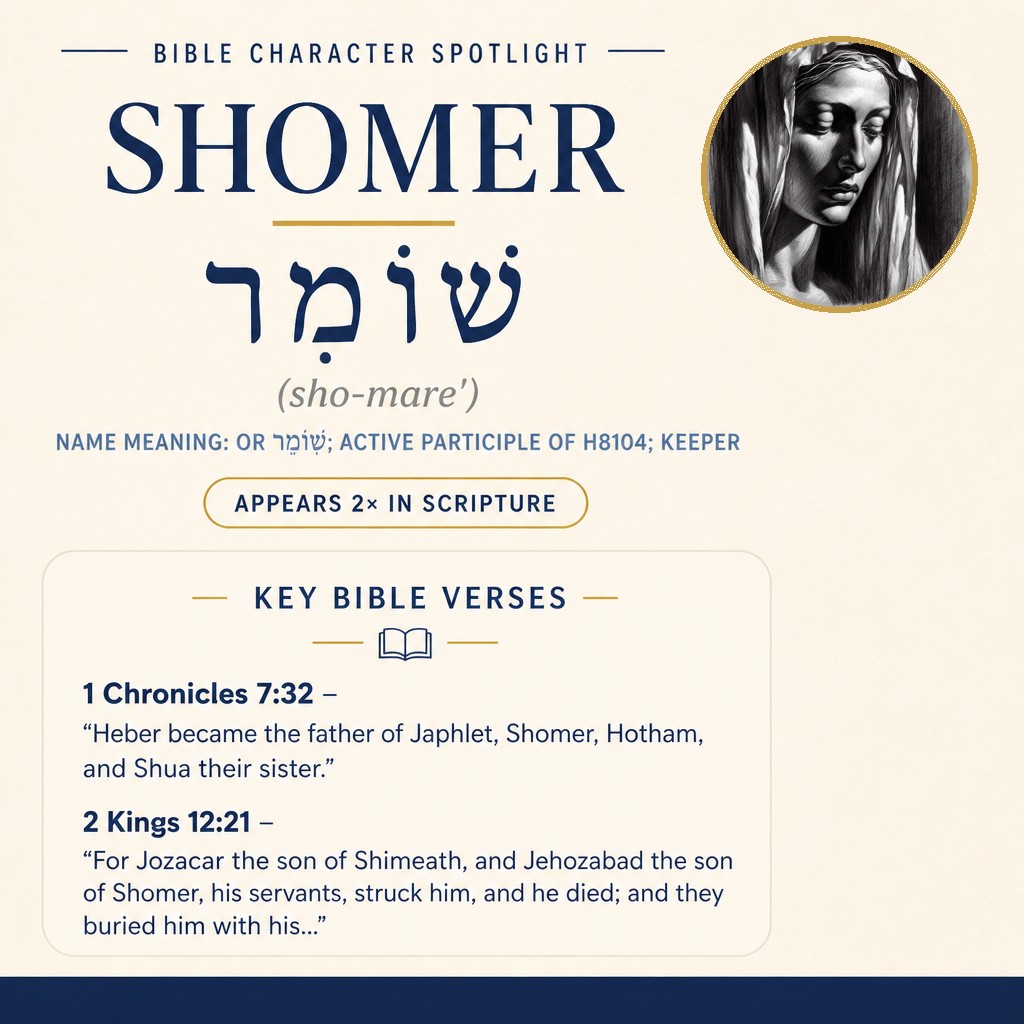
Shomer is the name of two Israelites mentioned in 1 Chronicles 7:32 and 2 Kings 12:21.

Father Named
In Judah’s royal narrative, “Jehozabad the son of Shomer” is named among Joash’s servants (2 Kings 12:21).
Learn More →Name Meaning
Strong’s gloss identifies Shomer as a Hebrew name meaning “keeper,” from a root meaning to hedge about (Strong’s H7763).
Learn More →Shomer is the name of two Israelites in the Bible. The name is explained in lexicon tradition as meaning a “keeper,” derived from a Hebrew verb associated with hedging about (as with thorns).
Shomer in Scripture
The first bearer of the name appears in a genealogical context within the line of Asher. The setting begins by identifying Asher’s sons and then narrows to Beriah’s descendants:
“The sons of Asher: Imnah, Ishvah, Ishvi, and Beriah. Serah was their sister.” (1 Chronicles 7:30, WEB)
“The sons of Beriah: Heber and Malchiel, who was the father of Birzaith.” (1 Chronicles 7:31, WEB)
Within that line, Shomer is listed as a son of Heber, alongside brothers and a sister:
“Heber became the father of Japhlet, Shomer, Hotham, and Shua their sister.” (1 Chronicles 7:32, WEB)
The genealogy continues by giving descendants of Japhlet:
“The sons of Japhlet: Pasach, Bimhal, and Ashvath. These are the children of Japhlet.” (1 Chronicles 7:33, WEB)
It also records a similarly spelled name, “Shemer,” with sons listed; in this context, the text reads:
“The sons of Shemer: Ahi, Rohgah, Jehubbah, and Aram.” (1 Chronicles 7:34, WEB)
And the passage continues with another family branch:
“The sons of Helem his brother: Zophah, Imna, Shelesh, and Amal.” (1 Chronicles 7:35, WEB)
In these verses, Shomer is identified only by his placement in the family record: he is named as one of Heber’s children in the genealogies associated with Asher.
The second bearer of the name appears in the narrative of the death of Joash (also called “Joash” in the cited passage). The text frames the scene by pointing to other records for a fuller account of the king’s deeds:
“Now the rest of the acts of Joash, and all that he did, aren’t they written in the book of the chronicles of the kings of Judah?” (2 Kings 12:19, WEB)
Then it reports a conspiracy by the king’s servants and an attack on him:
“His servants arose, and made a conspiracy, and struck Joash at the house of Millo, on the way that goes down to Silla.” (2 Kings 12:20, WEB)
Shomer is mentioned as the father of one of the conspirators, with the verse also naming another assailant and describing the outcome:
“For Jozacar the son of Shimeath, and Jehozabad the son of Shomer, his servants, struck him, and he died; and they buried him with his fathers in David’s city; and Amaziah his son reigned in his place.” (2 Kings 12:21, WEB)
In this episode, Shomer is not described directly as acting; rather, he is identified through his son Jehozabad, who is included among the servants who struck Joash.
Multiple bearers
Scripture presents two distinct individuals named Shomer.
(1) Shomer in the Asher genealogies. He is listed as one of Heber’s children: “Heber became the father of Japhlet, Shomer, Hotham, and Shua their sister” (1 Chronicles 7:32). The surrounding verses place this in the broader family record beginning with “The sons of Asher” (1 Chronicles 7:30) and continuing through Beriah and Heber (1 Chronicles 7:31–32).
(2) Shomer, father of Jehozabad. In the account of Joash’s death, Jehozabad is identified as “the son of Shomer,” and Jehozabad is named among the servants who struck the king: “Jehozabad the son of Shomer, his servants, struck him, and he died” (2 Kings 12:21). This Shomer is known in the text only by that paternal identification.
Name and Meaning
The name is written in Hebrew as שׁוֹמֵר and transliterated Showmer, pronounced sho-mare’. Lexicon tradition explains it as an active participle linked to a verb meaning “to hedge about (as with thorns),” yielding the sense of a “keeper,” with the component verb given as shamar (שָׁמַר).
Observation
The two biblical mentions of Shomer are brief but concrete: one Shomer is preserved in a genealogy as a son of Heber (1 Chronicles 7:32), and another is preserved in royal narrative as the father of Jehozabad, one of the servants involved in the killing of Joash (2 Kings 12:21).
Frequently Asked Questions
What does the name Shomer mean?
Shomer means “keeper.”
How many times does Shomer appear in the Bible?
Shomer appears 2 times.
Who was Shomer in the Bible?
Shomer is the name of two Israelites. One is listed as a son of Heber (1 Chronicles 7:32), and another is named as the father of Jehozabad (2 Kings 12:21).
Where is Shomer mentioned in a family list?
In 1 Chronicles 7:32, Heber became the father of Japhlet, Shomer, Hotham, and Shua their sister.
Explore Further
If you found this page about Shomer interesting and would like to discover more about other biblical characters, explore our comprehensive Encyclopedia of Biblical Characters. For those looking to delve deeper into the Greek origins of these names and terms, our Greek Lexicon is an invaluable resource.
Sources: Name and occurrence data from Strong’s Exhaustive Concordance and STEPBible reference data (CC BY). Scripture quotations from the World English Bible (public domain).