
Who was Amaziah in the bible
Amaziah was a king of Judah whose reign is narrated in 2 Chronicles 25 and mentioned in genealogical lists in 1 Chronicles.

His Reign
“He did that which was right in Yahweh’s eyes, but not with a perfect heart” (2 Chronicles 25:2). After victory, “he brought the gods of the children of Seir… and bowed down himself before them” (2 Chronicles 25:14).
Learn More →Name and Lists
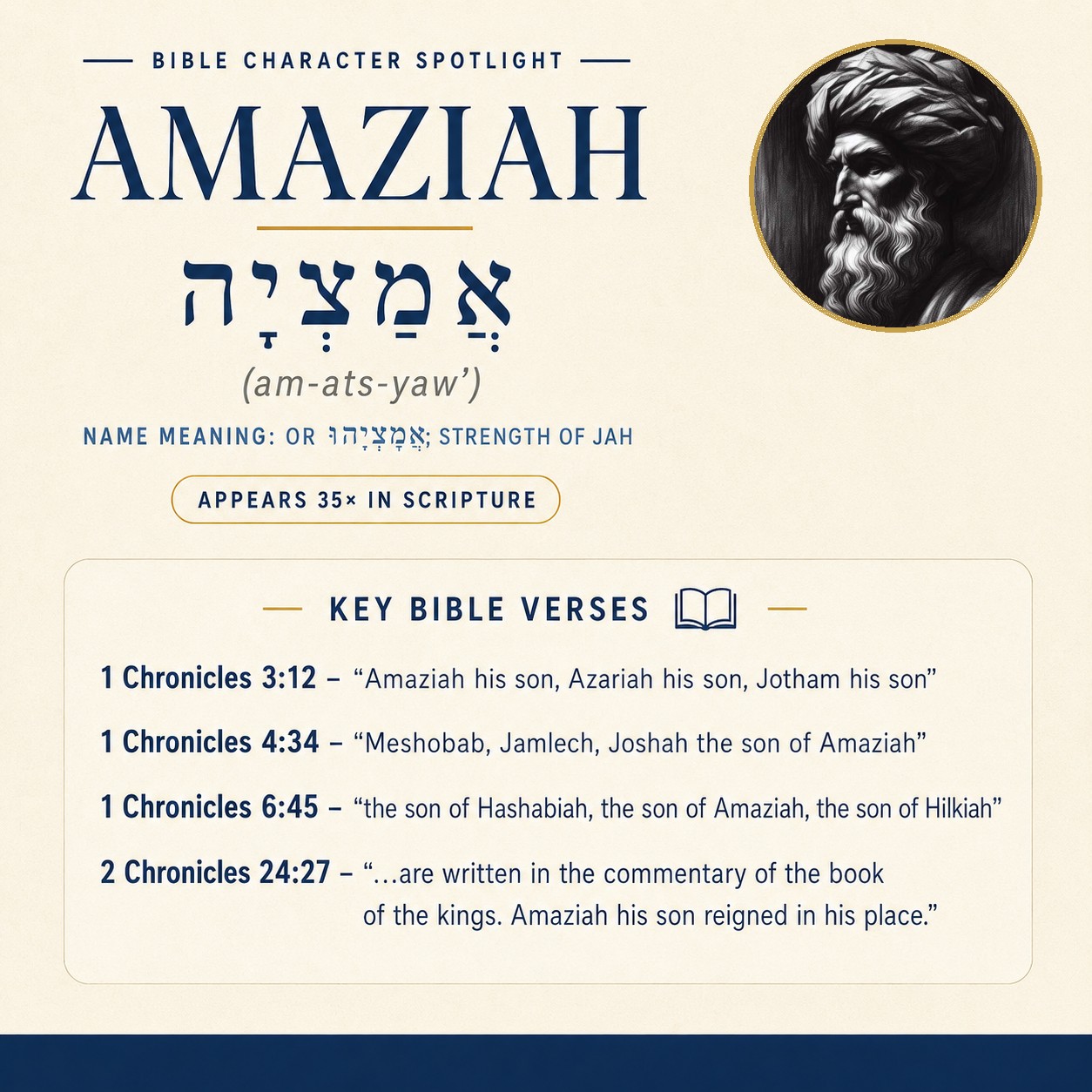
The name Amaziah (’Amatsyah) is derived as “strength of Jah” (Strong’s H558). It appears in genealogical contexts such as “Amaziah his son, Azariah his son” (1 Chronicles 3:12) and “Joshah the son of Amaziah” (1 Chronicles 4:34).
Learn More →Amaziah (Amatsjah) is a Hebrew name meaning “strength of Jah,” and it is borne by multiple Israelites in Scripture. The most fully described Amaziah is “Amaziah king of Judah,” whose reign and actions are narrated in 2 Chronicles 25.
Amaziah in Scripture
One brief genealogical mention places an Amaziah in a royal line:
“Amaziah his son, Azariah his son, Jotham his son,” (1 Chronicles 3:12)
Two additional occurrences identify other men named Amaziah as ancestors in genealogies:
“Meshobab, Jamlech, Joshah the son of Amaziah,” (1 Chronicles 4:34)
“the son of Hashabiah, the son of Amaziah, the son of Hilkiah,” (1 Chronicles 6:45)
The main narrative concerns Amaziah as king in Judah. The transition to his reign is stated as follows:
“Amaziah his son reigned in his place.” (2 Chronicles 24:27)
2 Chronicles 25 introduces his reign with age, length of rule, location, and his mother’s name:
“Amaziah was twenty-five years old when he began to reign, and he reigned twenty-nine years in Jerusalem. His mother’s name was Jehoaddan, of Jerusalem.” (2 Chronicles 25:1)
His religious assessment is given in a concise evaluation:
“He did that which was right in Yahweh’s eyes, but not with a perfect heart.” (2 Chronicles 25:2)
After his rule was secure, Amaziah punished those responsible for his father’s death, while sparing their children in keeping with what is described as a command in the law:
“Now when the kingdom was established to him, he killed his servants who had killed his father the king.” (2 Chronicles 25:3)
“But he didn’t put their children to death, but did according to that which is written in the law in the book of Moses, as Yahweh commanded, saying, ‘The fathers shall not die for the children, neither shall the children die for the fathers; but every man shall die for his own sin.’ ” (2 Chronicles 25:4)
He then organized a military force from Judah and Benjamin:
“Moreover Amaziah gathered Judah together, and ordered them according to their fathers’ houses, under captains of thousands and captains of hundreds, even all Judah and Benjamin. He counted them from twenty years old and upward, and found that there were three hundred thousand chosen men, able to go out to war, who could handle spear and shield.” (2 Chronicles 25:5)
Alongside this, he hired additional soldiers from Israel:
“He also hired one hundred thousand mighty men of valor out of Israel for one hundred talents of silver.” (2 Chronicles 25:6)
A “man of God” warned him not to take Israel’s army with him, explaining the warning in explicitly theological terms:
“A man of God came to him, saying, ‘O king, don’t let the army of Israel go with you, for Yahweh is not with Israel, with all the children of Ephraim.” (2 Chronicles 25:7)
“But if you will go, take action, and be strong for the battle. God will overthrow you before the enemy; for God has power to help, and to overthrow.” (2 Chronicles 25:8)
Amaziah’s immediate concern was financial—what to do about the payment already made. The “man of God” answered with a claim about Yahweh’s ability:
“Amaziah said to the man of God, ‘But what shall we do for the hundred talents which I have given to the army of Israel?’ The man of God answered, ‘Yahweh is able to give you much more than this.’ ” (2 Chronicles 25:9)
Amaziah complied and sent the Ephraimite contingent home, but their return was marked by anger against Judah:
“Then Amaziah separated them, the army that had come to him out of Ephraim, to go home again. Therefore their anger was greatly kindled against Judah, and they returned home in fierce anger.” (2 Chronicles 25:10)
He proceeded with a campaign against “the children of Seir.” The text presents him as strengthened in resolve and records the outcome at the Valley of Salt:
“Amaziah took courage, and led his people out, and went to the Valley of Salt, and struck ten thousand of the children of Seir.” (2 Chronicles 25:11)
Judah’s forces captured additional prisoners and killed them by throwing them from a height:
“The children of Judah carried away ten thousand alive, and brought them to the top of the rock, and threw them down from the top of the rock, so that they all were broken in pieces.” (2 Chronicles 25:12)
Meanwhile, the dismissed soldiers attacked Judah’s cities, causing deaths and taking plunder:
“But the men of the army whom Amaziah sent back, that they should not go with him to battle, fell on the cities of Judah, from Samaria even to Beth Horon, and struck of them three thousand, and took much plunder.” (2 Chronicles 25:13)
After the victory over the Edomites, Amaziah brought back the gods of the defeated people and worshiped them:
“Now after Amaziah had come from the slaughter of the Edomites, he brought the gods of the children of Seir, and set them up to be his gods, and bowed down himself before them, and burned incense to them.” (2 Chronicles 25:14)
This act provoked a prophetic confrontation, framed as Yahweh’s anger:
“Therefore Yahweh’s anger burned against Amaziah, and he sent to him a prophet, who said to him, ‘Why have you sought after the gods of the people, which have not delivered their own people out of your hand?’ ” (2 Chronicles 25:15)
Amaziah rejected the prophet’s counsel and threatened him; the prophet responded by declaring a divine determination of judgment tied to Amaziah’s refusal to listen:
“As he talked with him, the king said to him, ‘Have we made you one of the king’s counselors? Stop! Why should you be struck down?’ Then the prophet stopped, and said, ‘I know that God has determined to destroy you, because you have done this, and have not listened to my counsel.’ ” (2 Chronicles 25:16)
Amaziah next initiated a challenge against Joash king of Israel, acting after consulting his advisers:
“Then Amaziah king of Judah consulted his advisers, and sent to Joash, the son of Jehoahaz the son of Jehu, king of Israel, saying, ‘Come! Let’s look one another in the face.’ ” (2 Chronicles 25:17)
Joash replied with a parable warning Amaziah against pride and conflict, specifically addressing Amaziah’s sense of triumph over Edom and urging him to stay home:
“Joash king of Israel sent to Amaziah king of Judah, saying, ‘The thistle that was in Lebanon sent to the cedar that was in Lebanon, saying, “Give your daughter to my son as his wife.” Then a wild animal that was in Lebanon passed by, and trampled down the thistle.” (2 Chronicles 25:18)
“ ‘You say to yourself that you have struck Edom; and your heart lifts you up to boast. Now stay at home. Why should you meddle with trouble, that you should fall, even you, and Judah with you?’ ” (2 Chronicles 25:19)
Amaziah did not accept the warning. The narrative interprets his refusal as “of God,” connecting the outcome to the earlier turning toward Edom’s gods:
“But Amaziah would not listen; for it was of God, that he might deliver them into the hand of their enemies, because they had sought after the gods of Edom.” (2 Chronicles 25:20)
The kings met at Beth Shemesh, a place identified as belonging to Judah. Judah was defeated:
“So Joash king of Israel went up, and he and Amaziah king of Judah looked one another in the face at Beth Shemesh, which belongs to Judah.” (2 Chronicles 25:21)
“Judah was defeated by Israel; so every man fled to his tent.” (2 Chronicles 25:22)
Joash captured Amaziah and brought him to Jerusalem, where Joash broke down part of Jerusalem’s wall and took treasure from both God’s house and the king’s house, also taking hostages:
“Joash king of Israel took Amaziah king of Judah, the son of Joash the son of Jehoahaz, at Beth Shemesh, and brought him to Jerusalem, and broke down the wall of Jerusalem from the gate of Ephraim to the corner gate, four hundred cubits.” (2 Chronicles 25:23)
“He took all the gold and silver, and all the vessels that were found in God’s house with Obed-Edom, and the treasures of the king’s house, the hostages also, and returned to Samaria.” (2 Chronicles 25:24)
Amaziah outlived Joash of Israel by fifteen years:
“Amaziah the son of Joash king of Judah lived for fifteen years after the death of Joash son of Jehoahaz king of Israel.” (2 Chronicles 25:25)
The chronicler then gestures to additional records of his reign:
“Now the rest of the acts of Amaziah, first and last, behold, aren’t they written in the book of the kings of Judah and Israel?” (2 Chronicles 25:26)
His later downfall is linked to a turning away from following Yahweh, leading to conspiracy, flight, death at Lachish, and burial in the City of Judah:
“Now from the time that Amaziah turned away from following Yahweh, they made a conspiracy against him in Jerusalem. He fled to Lachish, but they sent after him to Lachish, and killed him there.” (2 Chronicles 25:27)
“They brought him on horses, and buried him with his fathers in the City of Judah.” (2 Chronicles 25:28)
Multiple people named
Scripture uses the name Amaziah for more than one person. Besides “Amaziah king of Judah” in 2 Chronicles 25, genealogical notices refer to other men named Amaziah, including “Amaziah his son” in a line listing (1 Chronicles 3:12), a man identified as the father of Joshah (1 Chronicles 4:34), and a man in an ancestral chain described as “the son of Hashabiah, the son of Amaziah, the son of Hilkiah” (1 Chronicles 6:45).
Name and Meaning
The name is written אֲמַצְיָה (also a longer form is noted in the lexicon tradition), transliterated ‘Amatsyah and pronounced am-ats-yaw. Its derivation is explained as coming from a Hebrew verb meaning “to be alert” and from the divine element “Jah” (Yahh), yielding the sense “strength of Jah.”
Observation
In the account of Amaziah king of Judah, the narrative itself connects his defeat and end with a change in allegiance: “from the time that Amaziah turned away from following Yahweh” (2 Chronicles 25:27), and earlier explains the conflict with Israel as occurring “because they had sought after the gods of Edom” (2 Chronicles 25:20).
Frequently Asked Questions
What does the name Amaziah mean?
Amaziah means “strength of Jah.”
How many times does Amaziah appear in the Bible?
Amaziah appears 35 time(s).
Who was Amaziah in the Bible?
Amaziah is the name of four Israelites. One Amaziah is identified as “Amaziah king of Judah” (2 Chronicles 25:17).
What did Amaziah do after returning from the slaughter of the Edomites?
After he came from the slaughter of the Edomites, Amaziah brought the gods of the children of Seir, set them up to be his gods, and bowed down to them (2 Chronicles 25:14).
Explore Further
If you found this page about Amaziah interesting and would like to discover more about other biblical characters, explore our comprehensive Encyclopedia of Biblical Characters. For those looking to delve deeper into the Greek origins of these names and terms, our Greek Lexicon is an invaluable resource.
Sources: Name and occurrence data from Strong’s Exhaustive Concordance and STEPBible reference data (CC BY). Scripture quotations from the World English Bible (public domain).





