Who was Reuben in the bible?
Reuben is presented as “the firstborn of Israel,” named among Israel’s tribes in Exodus, Deuteronomy, 1 Chronicles, and in Ezekiel’s tribal land and city-gate descriptions.

Family and Tribe
“These are the families of Reuben.” (Exodus 6:14) “The sons of Reuben, the Gadites, and the half-tribe of Manasseh… were forty-four thousand seven hundred sixty.” (1 Chronicles 5:18)
Learn More →Place and Memory
In Ezekiel’s allotments, “By the border of Ephraim… Reuben, one portion.” (Ezekiel 48:6) In the city, there is “the gate of Reuben, one.” (Ezekiel 48:31)
Learn More →Reuben is presented as “the firstborn of Israel” and, in the lexicon identity gloss, as a son of Jacob. His name is explained by Strong’s derivation as carrying the sense “see ye a son.”
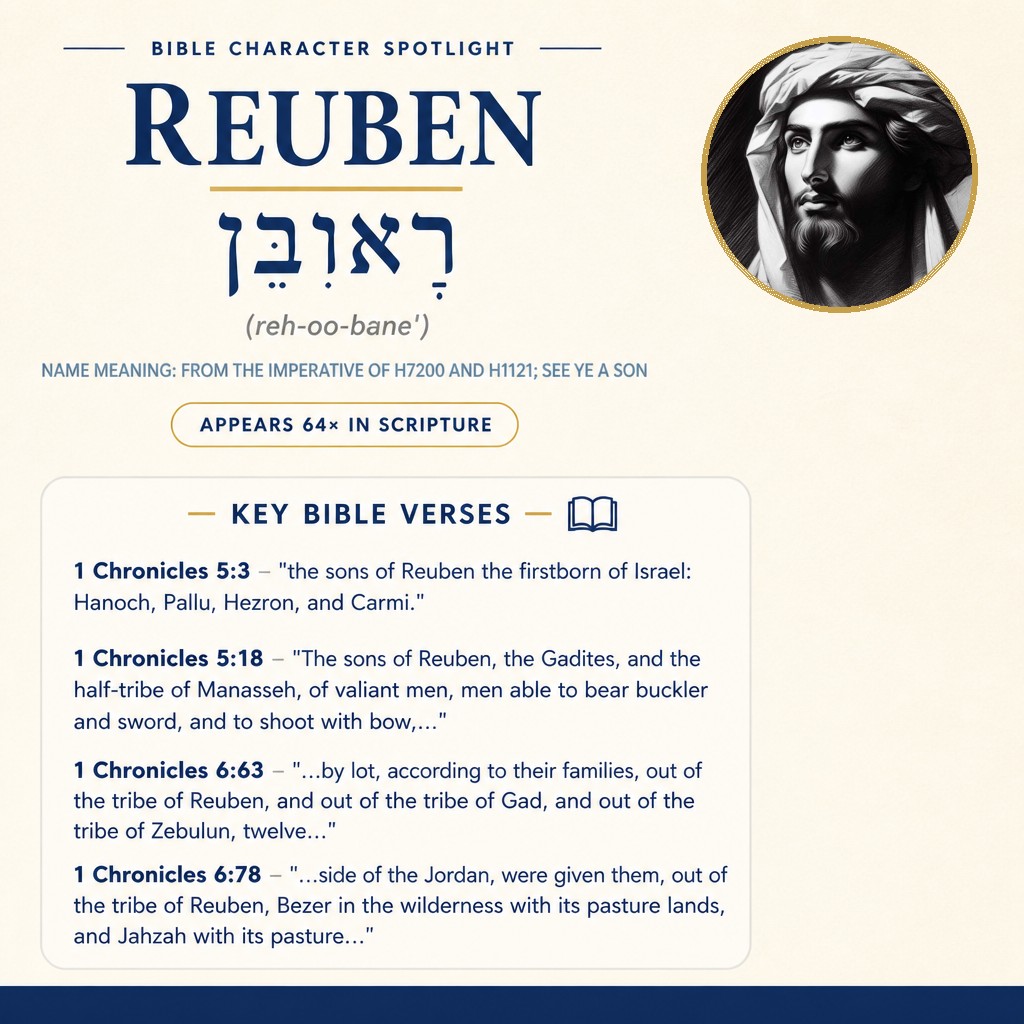
Reuben in Scripture
Reuben is first named among the sons of Israel listed in Exodus.
“Reuben, Simeon, Levi, and Judah,” (Exodus 1:2)
In Exodus, Reuben is identified as the firstborn of Israel, and his sons are listed as the heads of families associated with him.
“These are the heads of their fathers’ houses. The sons of Reuben the firstborn of Israel: Hanoch, and Pallu, Hezron, and Carmi; these are the families of Reuben.” (Exodus 6:14)
Deuteronomy refers to a notable event involving “Dathan and Abiram” by locating them within Reuben’s line, describing them as descendants “of Eliab, the son of Reuben,” and recounting what happened to them “in the middle of all Israel.”
“and what he did to Dathan and Abiram, the sons of Eliab, the son of Reuben—how the earth opened its mouth and swallowed them up, with their households, their tents, and every living thing that followed them, in the middle of all Israel;” (Deuteronomy 11:6)
Later in Deuteronomy, Reuben is included among those appointed to stand “for the curse” on Mount Ebal.
“These shall stand on Mount Ebal for the curse: Reuben, Gad, Asher, Zebulun, Dan, and Naphtali.” (Deuteronomy 27:13)
Deuteronomy also preserves a brief saying concerning Reuben’s continued life and the size of his people.
“Let Reuben live, and not die; Nor let his men be few.” (Deuteronomy 33:6)
In Chronicles, Reuben again appears as the firstborn of Israel, with the same four sons listed.
“the sons of Reuben the firstborn of Israel: Hanoch, Pallu, Hezron, and Carmi.” (1 Chronicles 5:3)
Chronicles also groups Reuben’s descendants with the Gadites and the half-tribe of Manasseh in a description of their military capability and number.
“The sons of Reuben, the Gadites, and the half-tribe of Manasseh, of valiant men, men able to bear buckler and sword, and to shoot with bow, and skillful in war, were forty-four thousand seven hundred sixty, that were able to go out to war.” (1 Chronicles 5:18)
When describing Levitical allotments, Chronicles notes that cities were given “out of the tribe of Reuben” and names specific locations east of the Jordan associated with that tribal territory.
“To the sons of Merari were given by lot, according to their families, out of the tribe of Reuben, and out of the tribe of Gad, and out of the tribe of Zebulun, twelve cities.” (1 Chronicles 6:63)
“and beyond the Jordan at Jericho, on the east side of the Jordan, were given them, out of the tribe of Reuben, Bezer in the wilderness with its pasture lands, and Jahzah with its pasture lands,” (1 Chronicles 6:78)
Ezekiel 48 places Reuben within a future arrangement of tribal portions in the land. The chapter begins, “Now these are the names of the tribes,” and then proceeds in order from north to south, assigning “one portion” to each tribe along an east–west band. Within this sequence, Reuben’s portion is explicitly located relative to Ephraim and Judah.
“Now these are the names of the tribes: … Dan, one portion.” (Ezekiel 48:1)
“By the border of Ephraim, from the east side even to the west side, Reuben, one portion.” (Ezekiel 48:6)
“By the border of Reuben, from the east side to the west side, Judah, one portion.” (Ezekiel 48:7)
In the same chapter, after describing the “holy offering” and measurements for the sanctuary area, priests, Levites, the city, and the prince, Ezekiel returns to the remaining tribes and their portions and then describes the city’s exits and gates. Among the gates named after Israel’s tribes is one specifically called the gate of Reuben, positioned on the city’s north side.
“and the gates of the city shall be named after the tribes of Israel, three gates northward: the gate of Reuben, one; the gate of Judah, one; the gate of Levi, one.” (Ezekiel 48:31)
Across these passages, Reuben appears both as an individual—named as “the firstborn of Israel” and identified with sons and families—and as a tribal designation in later references (“the tribe of Reuben”) and in Ezekiel’s land-portion and city-gate descriptions.
Name and Meaning
Reuben is written in Hebrew as רְאוּבֵן, transliterated Re’uwben and pronounced reh-oo-bane’. Strong’s derivation explains the name as coming from an imperative form related to “to see” together with “a son,” yielding the sense “see ye a son.” The derivation notes the components ben (בֵּן), “a son (as a builder of the family name),” and ra’ah (רָאָה), “to see,” whether literally or figuratively.
Observation
In the texts quoted, Reuben’s name is associated with both origins (“the firstborn of Israel” with named sons and “families of Reuben”) and enduring tribal identity, marked in later arrangements by “Reuben, one portion” and even “the gate of Reuben.”
Frequently Asked Questions
What does the name Reuben mean?
The name Reuben means “See, a son.”
How many times does Reuben appear in the Bible?
Reuben appears 64 times.
Who was Reuben?
Reuben was a son of Jacob. He is also called “the firstborn of Israel” (Exodus 6:14; 1 Chronicles 5:3).
Who are listed as the sons of Reuben?
The sons of Reuben are listed as Hanoch, Pallu, Hezron, and Carmi (Exodus 6:14; 1 Chronicles 5:3).
Explore Further
If you found this page about Reuben interesting and would like to discover more about other biblical characters, explore our comprehensive Encyclopedia of Biblical Characters. For those looking to delve deeper into the Greek origins of these names and terms, our Greek Lexicon is an invaluable resource.
Sources: Name and occurrence data from Strong’s Exhaustive Concordance and STEPBible reference data (CC BY). Scripture quotations from the World English Bible (public domain).