
Who was Matthan in the bible?
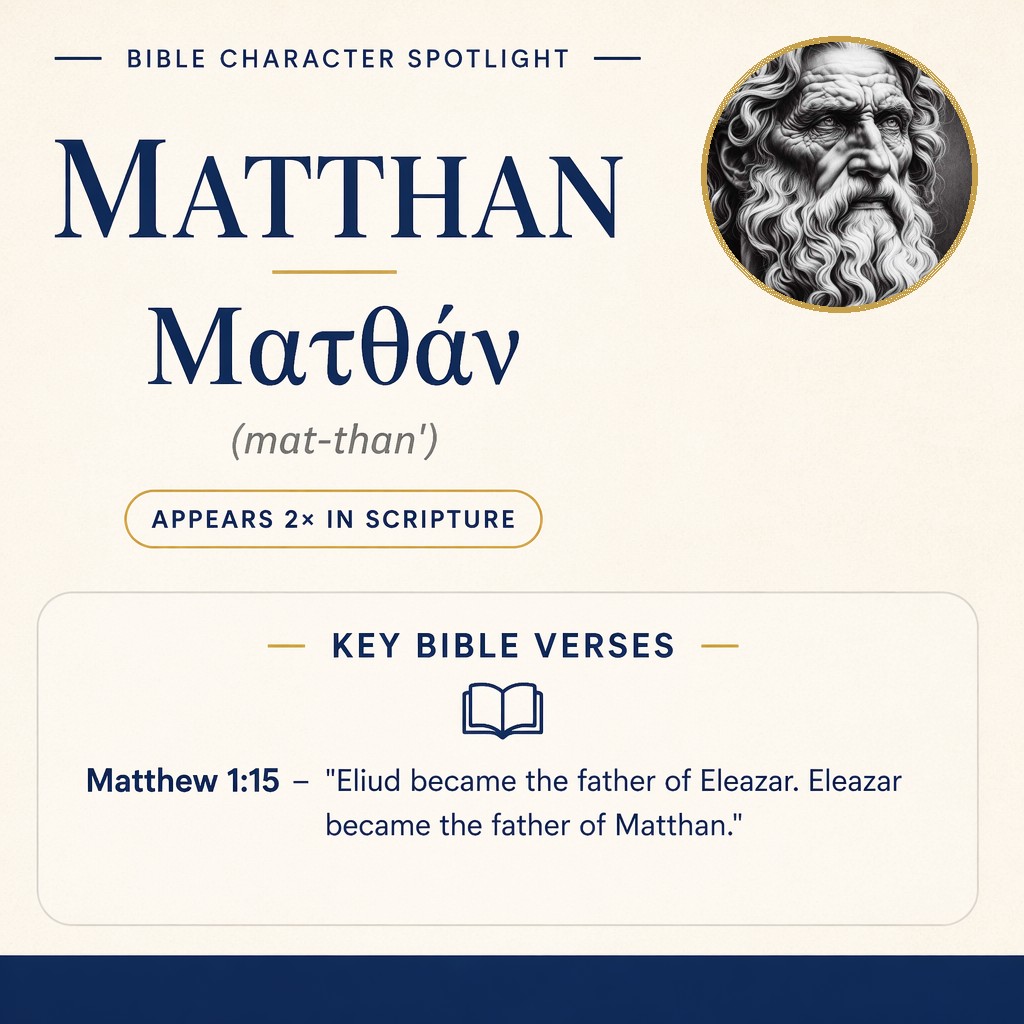
Matthan is a man in Jesus’ genealogy in Matthew 1:15, named as Eleazar’s son and Jacob’s father.

Family Line
The same verse adds, “Matthan became the father of Jacob” (Matthew 1:15), placing him within the listed generations.
Learn More →Name Notes
The lexicon lists Ματθάν (Matthan) as a Greek form “of Hebrew origin,” occurring in Matthew 1:15.
Learn More →Matthan (Greek Ματθάν, Matthan) is a man named in the genealogy of Jesus Christ in the Gospel of Matthew. The name is of Hebrew origin (Strong’s notes relate it to H04977), and in Matthew’s list Matthan appears as an ancestor in the line leading to Joseph.
Matthan in Scripture
Matthan is mentioned within Matthew’s opening genealogy, where the text traces a sequence of fathers and sons. The immediate line in which Matthan appears is introduced by earlier names in the same chain:
“Zerubbabel became the father of Abiud. Abiud became the father of Eliakim. Eliakim became the father of Azor.” (Matthew 1:13)
“Azor became the father of Zadok. Zadok became the father of Achim. Achim became the father of Eliud.” (Matthew 1:14)
Matthan is then placed explicitly between Eleazar and Jacob:
“Eliud became the father of Eleazar. Eleazar became the father of Matthan. Matthan became the father of Jacob.” (Matthew 1:15)
In this presentation, Matthan’s identity is defined by his position in the succession of generations: he is the son of Eleazar and the father of Jacob. Matthew continues the genealogy by naming Jacob’s son and describing Joseph’s marital connection to Mary, and then connecting Mary to the birth of Jesus:
“Jacob became the father of Joseph, the husband of Mary, from whom was born Jesus, who is called Christ.” (Matthew 1:16)
Thus, within the immediate context, Matthan is one link in the recorded line that culminates in “Jesus, who is called Christ” (Matthew 1:16). Matthew then summarizes the structure of the genealogy in groups of generations:
“So all the generations from Abraham to David are fourteen generations; from David to the exile to Babylon fourteen generations; and from the carrying away to Babylon to the Christ, fourteen generations.” (Matthew 1:17)
After closing the genealogy, the chapter turns to the circumstances surrounding Jesus’ birth. While Matthan is not mentioned again in this narrative, the transition shows why the genealogy is being given: it leads into the account of “the birth of Jesus Christ.” The narrative begins by describing Mary’s engagement to Joseph and the discovery of her pregnancy:
“Now the birth of Jesus Christ was like this: After his mother, Mary, was engaged to Joseph, before they came together, she was found pregnant by the Holy Spirit.” (Matthew 1:18)
Within Matthew 1, therefore, Matthan’s role is genealogical. He is identified only through the father–son chain (“Eleazar became the father of Matthan. Matthan became the father of Jacob,” Matthew 1:15) that leads to Joseph and then to Jesus’ birth being introduced in the chapter’s narrative (Matthew 1:16–18).
Name and Meaning
In Greek, the name is written Ματθάν (transliteration: Matthan; pronunciation: mat-than’). Strong’s notes describe it as a name of Hebrew origin (connected with H04977). In Matthew’s genealogy it functions as a personal name for the individual who stands between Eleazar and Jacob in the generational sequence (Matthew 1:15).
Observation
Although Matthan is mentioned only in a brief genealogical formula, Matthew places him in a carefully counted sequence of “generations” that the writer summarizes as extending “to the Christ” (Matthew 1:17).
Frequently Asked Questions
What does the name Matthan mean?
Matthan is a name of Hebrew origin.
How many times does Matthan appear in the Bible?
Matthan appears 2 times.
Who was Matthan in the Bible?
Matthan is named in a genealogy in Matthew. In Matthew 1:15, Matthan is listed as the father of Jacob.
Where is Matthan mentioned?
Matthan is mentioned in Matthew 1:15.
Explore Further
If you found this page about Matthan interesting and would like to discover more about other biblical characters, explore our comprehensive Encyclopedia of Biblical Characters. For those looking to delve deeper into the Greek origins of these names and terms, our Greek Lexicon is an invaluable resource.
Sources: Name and occurrence data from Strong’s Exhaustive Concordance and STEPBible reference data (CC BY). Scripture quotations from the World English Bible (public domain).





