Who was Mattan in the bible?
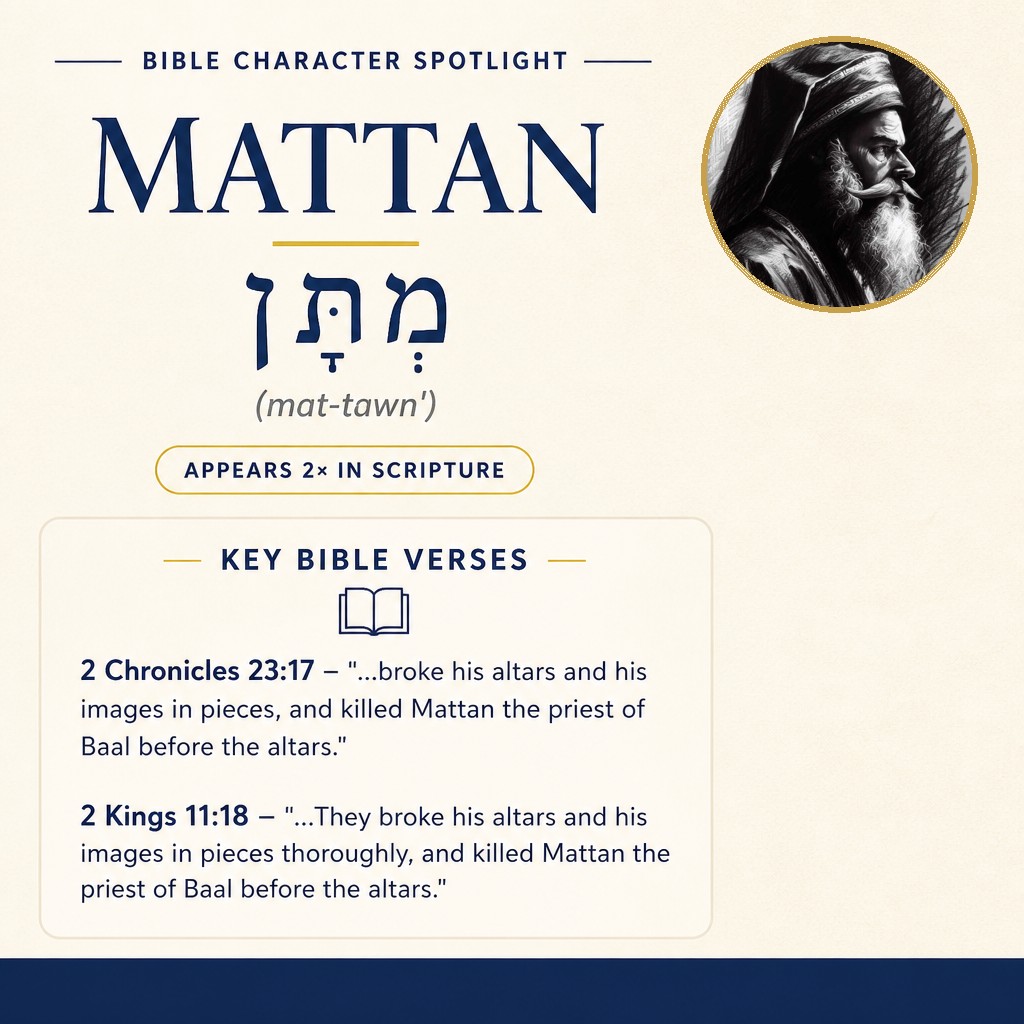
Mattan was “the priest of Baal,” killed before Baal’s altars in 2 Kings 11:18 and 2 Chronicles 23:17.

What Happened
“All the people” went to “the house of Baal,” destroyed it, and “killed Mattan the priest of Baal before the altars” (2 Kings 11:18; 2 Chronicles 23:17).
Learn More →Name Meaning
Strong’s gloss connects Mattan with a Hebrew term meaning “a present.” The lexicon also notes the name is used of a priest of Baal and of an Israelite.
Learn More →Mattan (Hebrew מַתָּן, Mattan) is presented in Scripture as “the priest of Baal,” killed when “all the people” destroyed Baal’s house and its objects. According to the name’s Hebrew derivation, Mattan is related to a word meaning “a present.”
Mattan in Scripture
Mattan appears in two parallel accounts that describe the same moment of public action: following a covenant to be Yahweh’s people, the people demolish Baal’s sanctuary and execute Baal’s priest, Mattan.
In 2 Kings, the immediate setting begins with the death of Athaliah and a covenant led by Jehoiada. The narrative first reports Athaliah’s death:
“So they made way for her; and she went by the way of the horses’ entry to the king’s house, and she was slain there.” (2 Kings 11:16)
Then it describes a covenant with a stated purpose:
“Jehoiada made a covenant between Yahweh and the king and the people, that they should be Yahweh’s people; also between the king and the people.” (2 Kings 11:17)
Against that backdrop, the text records the destruction of Baal’s house and Mattan’s death in a single, concentrated report:
“All the people of the land went to the house of Baal, and broke it down. They broke his altars and his images in pieces thoroughly, and killed Mattan the priest of Baal before the altars. The priest appointed officers over Yahweh’s house.” (2 Kings 11:18)
The same scene continues with the king’s public enthronement and a city-wide response. After the actions at Baal’s house and the appointment of officers, Jehoiada leads the king from Yahweh’s house to the royal house:
“He took the captains over hundreds, and the Carites, and the guard, and all the people of the land; and they brought down the king from Yahweh’s house, and came by the way of the gate of the guard to the king’s house. He sat on the throne of the kings.” (2 Kings 11:19)
The result is described as communal joy and public quiet, with a final reminder of Athaliah’s death:
“So all the people of the land rejoiced, and the city was quiet. They had slain Athaliah with the sword at the king’s house.” (2 Kings 11:20)
The chapter closes by identifying the king by name and age:
“Jehoash was seven years old when he began to reign.” (2 Kings 11:21)
2 Chronicles presents a closely corresponding account, again placing Mattan’s death within a sequence that includes Athaliah’s death, a covenant to belong to Yahweh, the demolition of Baal’s house, and renewed ordering of worship at Yahweh’s house.
The Chronicler likewise reports Athaliah’s death at the king’s house:
“So they made way for her. She went to the entrance of the horse gate to the king’s house; and they killed her there.” (2 Chronicles 23:15)
Next comes the covenant, with wording that parallels the purpose stated in Kings:
“Jehoiada made a covenant between himself, all the people, and the king, that they should be Yahweh’s people.” (2 Chronicles 23:16)
Then Mattan is introduced and identified by role in the report of Baal’s house being destroyed:
“All the people went to the house of Baal, broke it down, broke his altars and his images in pieces, and killed Mattan the priest of Baal before the altars.” (2 Chronicles 23:17)
Immediately after this, the Chronicler highlights Jehoiada’s organization of service at Yahweh’s house, specifically under “the hand of the Levitical priests,” with offerings made as written in the law of Moses and accompanied by rejoicing and singing:
“Jehoiada appointed the officers of Yahweh’s house under the hand of the Levitical priests, whom David had distributed in Yahweh’s house, to offer the burnt offerings of Yahweh, as it is written in the law of Moses, with rejoicing and with singing, as David had ordered.” (2 Chronicles 23:18)
This ordering includes guarding access to Yahweh’s house:
“He set the gatekeepers at the gates of Yahweh’s house, that no one who was unclean in anything should enter in.” (2 Chronicles 23:19)
Finally, the king is brought down from Yahweh’s house and seated on the kingdom’s throne, in a public procession involving leaders and “all the people of the land”:
“He took the captains of hundreds, the nobles, the governors of the people, and all the people of the land, and brought the king down from Yahweh’s house. They came through the upper gate to the king’s house, and set the king on the throne of the kingdom.” (2 Chronicles 23:20)
Within both accounts, Mattan’s sole identifying description is his office: “Mattan the priest of Baal” (2 Kings 11:18; 2 Chronicles 23:17). His death is presented not as an isolated incident, but as part of a larger public turning: Jehoiada’s covenant that the king and people “should be Yahweh’s people” (2 Kings 11:17; 2 Chronicles 23:16), the destruction of Baal’s house, and renewed structuring of officers and access at Yahweh’s house (2 Kings 11:18; 2 Chronicles 23:18–19).
Name and Meaning
The name is written in Hebrew as מַתָּן (transliterated Mattan; pronounced mat-tawn’). Its derivation is linked with a Hebrew term meaning “a present,” with a component word mattan (מַתָּן) carrying that sense.
Observation
In the narratives where he appears, Mattan is named at the moment when “all the people” dismantle Baal’s house and “killed Mattan the priest of Baal before the altars” (2 Kings 11:18; 2 Chronicles 23:17), directly following the covenant “that they should be Yahweh’s people” (2 Kings 11:17; 2 Chronicles 23:16).
Frequently Asked Questions
What does the name Mattan mean?
Mattan is given as the name of a priest of Baal, and of an Israelite.
How many times does Mattan appear in the Bible?
Mattan appears 2 times.
Who was Mattan?
Mattan is identified as the priest of Baal. In both 2 Chronicles 23:17 and 2 Kings 11:18, he is described as being killed at the house of Baal.
What happened to Mattan in 2 Kings 11:18?
2 Kings 11:18 says the people broke down the house of Baal, smashed its altars and images, and killed Mattan the priest.
Explore Further
If you found this page about Mattan interesting and would like to discover more about other biblical characters, explore our comprehensive Encyclopedia of Biblical Characters. For those looking to delve deeper into the Greek origins of these names and terms, our Greek Lexicon is an invaluable resource.
Sources: Name and occurrence data from Strong’s Exhaustive Concordance and STEPBible reference data (CC BY). Scripture quotations from the World English Bible (public domain).