Who was Hezron in the bible?
Hezron is a name borne by Israelites in genealogies (Genesis 46:12; Exodus 6:14; 1 Chronicles 2; 5:3) and by places in Judah’s territory (Joshua 15:3, 25).

Family Lines
“The sons also of Hezron, who were born to him: Jerahmeel, Ram, and Chelubai” (1 Chronicles 2:9). “Afterward Hezron went in to the daughter of Machir… and she bore him Segub” (1 Chronicles 2:21).
Learn More →Places Named Hezron
A boundary description says it “passed along by Hezron” (Joshua 15:3). A town list includes “Kerioth Hezron (also called Hazor)” (Joshua 15:25).
Learn More →Hezron (Hebrew חֶצְרוֹן, Chetsrown) is a biblical name borne by more than one figure in the genealogical lists: one Hezron appears among the descendants of Judah through Perez, and another Hezron appears as a son of Reuben. The same name also designates places mentioned in Joshua’s boundary and city lists.
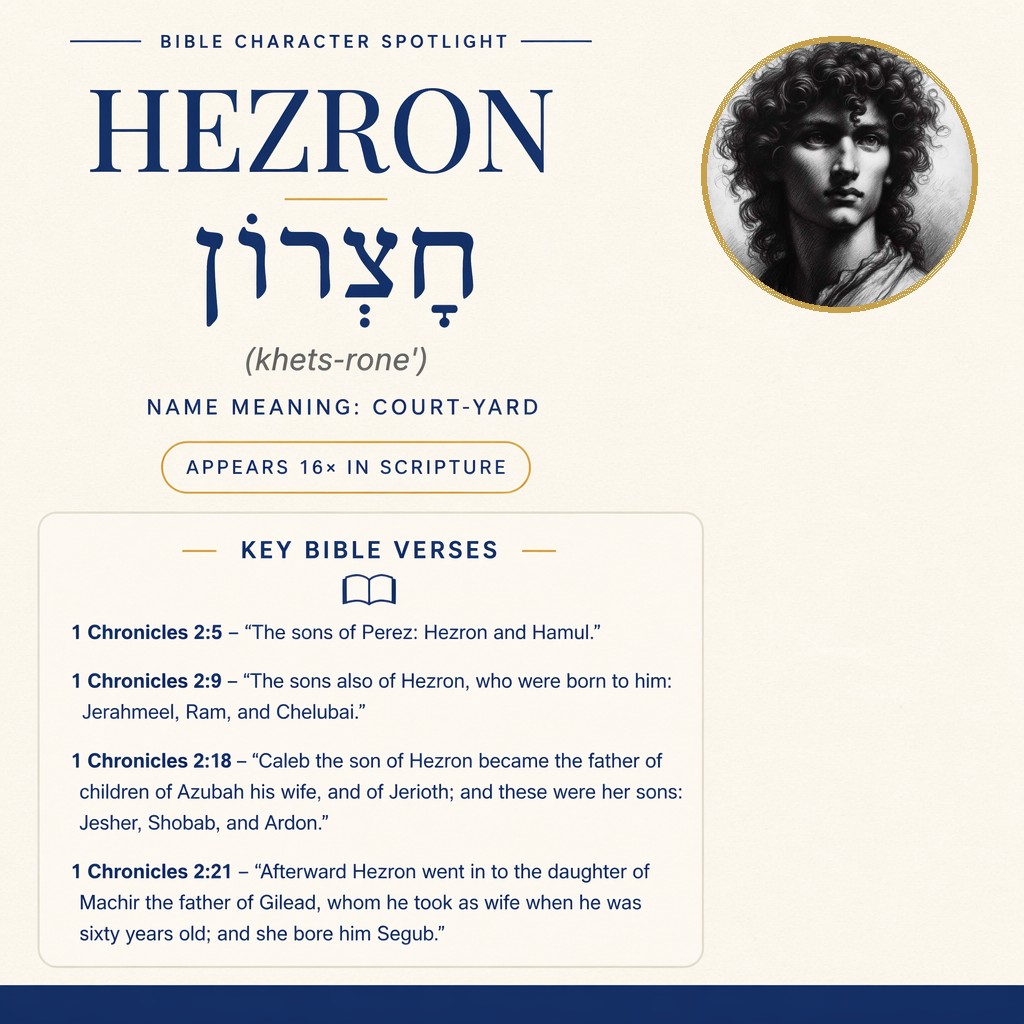
Hezron in Scripture
In 1 Chronicles 2, Hezron is introduced within the tribe of Judah, through the line of Perez. The chapter sets a broad context first, listing “the sons of Israel” and then narrowing to Judah’s descendants (1 Chronicles 2:1–4). Hezron appears when Perez’s sons are named:
“The sons of Perez: Hezron and Hamul.” (1 Chronicles 2:5)
The genealogy then continues by naming Hezron’s sons, placing him as a key link in the unfolding family line:
“The sons also of Hezron, who were born to him: Jerahmeel, Ram, and Chelubai.” (1 Chronicles 2:9)
From Ram, the chapter extends a longer descent (1 Chronicles 2:10–17), tracing father-to-son relationships down to well-known figures inside the chapter’s own genealogy. This segment begins:
“Ram became the father of Amminadab, and Amminadab became the father of Nahshon, prince of the children of Judah;” (1 Chronicles 2:10)
and later reaches:
“and Jesse became the father of his firstborn Eliab, and Abinadab the second, and Shimea the third, … Ozem the sixth, David the seventh;” (1 Chronicles 2:13–15)
Within the same chapter, Hezron is also connected to a “Caleb the son of Hezron,” whose line is developed in its own cluster of notes. The text states:
“Caleb the son of Hezron became the father of children of Azubah his wife, and of Jerioth; and these were her sons: Jesher, Shobab, and Ardon.” (1 Chronicles 2:18)
The chapter continues with Caleb’s further descendants (1 Chronicles 2:19–20), then returns to a significant personal detail about Hezron himself: in later life, he took a wife described by her parentage, and a son is named from that union.
“Afterward Hezron went in to the daughter of Machir the father of Gilead, whom he took as wife when he was sixty years old; and she bore him Segub.” (1 Chronicles 2:21)
The account immediately traces Segub’s line and describes territorial possession attributed to Jair, Segub’s descendant:
“Segub became the father of Jair, who had twenty-three cities in the land of Gilead.” (1 Chronicles 2:22)
It then notes conflict over those towns, while keeping the focus on the genealogy’s framing around Machir:
“Geshur and Aram took the towns of Jair from them, with Kenath, and its villages, even sixty cities. All these were the sons of Machir the father of Gilead.” (1 Chronicles 2:23)
Hezron’s death is recorded with a place reference, and another child is named in connection with Hezron’s wife Abijah:
“After Hezron died in Caleb Ephrathah, Abijah Hezron’s wife bore him Ashhur the father of Tekoa.” (1 Chronicles 2:24)
The chapter then develops Jerahmeel’s branch specifically by listing “the sons of Jerahmeel the firstborn of Hezron,” providing additional names:
“The sons of Jerahmeel the firstborn of Hezron were Ram the firstborn, Bunah, Oren, Ozem, and Ahijah.” (1 Chronicles 2:25)
While 1 Chronicles 2 contains the fullest narrative and genealogical setting for Hezron in the supplied passages, other books also place a Hezron within Israel’s tribal family lists. In Genesis, Hezron appears as part of Reuben’s sons:
“The sons of Reuben: Hanoch, Pallu, Hezron, and Carmi.” (Genesis 46:9)
Exodus repeats the same grouping in a structured register:
“These are the heads of their fathers’ houses. The sons of Reuben the firstborn of Israel: Hanoch, and Pallu, Hezron, and Carmi; these are the families of Reuben.” (Exodus 6:14)
And 1 Chronicles similarly lists the sons of Reuben:
“the sons of Reuben the firstborn of Israel: Hanoch, Pallu, Hezron, and Carmi.” (1 Chronicles 5:3)
Hezron also appears as a name in Judah’s genealogical line through Perez in Genesis:
“The sons of Judah: Er, Onan, Shelah, Perez, and Zerah; but Er and Onan died in the land of Canaan. The sons of Perez were Hezron and Hamul.” (Genesis 46:12)
Multiple Bearers of the Name
The provided verses describe at least two distinct Israelites named Hezron, as well as place-names incorporating Hezron.
1) Hezron, son of Perez (Judah’s line). He is named as one of Perez’s two sons: “The sons of Perez: Hezron and Hamul.” (1 Chronicles 2:5; compare Genesis 46:12). In 1 Chronicles 2 he is further described as having sons—“Jerahmeel, Ram, and Chelubai” (1 Chronicles 2:9)—and as taking “the daughter of Machir the father of Gilead” as wife “when he was sixty years old,” who “bore him Segub” (1 Chronicles 2:21). The text also states, “After Hezron died in Caleb Ephrathah, Abijah Hezron’s wife bore him Ashhur the father of Tekoa.” (1 Chronicles 2:24). This Hezron is therefore situated within Judah’s genealogical framework in 1 Chronicles 2, with multiple descendants named in that chapter.
2) Hezron, son of Reuben. A separate Hezron is listed among Reuben’s sons: “Hanoch, Pallu, Hezron, and Carmi.” (Genesis 46:9; Exodus 6:14; 1 Chronicles 5:3). These passages present Hezron within the Reubenite family lists, and Exodus identifies these names as “the families of Reuben” (Exodus 6:14).
3) Hezron as a place-name. In Joshua’s description of a boundary, Hezron appears as a point along the line: “and passed along by Hezron” (Joshua 15:3). A related form appears as a city designation: “Hazor Hadattah, Kerioth Hezron (also called Hazor),” (Joshua 15:25). These references treat Hezron as part of geographic terminology in Judah’s territorial listings.
Name and Meaning
The name is written in Hebrew as חֶצְרוֹן, transliterated Chetsrown and pronounced khets-rone’. Its derivation is connected to the sense of a “court-yard,” related to a component word chatser (חָצֵר) referring to “a yard (as inclosed by a fence).” The lexicon information also notes that Chetsron is used as the name of “a place in Palestine,” and “also of two Israelites,” matching the mixed personal and place usage seen in the verses above.
Observation
Across the passages, “Hezron” functions as a linking name: in Judah’s line, “The sons also of Hezron” are named (1 Chronicles 2:9), and in Reuben’s line, Hezron is one of the sons that define “the families of Reuben” (Exodus 6:14).
Frequently Asked Questions
What does the name Hezron mean?
Hezron means “court-yard.”
How many times does Hezron appear in the Bible?
Hezron occurs 16 times.
Who was Hezron in the Bible?
Hezron is the name of a place in Palestine and also of two Israelites. One Hezron is listed among the sons of Perez (1 Chronicles 2:5), and another is listed among the sons of Reuben (Exodus 6:14).
Who were Hezron’s sons born to him?
Hezron’s sons who were born to him are named as Jerahmeel, Ram, and Chelubai (1 Chronicles 2:9).
Explore Further
If you found this page about Hezron interesting and would like to discover more about other biblical characters, explore our comprehensive Encyclopedia of Biblical Characters. For those looking to delve deeper into the Greek origins of these names and terms, our Greek Lexicon is an invaluable resource.
Sources: Name and occurrence data from Strong’s Exhaustive Concordance and STEPBible reference data (CC BY). Scripture quotations from the World English Bible (public domain).