Who was Epher in the bible?
Epher is a name borne by multiple individuals in Scripture, appearing in Genesis 25:4 and 1 Chronicles 1:33; 4:17; 5:24.
Ezrah’s Son
“The sons of Ezrah: Jether, Mered, Epher, and Jalon” (1 Chronicles 4:17).
Learn More →Manasseh Head
“These were the heads of their fathers’ houses: even Epher… mighty men of valor, famous men” (1 Chronicles 5:24). The passage places this list among “the children of the half-tribe of Manasseh” (1 Chronicles 5:23–24).
Learn More →Epher is a biblical name borne by more than one person: one appears in genealogies connected with Midian and Keturah, and others appear in Israelite genealogical lists in Chronicles. A lexicon paraphrase links the name to the idea of a “gazelle,” with a related component word associated with a fawn.
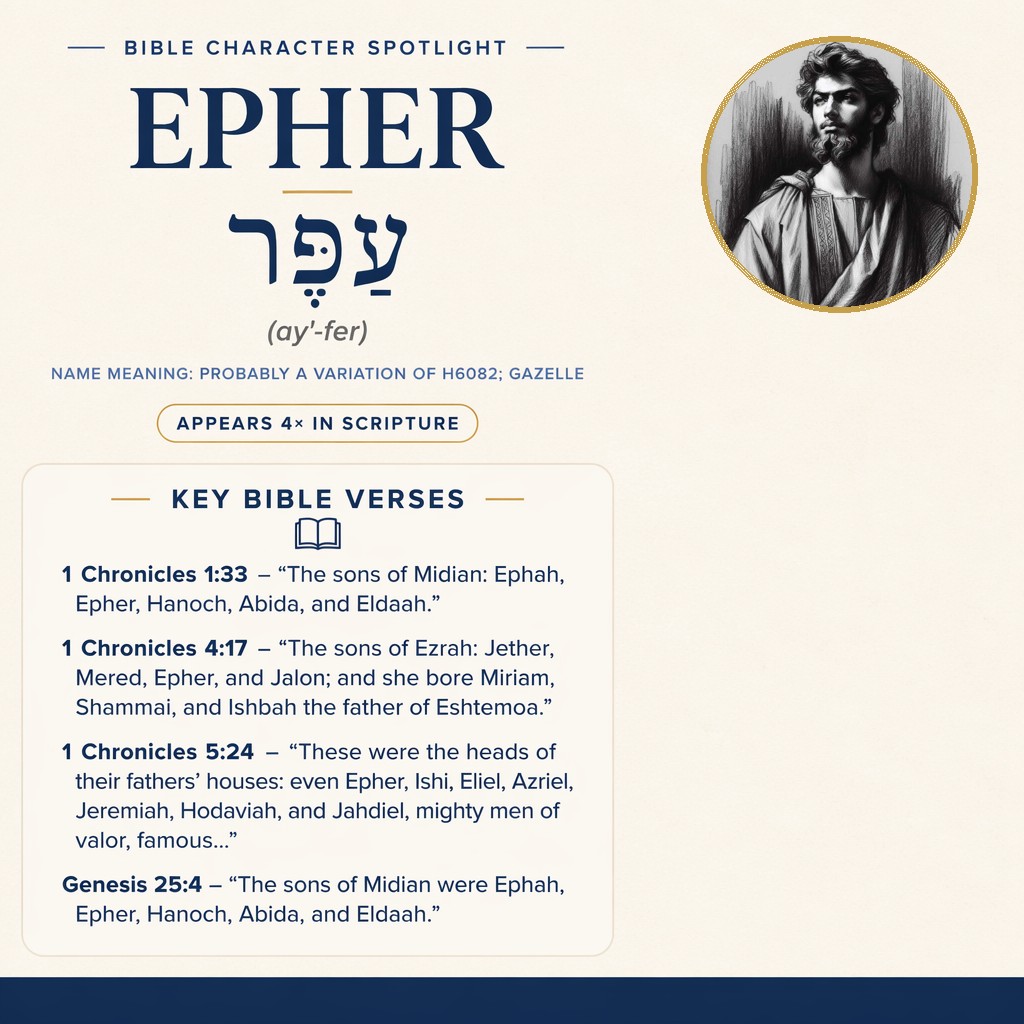
Epher in Scripture
The name Epher appears in several genealogical contexts, and the passages present distinct settings that indicate multiple bearers of the same name.
1) Epher among the sons of Midian (Genesis; echoed in Chronicles). In Genesis 25, Epher is listed as one of Midian’s sons. The immediate context places Midian among the sons born to Keturah, and the chapter continues by describing Abraham’s giving and sending away of the sons of his concubines.
“The sons of Midian were Ephah, Epher, Hanoch, Abida, and Eldaah. All these were the children of Keturah.” (Genesis 25:4)
The chapter’s surrounding lines give the setting in a broader genealogical and household frame:
“She bore him Zimran, Jokshan, Medan, Midian, Ishbak, and Shuah.” (Genesis 25:2)
“Abraham gave all that he had to Isaac,” (Genesis 25:5)
“but Abraham gave gifts to the sons of Abraham’s concubines. While he still lived, he sent them away from Isaac his son, eastward, to the east country.” (Genesis 25:6)
Chronicles repeats the same Midianite list in its opening genealogies, locating it within a sequence that includes Ishmael’s sons immediately before and Isaac’s line immediately after.
“The sons of Midian: Ephah, Epher, Hanoch, Abida, and Eldaah. All these were the sons of Keturah.” (1 Chronicles 1:33)
The surrounding context in Chronicles frames this entry as part of a larger genealogical sweep:
“Jetur, Naphish, and Kedemah. These are the sons of Ishmael.” (1 Chronicles 1:31)
“The sons of Keturah, Abraham’s concubine: she bore Zimran, Jokshan, Medan, Midian, Ishbak, and Shuah. The sons of Jokshan: Sheba and Dedan.” (1 Chronicles 1:32)
“Abraham became the father of Isaac. The sons of Isaac: Esau and Israel.” (1 Chronicles 1:34)
Within these two passages (Genesis 25:4; 1 Chronicles 1:33), Epher is presented simply as a named descendant within Midian’s line, with no further narrative actions attributed to him.
2) Epher among the sons of Ezrah (Judah genealogy context in Chronicles). A second Epher appears in a different genealogical listing in 1 Chronicles 4. Here, Epher is named among Ezrah’s sons, in a verse that also mentions additional births in the same immediate context.
“The sons of Ezrah: Jether, Mered, Epher, and Jalon; and she bore Miriam, Shammai, and Ishbah the father of Eshtemoa.” (1 Chronicles 4:17)
The surrounding genealogy shows this list embedded among other family lines:
“The sons of Caleb the son of Jephunneh: Iru, Elah, and Naam. The son of Elah: Kenaz.” (1 Chronicles 4:15)
“The sons of Jehallelel: Ziph, Ziphah, Tiria, and Asarel.” (1 Chronicles 4:16)
“His wife the Jewess bore Jered the father of Gedor, Heber the father of Soco, and Jekuthiel the father of Zanoah. These are the sons of Bithiah the daughter of Pharaoh, whom Mered took.” (1 Chronicles 4:18)
“The sons of the wife of Hodiah, the sister of Naham, were the father of Keilah the Garmite, and Eshtemoa the Maacathite.” (1 Chronicles 4:19)
In this setting, Epher is one among several listed sons, and the passage supplies genealogical connections (“the sons of Ezrah”) rather than personal deeds.
3) Epher as a head of a father’s house (half-tribe of Manasseh context in Chronicles). A third Epher appears in 1 Chronicles 5, where he is named among “heads of their fathers’ houses” and described along with others as “mighty men of valor” and “famous men.” The immediate context identifies the broader group as “the children of the half-tribe of Manasseh,” describes their territorial spread, and then recounts warfare, settlement, and later removal by Assyria after trespass.
“The children of the half-tribe of Manasseh lived in the land: they increased from Bashan to Baal Hermon, Senir, and Mount Hermon.” (1 Chronicles 5:23)
“These were the heads of their fathers’ houses: even Epher, Ishi, Eliel, Azriel, Jeremiah, Hodaviah, and Jahdiel, mighty men of valor, famous men, heads of their fathers’ houses.” (1 Chronicles 5:24)
The chapter then continues with a concise narrative explanation for what follows:
“They trespassed against the God of their fathers, and played the prostitute after the gods of the peoples of the land, whom God destroyed before them.” (1 Chronicles 5:25)
“So the God of Israel stirred up the spirit of Pul king of Assyria, and the spirit of Tilgath Pilneser king of Assyria, and he carried them away, even the Reubenites, and the Gadites, and the half-tribe of Manasseh, and brought them to Halah, Habor, Hara, and to the river of Gozan, to this day.” (1 Chronicles 5:26)
Just before the half-tribe’s territorial description, the chapter also provides a brief comment about conflict and settlement:
“For many fell slain, because the war was of God. They lived in their place until the captivity.” (1 Chronicles 5:22)
In this context, Epher is presented as a prominent clan leader (“head of their fathers’ houses”) among the half-tribe of Manasseh, within a larger account that links the group’s later displacement to unfaithfulness (“They trespassed against the God of their fathers”).
Multiple Bearers
The passages describe multiple people named Epher:
(1) In Genesis 25:4 and 1 Chronicles 1:33, Epher is listed among “the sons of Midian” and thus belongs to the genealogy tied to Keturah.
(2) In 1 Chronicles 4:17, Epher is listed as one of “The sons of Ezrah,” in a separate genealogical section.
(3) In 1 Chronicles 5:24, Epher is one of the “heads of their fathers’ houses” among “The children of the half-tribe of Manasseh” (1 Chronicles 5:23), described as “mighty men of valor” and “famous men.”
Name and Meaning
The name is written in Hebrew as עֵפֶר, transliterated ‘Epher and pronounced ay’-fer. A lexicon paraphrase explains it as probably a variation of another related form and associates it with the meaning “gazelle,” noting a component word ‘opher (עֹפֶר) meaning “a fawn,” linked to a “dusty color.”
Brief Observation
Across these genealogies, the same name identifies individuals in distinct lines: one appears only as a listed descendant of Midian (Genesis 25:4; 1 Chronicles 1:33), another as a son within an Israelite genealogy (1 Chronicles 4:17), and another as a recognized leader among the half-tribe of Manasseh, “mighty men of valor” (1 Chronicles 5:24) within a narrative that also records trespass and exile (1 Chronicles 5:25–26).
Frequently Asked Questions
What does the name Epher mean?
The name Epher is said to mean “gazelle.”
How many times does Epher appear in the Bible?
Epher appears 4 times.
Who was Epher in the Bible?
Epher is the name of an Arabian and of two Israelites. In Genesis 25:4 and 1 Chronicles 1:33, Epher is listed as one of the sons of Midian, among the children of Keturah.
Where is Epher listed among Midian’s sons?
Genesis 25:4 lists “Ephah, Epher, Hanoch, Abida, and Eldaah” as the sons of Midian, the children of Keturah.
Explore Further
If you found this page about Epher interesting and would like to discover more about other biblical characters, explore our comprehensive Encyclopedia of Biblical Characters. For those looking to delve deeper into the Greek origins of these names and terms, our Greek Lexicon is an invaluable resource.
Sources: Name and occurrence data from Strong’s Exhaustive Concordance and STEPBible reference data (CC BY). Scripture quotations from the World English Bible (public domain).