
Who was Beriah in the bible?
Beriah is the name of four Israelites mentioned in Genesis 46:17; Numbers 26:44–45; and 1 Chronicles 7:23, 7:30–31, 8:13, 8:16, and 23:10–11.

Asher’s Descendant
“The sons of Asher: Imnah, Ishvah, Ishvi, Beriah, and Serah their sister. The sons of Beriah: Heber and Malchiel” (Genesis 46:17).
Learn More →Other Bearers
Another Beriah appears among household heads: “Beriah, and Shema, who were heads of fathers’ households of the inhabitants of Aijalon” (1 Chronicles 8:13), and another is listed among Shimei’s sons (1 Chronicles 23:10).
Learn More →Beriah is a biblical name associated with multiple Israelites in genealogical records; the name is connected with “trouble” and is explained in one narrative as given because “there was trouble with his house.” The lexicon gloss identifies Beriah as the name of four Israelites, and the verses show distinct bearers in different lineages.
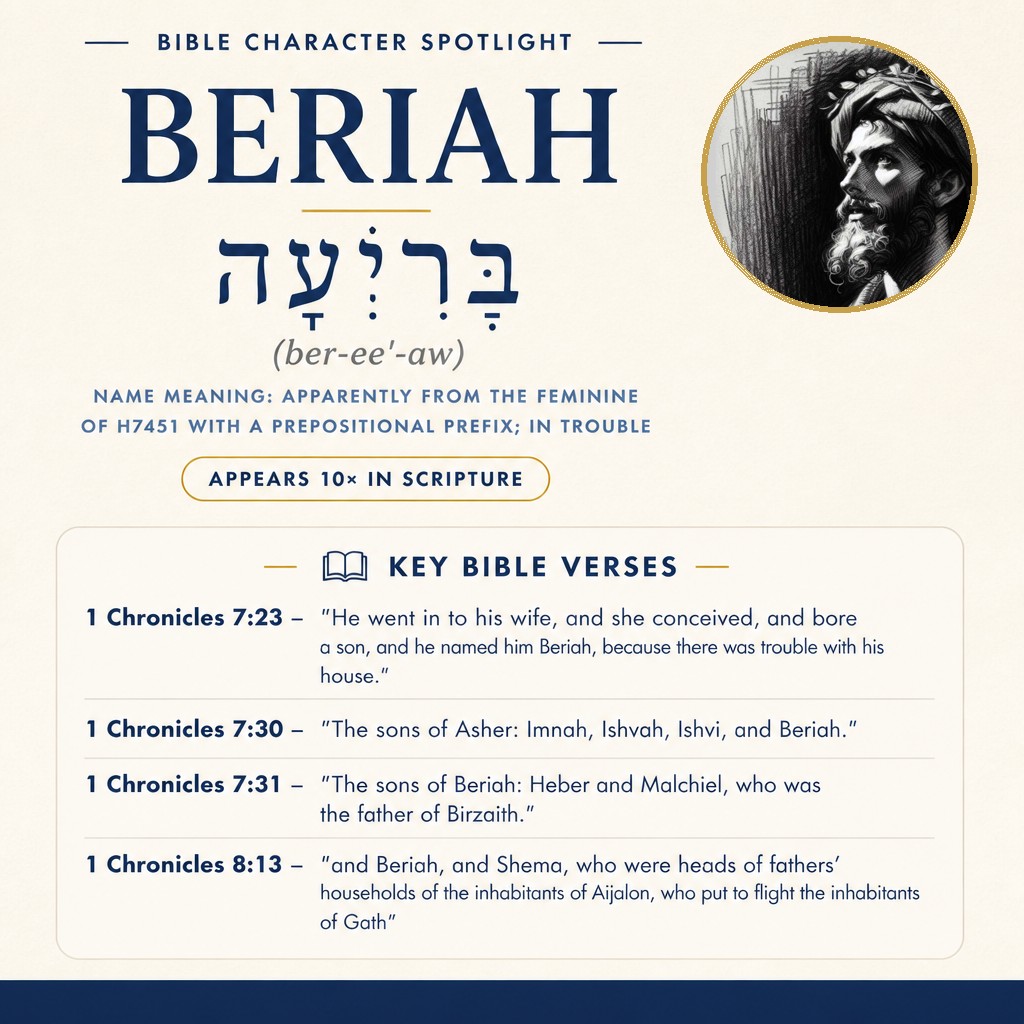
Beriah in Scripture
The earliest appearance in the provided verses places Beriah among the descendants of Asher in a list of Jacob’s household. Genesis both names Beriah as Asher’s son and identifies Beriah’s sons:
“The sons of Asher: Imnah, Ishvah, Ishvi, Beriah, and Serah their sister. The sons of Beriah: Heber and Malchiel.” (Genesis 46:17)
Numbers later reflects this same family line as a named clan within Asher’s descendants, expanding the list into “families” derived from Beriah and his sons:
“The sons of Asher after their families: of Imnah, the family of the Imnites; of Ishvi, the family of the Ishvites; of Beriah, the family of the Berites.” (Numbers 26:44)
“Of the sons of Beriah: of Heber, the family of the Heberites; of Malchiel, the family of the Malchielites.” (Numbers 26:45)
In 1 Chronicles 7, Beriah appears in two different settings within a larger sequence of tribal genealogies. The chapter moves through the sons of Issachar and Benjamin, then gives a genealogy of Ephraim with a brief narrative note about loss, mourning, and the birth of a son named Beriah. In that Ephraimite context, the text explains the naming:
“He went in to his wife, and she conceived, and bore a son, and he named him Beriah, because there was trouble with his house.” (1 Chronicles 7:23)
Within the flow of the chapter, this naming follows the account that “Ezer, and Elead” were killed by “the men of Gath who were born in the land,” leading to Ephraim’s mourning and comfort from his brothers (1 Chronicles 7:21–22). After the birth and naming of Beriah, the genealogy continues, mentioning a daughter and later descendants in the same line, leading onward to: “Nun his son, and Joshua his son.” (1 Chronicles 7:27)
Still within 1 Chronicles 7, the chapter then turns to the tribe of Asher. Beriah appears again, here explicitly as one of Asher’s sons, and then as the father of Heber and Malchiel. These verses match the earlier Genesis list but are set in the Chronicler’s arrangement:
“The sons of Asher: Imnah, Ishvah, Ishvi, and Beriah. Serah was their sister.” (1 Chronicles 7:30)
“The sons of Beriah: Heber and Malchiel, who was the father of Birzaith.” (1 Chronicles 7:31)
In the surrounding Asherite genealogy, the chapter continues to track lines through Heber and others, and closes with a general characterization of Asher’s descendants: “All these were the children of Asher, heads of the fathers’ houses, choice and mighty men of valor, chief of the princes.” (1 Chronicles 7:40)
Another bearer of the name appears in Benjamin’s genealogies in 1 Chronicles 8. There Beriah is listed alongside Shema as a head of fathers’ households connected with Aijalon, and a brief military note is attached to these heads:
“and Beriah, and Shema, who were heads of fathers’ households of the inhabitants of Aijalon, who put to flight the inhabitants of Gath;” (1 Chronicles 8:13)
Later in the same chapter, Beriah is mentioned again as a father, with three sons named:
“Michael, Ishpah, Joha, the sons of Beriah,” (1 Chronicles 8:16)
In 1 Chronicles 23, the name Beriah appears in a different genealogical context, as one of the sons of Shimei. The record lists Shimei’s sons and then comments on the family situation of two of them:
“The sons of Shimei: Jahath, Zina, Jeush, and Beriah. These four were the sons of Shimei.” (1 Chronicles 23:10)
“Jahath was the chief, and Zizah the second; but Jeush and Beriah didn’t have many sons; therefore they became a fathers’ house in one reckoning.” (1 Chronicles 23:11)
Multiple Bearers
The provided verses present Beriah as a name held by more than one individual, in different genealogical settings.
1) Beriah in Ephraim’s line (1 Chronicles 7:23). In the Ephraim genealogy, Beriah is the son whose name is explicitly explained by the narrative: “he named him Beriah, because there was trouble with his house.” (1 Chronicles 7:23) The surrounding context frames this as coming after deaths in the family and Ephraim’s mourning (1 Chronicles 7:21–22), followed by the continuation of the genealogy through later descendants (1 Chronicles 7:24–27).
2) Beriah the son of Asher (Genesis 46:17; Numbers 26:44–45; 1 Chronicles 7:30–31). In Genesis, Beriah is named among “The sons of Asher,” and his sons are given as “Heber and Malchiel.” (Genesis 46:17) Numbers preserves Beriah as the basis for an Asherite family group: “of Beriah, the family of the Berites,” and similarly recognizes “the family of the Heberites” and “the family of the Malchielites” as descending from Beriah’s sons (Numbers 26:44–45). Chronicles repeats the Asherite placement and adds a note about Malchiel: “Malchiel, who was the father of Birzaith.” (1 Chronicles 7:31)
3) Beriah among Benjamin’s heads of households (1 Chronicles 8:13, 8:16). In Benjamin’s genealogical material, Beriah and Shema are described as “heads of fathers’ households of the inhabitants of Aijalon,” with the statement that they “put to flight the inhabitants of Gath.” (1 Chronicles 8:13) This Beriah is also shown as a father: “Michael, Ishpah, Joha, the sons of Beriah,” (1 Chronicles 8:16). These details distinguish him from the Asherite Beriah (named with sons Heber and Malchiel) and from the Beriah in Ephraim’s line.
4) Beriah the son of Shimei (1 Chronicles 23:10–11). A further Beriah is listed as one of Shimei’s four sons: “Jahath, Zina, Jeush, and Beriah.” (1 Chronicles 23:10) The text adds a demographic note relevant to household reckoning: “Jeush and Beriah didn’t have many sons; therefore they became a fathers’ house in one reckoning.” (1 Chronicles 23:11)
Name and Meaning
Beriah is written in Hebrew as בְּרִיעָה, transliterated Beriy’ah and pronounced ber-ee’-aw. According to the name derivation supplied in the lexicon paraphrase, the name is connected with the sense “in trouble,” and it is linked to a component ra’ (רַע) meaning “bad” or “evil” (natural or moral). One biblical text also gives an in-text explanation that aligns with this sense: “he named him Beriah, because there was trouble with his house.” (1 Chronicles 7:23)
Brief Observation
Across the genealogies, Beriah functions as a name that anchors lines and households—whether as the origin of “the family of the Berites” (Numbers 26:44) or as a named son whose birth is interpreted through hardship: “because there was trouble with his house.” (1 Chronicles 7:23)
Frequently Asked Questions
What does the name Beriah mean?
Beriah means “in trouble.”
How many times does Beriah appear in the Bible?
Beriah appears 10 times.
Who was Beriah?
Beriah is the name of four Israelites. One Beriah is listed as a son of Asher, and he had sons named Heber and Malchiel (Genesis 46:17).
Why was a child named Beriah in 1 Chronicles?
In 1 Chronicles 7:23, a son was named Beriah “because there was trouble with his house” (1 Chronicles 7:23).
Explore Further
If you found this page about Beriah interesting and would like to discover more about other biblical characters, explore our comprehensive Encyclopedia of Biblical Characters. For those looking to delve deeper into the Greek origins of these names and terms, our Greek Lexicon is an invaluable resource.
Sources: Name and occurrence data from Strong’s Exhaustive Concordance and STEPBible reference data (CC BY). Scripture quotations from the World English Bible (public domain).




