
Who was Beri in the bible?
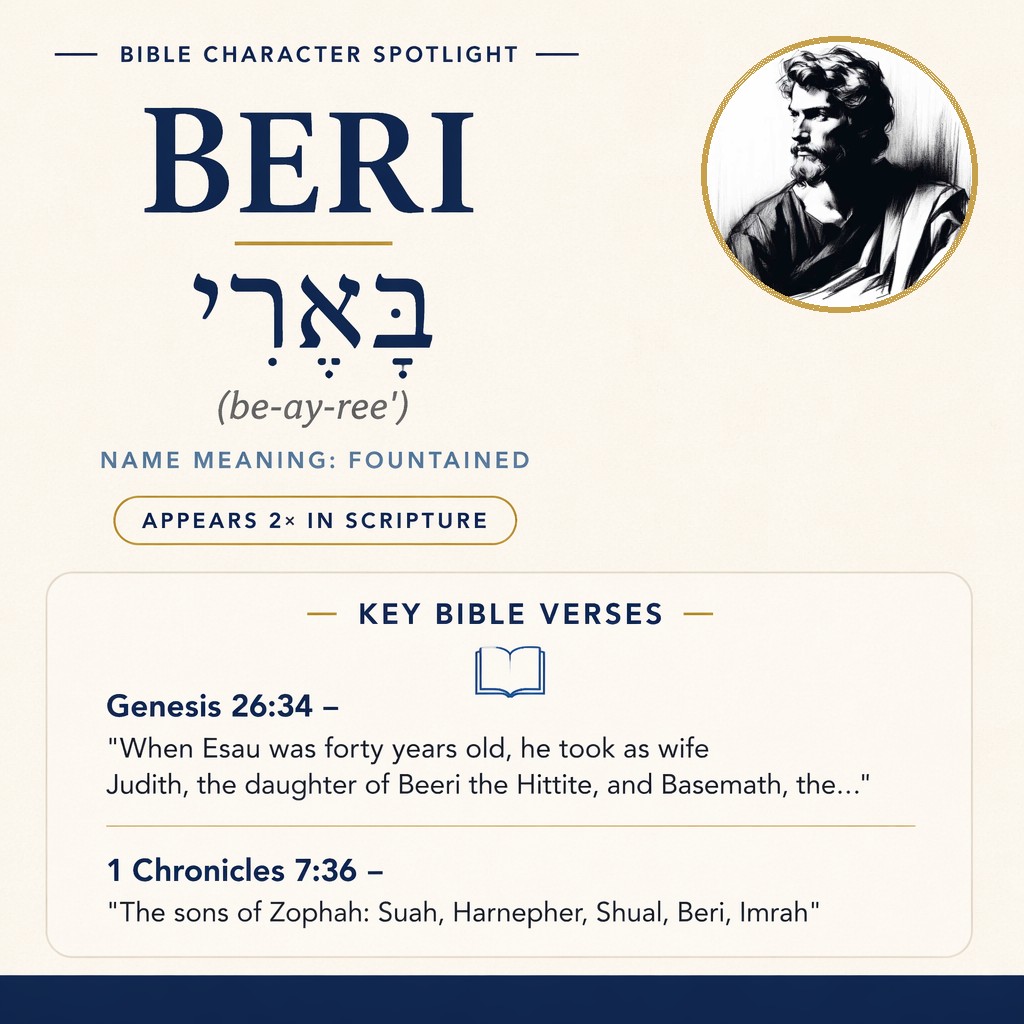
Beri (also spelled Beeri) is a biblical name appearing as a Hittite father-in-law of Esau (Genesis 26:34) and as an Israelite listed among Zophah’s sons (1 Chronicles 7:36).

Name and Form
Lexicon notes link Beri (Beriy) as a probable contraction of Beeri (Be’eriy), and connect the name to a well/pit word-root.
Learn More →Beri is the name of an Israelite listed among the sons of Zophah, and the name is also connected (in a closely related form) to Beeri, identified as a Hittite who was the father of Judith, one of Esau’s wives. Lexicon information associates the name with the idea of a “well” or “pit,” and indicates that the name has more than one bearer in Scripture.
Beri in Scripture
The form “Beri” appears in a genealogical list in 1 Chronicles, where he is named as one of several sons of Zophah. The immediate context sets Beri within a sequence of family lines.
“The sons of Shemer: Ahi, Rohgah, Jehubbah, and Aram.” (1 Chronicles 7:34, WEB)
“The sons of Helem his brother: Zophah, Imna, Shelesh, and Amal.” (1 Chronicles 7:35, WEB)
“The sons of Zophah: Suah, Harnepher, Shual, Beri, Imrah,” (1 Chronicles 7:36, WEB)
In the continuing line after this mention, the chapter remains in list form, adding further names that follow Beri’s appearance among Zophah’s sons.
“Bezer, Hod, Shamma, Shilshah, Ithran, and Beera.” (1 Chronicles 7:37, WEB)
“The sons of Jether: Jephunneh, Pispa, and Ara.” (1 Chronicles 7:38, WEB)
“The sons of Ulla: Arah, Hanniel, and Rizia.” (1 Chronicles 7:39, WEB)
Within this material, Beri is not described by deeds or speech; he is identified by placement in the family list: “The sons of Zophah… Beri” (1 Chronicles 7:36). The verses present him as part of an Israelite genealogy.
A closely related name form, “Beeri”, appears in Genesis in connection with Esau’s marriages. The narrative context immediately preceding that verse describes Isaac’s servants discovering water in a well, and the naming of a place.
“The same day, Isaac’s servants came, and told him concerning the well which they had dug, and said to him, ‘We have found water.’” (Genesis 26:32, WEB)
“He called it ‘Shibah’. Therefore the name of the city is ‘Beersheba’ to this day.” (Genesis 26:33, WEB)
Then Genesis identifies Beeri as a Hittite and as the father of Judith, whom Esau took as a wife, alongside another Hittite marriage in the same verse.
“When Esau was forty years old, he took as wife Judith, the daughter of Beeri the Hittite, and Basemath, the daughter of Elon the Hittite.” (Genesis 26:34, WEB)
The verse that follows reports the effect of these marriages on Isaac and Rebekah.
“They grieved Isaac’s and Rebekah’s spirits.” (Genesis 26:35, WEB)
Multiple Bearers
The lexicon information attached to these entries recognizes more than one bearer of the name: one associated with the Hittites (as “Beeri the Hittite” in Genesis 26:34) and one associated with an Israelite genealogy (as “Beri” among “The sons of Zophah” in 1 Chronicles 7:36). Scripture presents them in different settings: one is identified by ethnicity and a daughter’s marriage (“Judith, the daughter of Beeri the Hittite,” Genesis 26:34), and the other by his place in a list of descendants (“The sons of Zophah… Beri,” 1 Chronicles 7:36).
Name and Meaning
The name appears in Hebrew as בֵּרִי (transliteration Beriy, pronunciation bay-ree’) and in a closely related form as בְּאֵרִי (transliteration Be’eriy, pronunciation be-ay-ree’). Lexicon-derived information connects the longer form to a root associated with a “well” or “pit,” using the component word be’er (בְּאֵר), “a pit; especially a well,” and describes the name’s sense as connected with being “fountained.” The shorter form is explained as likely a contracted form of the longer.
Observation
In Scripture, the Israelite Beri is preserved through a genealogical record (“The sons of Zophah… Beri,” 1 Chronicles 7:36), while Beeri the Hittite is remembered through a family connection that affected Isaac and Rebekah (“They grieved Isaac’s and Rebekah’s spirits,” Genesis 26:35).
Frequently Asked Questions
What does the name Beri mean?
The name Beri is given as meaning “fountained.”
How many times does Beri appear in the Bible?
Beri/Beeri appears 2 times total across the two entries.
Who was Beri?
Beri is named as an Israelite in a list of Zophah’s sons in 1 Chronicles 7:36.
Was there more than one person named Beri?
Yes. Beeri is named as a Hittite (Genesis 26:34) and also as an Israelite, and Beri is named as an Israelite (1 Chronicles 7:36).
Explore Further
If you found this page about Beri interesting and would like to discover more about other biblical characters, explore our comprehensive Encyclopedia of Biblical Characters. For those looking to delve deeper into the Greek origins of these names and terms, our Greek Lexicon is an invaluable resource.
Sources: Name and occurrence data from Strong’s Exhaustive Concordance and STEPBible reference data (CC BY). Scripture quotations from the World English Bible (public domain).




