Who was Adrammelech in the bible?
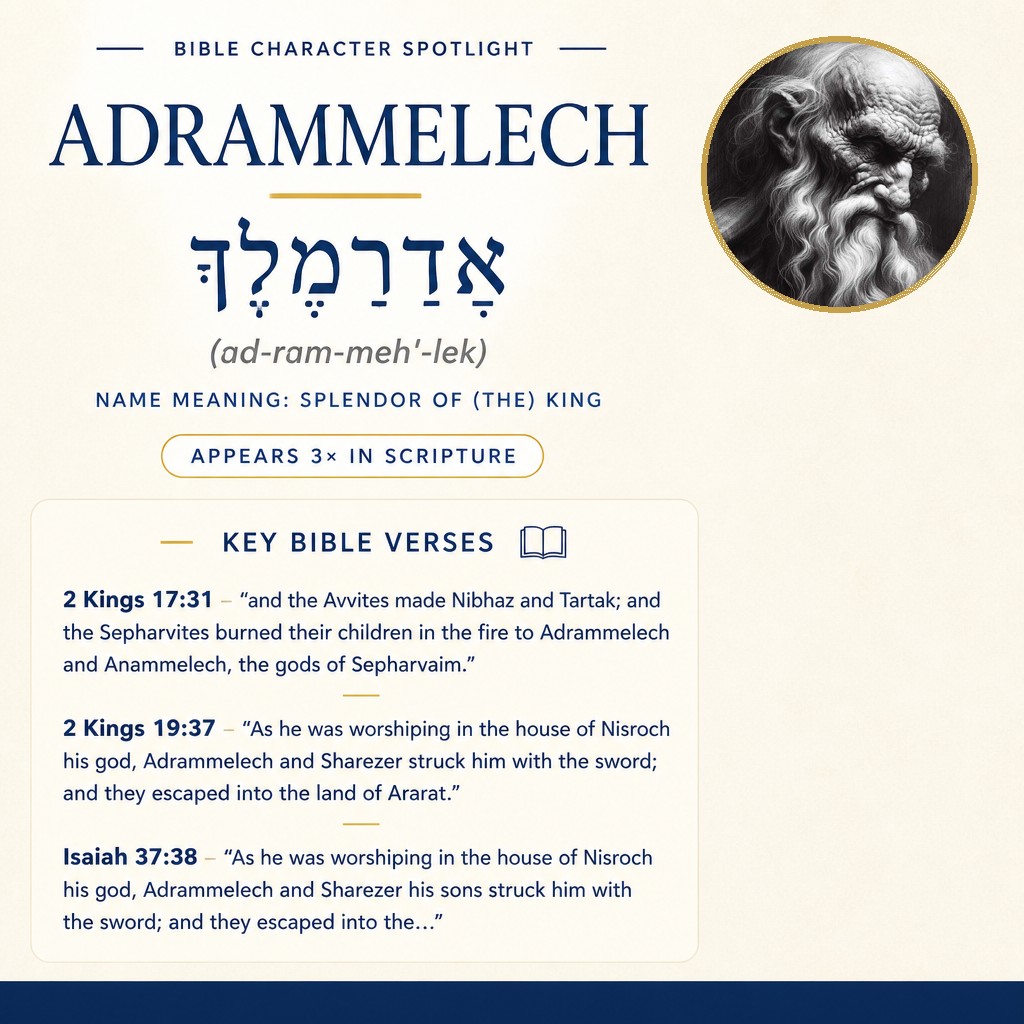
Adrammelech appears in 2 Kings 17:31; 2 Kings 19:37; and Isaiah 37:38 as a Sepharvaim god and as a son involved in Sennacherib’s death.

Idol Worship
“The Sepharvites burned their children in the fire to Adrammelech and Anammelech, the gods of Sepharvaim” (2 Kings 17:31).
Learn More →Sennacherib’s Death
“Adrammelech and Sharezer struck him with the sword; and they escaped into the land of Ararat” (2 Kings 19:37; Isaiah 37:38).
Learn More →Adrammelech is a name associated with two distinct bearers in the Bible: (1) an Assyrian idol described as “the gods of Sepharvaim,” and (2) a son of Sennacherib king of Assyria who took part in his father’s killing. The name is explained in lexicon form as meaning “splendor of (the) king.”
Adrammelech in Scripture
Adrammelech first appears in a description of the mixed worship practiced by various peoples settled in the cities where they lived. The setting emphasizes that “every nation made gods of their own” and placed them “in the houses of the high places.” In that context, Adrammelech is named among the deities served by the Sepharvites.
“However every nation made gods of their own, and put them in the houses of the high places which the Samaritans had made, every nation in their cities in which they lived.” (2 Kings 17:29, WEB)
“and the Avvites made Nibhaz and Tartak; and the Sepharvites burned their children in the fire to Adrammelech and Anammelech, the gods of Sepharvaim.” (2 Kings 17:31, WEB)
This passage situates Adrammelech within a broader picture of divided religious practice. The text continues by describing a combination of fearing Yahweh while also maintaining local worship patterns and offerings in “the houses of the high places.”
“So they feared Yahweh, and also made from among themselves priests of the high places for themselves, who sacrificed for them in the houses of the high places.” (2 Kings 17:32, WEB)
“They feared Yahweh, and also served their own gods, after the ways of the nations from among whom they had been carried away.” (2 Kings 17:33, WEB)
In its second and third occurrences, Adrammelech is presented as a person connected to the end of Sennacherib’s reign. The narrative setting begins with a decisive act attributed to Yahweh and its aftermath: an angel strikes a large number of Assyrians, and Sennacherib withdraws to Nineveh.
“That night, Yahweh’s angel went out, and struck one hundred eighty-five thousand in the camp of the Assyrians. When men arose early in the morning, behold, these were all dead bodies.” (2 Kings 19:35, WEB)
“So Sennacherib king of Assyria departed, and went and returned, and lived at Nineveh.” (2 Kings 19:36, WEB)
Then Adrammelech is named among those who attacked Sennacherib while he was engaged in worship. The account in Kings describes the act and flight, and adds that a successor reigned.
“As he was worshiping in the house of Nisroch his god, Adrammelech and Sharezer struck him with the sword; and they escaped into the land of Ararat. Esar Haddon his son reigned in his place.” (2 Kings 19:37, WEB)
Isaiah repeats the same basic event with a slightly fuller identification of the assailants as Sennacherib’s sons, preserving the same setting (“the house of Nisroch his god”), the same outcome (struck with the sword), the same escape (“the land of Ararat”), and the same succession (“Esar Haddon his son reigned in his place”).
“As he was worshiping in the house of Nisroch his god, Adrammelech and Sharezer his sons struck him with the sword; and they escaped into the land of Ararat. Esar Haddon his son reigned in his place.” (Isaiah 37:38, WEB)
Multiple Bearers
Adrammelech as a god of Sepharvaim. In 2 Kings 17, Adrammelech is explicitly placed among foreign deities: “Adrammelech and Anammelech, the gods of Sepharvaim” (2 Kings 17:31). The verse also states the form of devotion offered: “the Sepharvites burned their children in the fire to Adrammelech and Anammelech” (2 Kings 17:31).
Adrammelech as a son of Sennacherib. In the accounts of Sennacherib at Nineveh, Adrammelech is named as one of the attackers: “Adrammelech and Sharezer struck him with the sword” (2 Kings 19:37). Isaiah identifies them as sons: “Adrammelech and Sharezer his sons struck him with the sword” (Isaiah 37:38). Both passages say they “escaped into the land of Ararat” and connect the aftermath to the reign of “Esar Haddon his son” (2 Kings 19:37; Isaiah 37:38).
Name and Meaning
In Hebrew the name is written אֲדְרַמֶּלֶךְ, transliterated ‘Adrammelek, and pronounced ad-ram-meh’-lek. The lexicon explanation connects it to words meaning to expand or be great (‘adar) and “king” (melek), yielding the sense “splendor of (the) king.”
Observation
Across these passages, the same name appears in sharply different contexts: once as “the gods of Sepharvaim” receiving offerings (2 Kings 17:31), and again as a son involved in striking Sennacherib “with the sword” while he worshiped “in the house of Nisroch his god” (2 Kings 19:37; Isaiah 37:38).
Frequently Asked Questions
What does the name Adrammelech mean?
The name Adrammelech means “splendor of (the) king.”
How many times does Adrammelech appear in the Bible?
Adrammelech appears 3 times.
Who was Adrammelech in the Bible?
Adrammelech is named as an Assyrian idol, and also as a son of Sennacherib.
What does Adrammelech do in connection with Sennacherib?
While Sennacherib was worshiping in the house of Nisroch his god, Adrammelech and Sharezer struck him with the sword and escaped into the land of Ararat (Isaiah 37:38).
Explore Further
If you found this page about Adrammelech interesting and would like to discover more about other biblical characters, explore our comprehensive Encyclopedia of Biblical Characters. For those looking to delve deeper into the Greek origins of these names and terms, our Greek Lexicon is an invaluable resource.
Sources: Name and occurrence data from Strong’s Exhaustive Concordance and STEPBible reference data (CC BY). Scripture quotations from the World English Bible (public domain).