Who was Abiud in the bible?
Abiud is named in Matthew 1:13 in Jesus’ genealogy, between Zerubbabel and Eliakim.

Family Line
His place in the line is stated: "Abiud became the father of Eliakim" (Matthew 1:13).
Learn More →Name Origin
Strong’s identifies Abiud as a Greek form "of Hebrew origin." He is listed as "Abiud" in this entry.
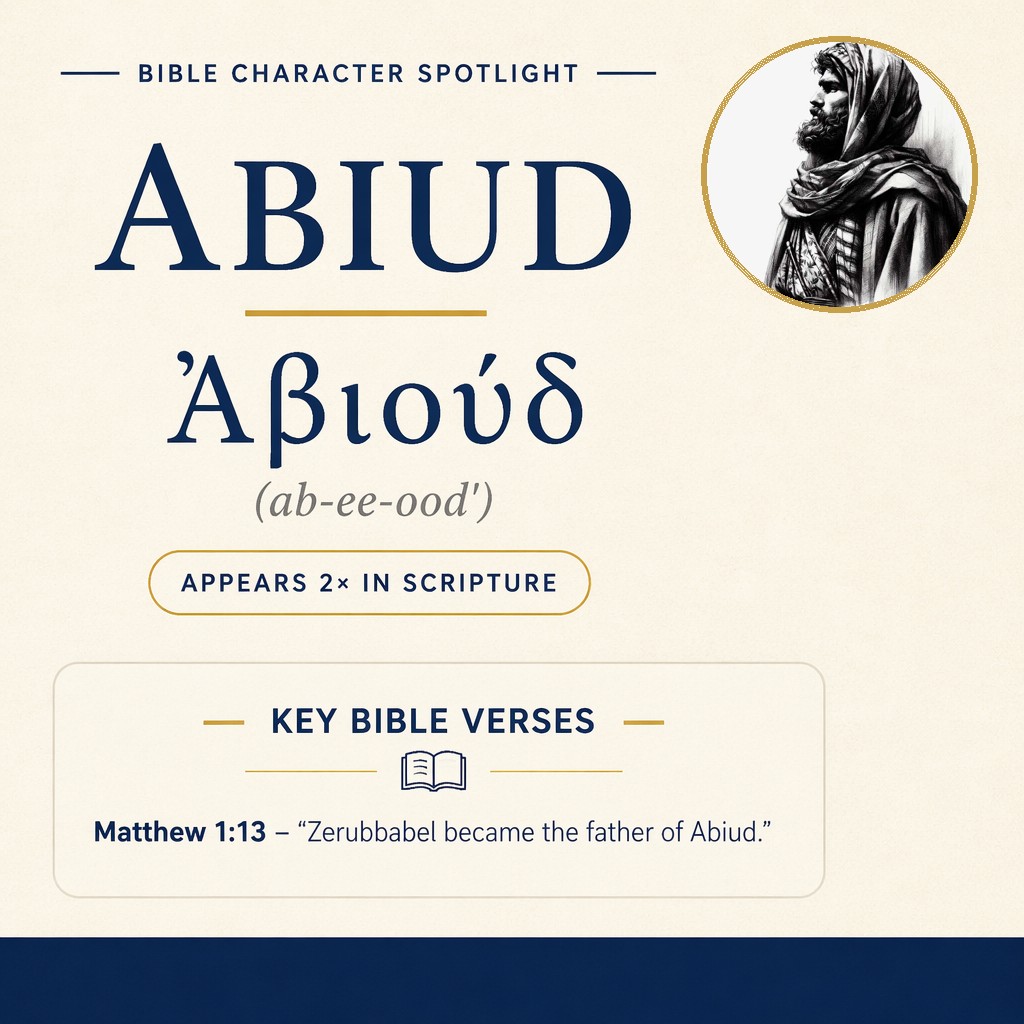
Learn More →Abiud is a man named in the genealogy recorded in Matthew, presented as a link in a line of descent: “Zerubbabel became the father of Abiud.” The name Abiud (Greek Ἀβιούδ) is of Hebrew origin.
Abiud in Scripture
Abiud appears in Matthew 1 within a sequence of “became the father of” statements that trace a line of descent leading to Jesus. In the portion of the genealogy where Abiud is mentioned, the text sets the larger frame by referring to a pivotal moment for the family line: “at the time of the exile to Babylon.”
Matthew 1:11: “Josiah became the father of Jechoniah and his brothers, at the time of the exile to Babylon.”
After that marker, Matthew continues the genealogy “After the exile to Babylon,” moving from Jechoniah to Shealtiel and then to Zerubbabel.
Matthew 1:12: “After the exile to Babylon, Jechoniah became the father of Shealtiel. Shealtiel became the father of Zerubbabel.”
Abiud is then named as the next generation after Zerubbabel. Matthew states both Abiud’s parentage and his place as a father in the continuing line.
Matthew 1:13: “Zerubbabel became the father of Abiud. Abiud became the father of Eliakim. Eliakim became the father of Azor.”
The genealogy continues beyond Abiud, showing that his mention functions as a single link between Zerubbabel and Eliakim, and then onward through additional generations. Immediately following Abiud’s verse, Matthew lists Azor’s descendants in the same formula, carrying the line forward.
Matthew 1:14: “Azor became the father of Zadok. Zadok became the father of Achim. Achim became the father of Eliud.”
Matthew 1:15: “Eliud became the father of Eleazar. Eleazar became the father of Matthan. Matthan became the father of Jacob.”
The chapter’s genealogical sequence proceeds to Joseph and then to Jesus. This places Abiud in the larger narrative movement of Matthew 1, which culminates in identifying Jesus as the one “who is called Christ.”
Matthew 1:16: “Jacob became the father of Joseph, the husband of Mary, from whom was born Jesus, who is called Christ.”
Within these verses, Abiud is presented only in genealogical terms: he is the son of Zerubbabel and the father of Eliakim, positioned in a lineage Matthew traces through and beyond the “exile to Babylon” and down to Joseph and Jesus.
Name and Meaning
In Greek script the name is written Ἀβιούδ (transliterated Abioud, pronounced ab-ee-ood’). Strong’s notes that the name is of Hebrew origin (H031), indicating that Matthew’s Greek form reflects a Hebrew-rooted name.
Observation
Matthew’s genealogy mentions Abiud in a single, clear relational statement—“Zerubbabel became the father of Abiud. Abiud became the father of Eliakim”—so his biblical role, as recorded here, is to connect successive generations in the line that the chapter traces to “Jesus, who is called Christ.”
Frequently Asked Questions
What does the name Abiud mean?
Abiud is a name of Hebrew origin.
How many times does Abiud appear in the Bible?
Abiud appears 2 times.
Who was Abiud?
Abiud is named in a genealogy in Matthew 1:13, where Zerubbabel is said to be the father of Abiud, and Abiud the father of Eliakim.
Where is Abiud mentioned?
Abiud is mentioned in Matthew 1:13.
Explore Further
If you found this page about Abiud interesting and would like to discover more about other biblical characters, explore our comprehensive Encyclopedia of Biblical Characters. For those looking to delve deeper into the Greek origins of these names and terms, our Greek Lexicon is an invaluable resource.
Sources: Name and occurrence data from Strong’s Exhaustive Concordance and STEPBible reference data (CC BY). Scripture quotations from the World English Bible (public domain).