Exploring the Meaning of Abioud in Greek
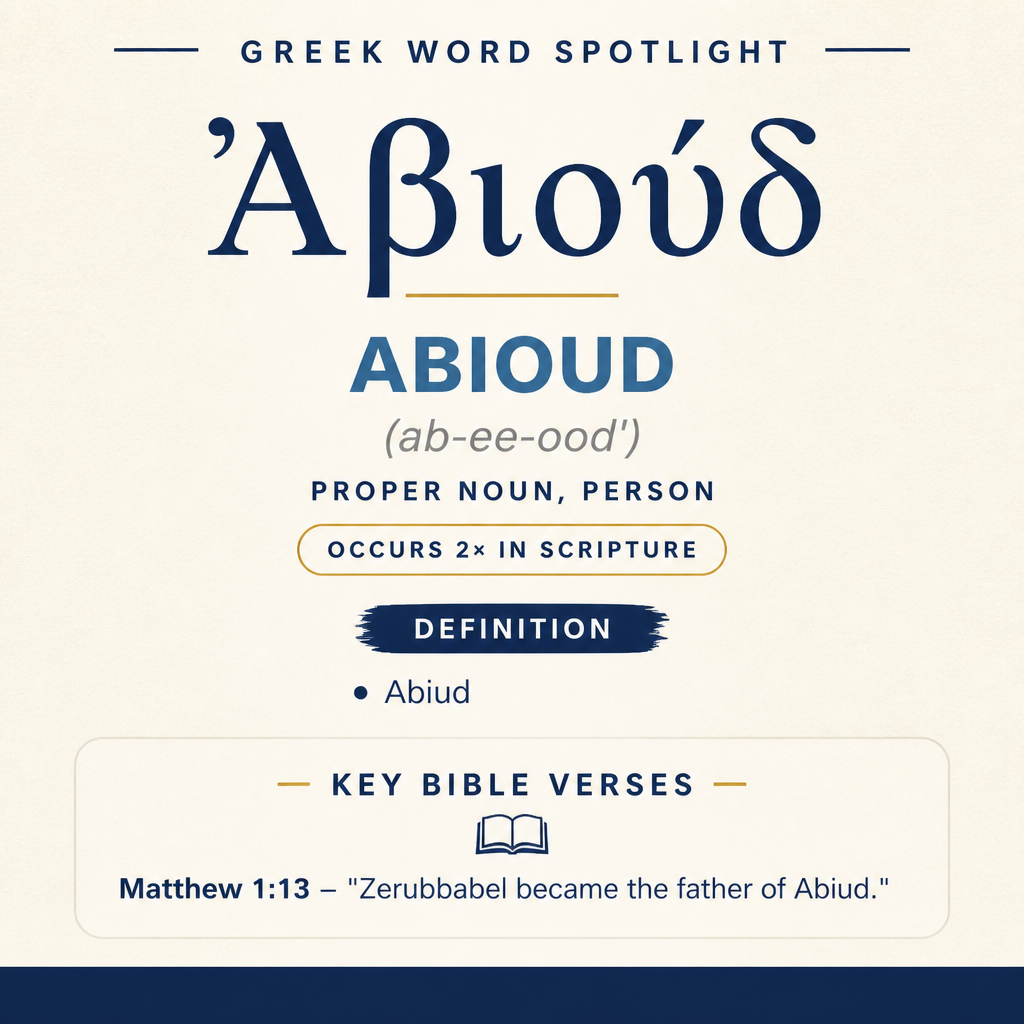
Ἀβιούδ (Abioud) means “Abiud” and appears in Matthew’s genealogy in Matthew 1:13.
Scripture Occurrences
This name occurs 2 times in Scripture. One occurrence is in Matthew 1:13.
Learn More →Genealogy Context
In Matthew 1:13, Zerubbabel became the father of Abiud. Abiud became the father of Eliakim.
Learn More →Ἀβιούδ means “Abiud,” a personal name. In Scripture it appears within a genealogical sequence in Matthew’s opening genealogy.
Occurrences
Matthew 1:13
“Zerubbabel became the father of Abiud. Abiud became the father of Eliakim. Eliakim became the father of Azor.” (Matthew 1:13)
Here Ἀβιούδ functions as one link in a chain of descent, set between two other named individuals. The verse is built from a repeated genealogical formula (“became the father of”), and Abiud occupies the middle position: he is presented as the son of Zerubbabel and the father of Eliakim. In this tightly structured line, the name does not introduce a narrative episode or speech; it serves to connect generations by naming a specific person through whom the family line is traced forward. The placement of Abiud between Zerubbabel and Eliakim also gives the genealogy continuity: it does not jump from one prominent figure to another without naming the intervening generation, but marks a step-by-step transmission of fatherhood from one named person to the next.

The verse’s symmetry reinforces Abiud’s role. The name appears twice in immediate succession—first as the child in relation to Zerubbabel, then as the father in relation to Eliakim—so that Abiud is portrayed in two familial directions at once. This double mention in a single verse emphasizes function rather than description: Abiud is defined in this context by relationship (“father of,” “son of”) and by position inside an ordered list, not by personal deeds, location, or character traits. The result is a compact identification whose main contribution is to anchor the continuity of the genealogy at a specific generational point.

Sense and Usage
As a proper name meaning “Abiud,” Ἀβιούδ is used to designate an individual in a lineage record. In Matthew 1:13 the usage is strictly referential: the word points to a particular person and distinguishes him from the surrounding names in the series. Because the verse is entirely genealogical, the sense of the name is carried by how it is framed—through repeated statements of fatherhood—rather than by any descriptive or narrative expansion. The name’s meaning is therefore expressed through its role as an identifier within a documented family line.
The way Matthew 1:13 uses Abiud also shows how a proper name can bear weight without additional information. The genealogy’s repeated structure allows each name to function as a hinge between two clauses: one clause ties the person to the previous generation, and the next clause ties the same person to the following generation. Abiud’s name is the pivot that holds those two clauses together. This is a distinctive kind of usage: the name itself supplies the necessary individuality, while the surrounding formula supplies the relational meaning—namely, the movement of descent across generations.
Within the verse, Abiud is not isolated as a standalone figure; he is embedded in a sequence that is meant to be read as a continuous line. The immediate context (“Zerubbabel … Abiud … Eliakim … Azor”) places Abiud among multiple proper names, each serving as a marker in the progression. That setting highlights the practical function of Ἀβιούδ in genealogical discourse: to preserve the integrity of the chain by naming each generational transition. The repetition of the name in two adjacent sentences makes the same point from two angles, ensuring there is no ambiguity about where Abiud stands in the line.
Genealogical Imagery
Matthew 1:13 presents family descent as a steady sequence of named links, where each generation is articulated by the simple cadence of “became the father of.” In that cadence, Abiud carries the imagery of connection: one name receiving a line from the past (“Zerubbabel became the father of Abiud”) and passing it forward (“Abiud became the father of Eliakim”). The verse’s austere style—names joined by repeated fatherhood statements—casts Abiud as a necessary segment in the visible chain of generations, a single named point where continuity is affirmed and the line advances.
Sources: Lexical data from Strong’s Exhaustive Concordance and the Translators Brief Lexicon of Extended Strongs for Greek (STEPBible, CC BY). Occurrence data from the Translators Amalgamated Greek New Testament (STEPBible, CC BY). Scripture quotations from the World English Bible (public domain).