
Who was Abinoam in the bible?
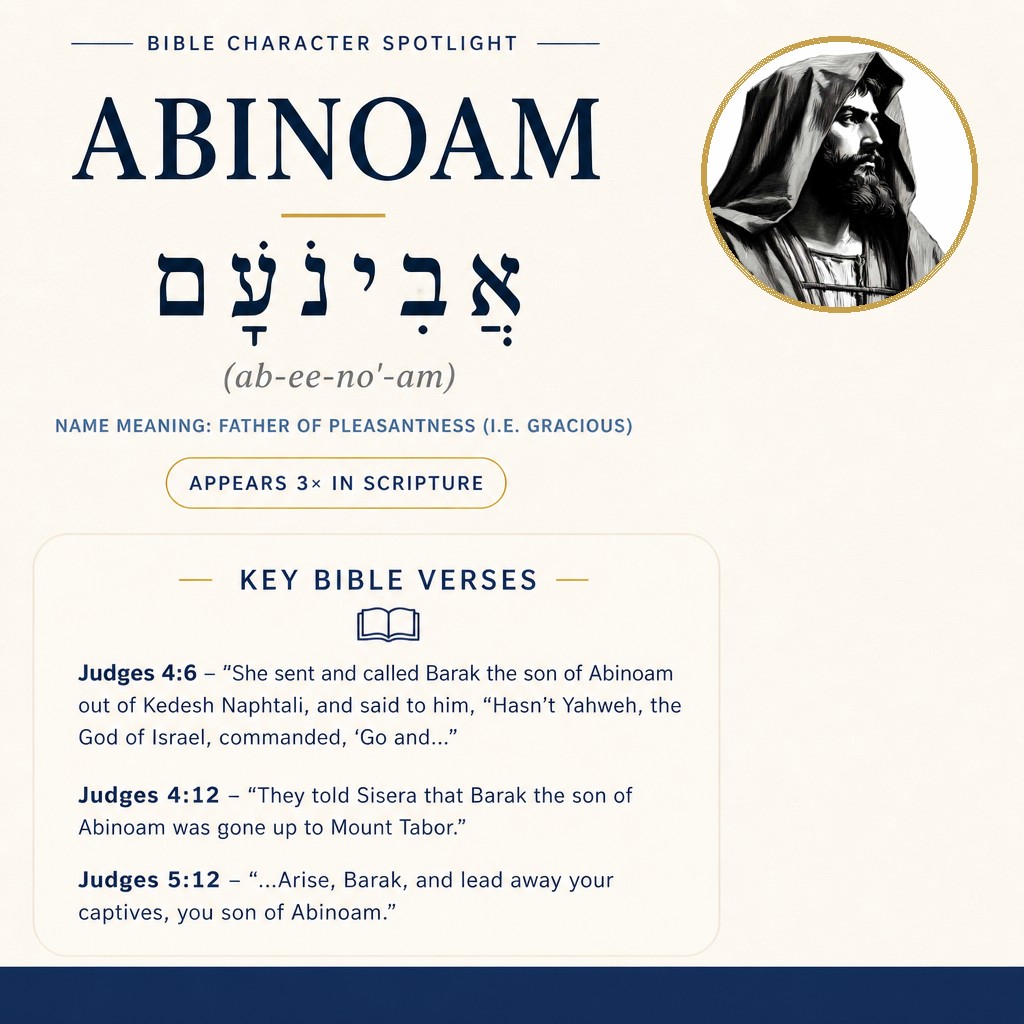
Abinoam was an Israelite mentioned in Judges 4–5 as the father of Barak.

Where Mentioned
His name appears in connection with Barak at Kedesh Naphtali and Mount Tabor (Judges 4:6, 4:12).
Learn More →Name Meaning
Strong’s derives Abinoam from terms meaning “father” and “pleasantness,” describing it as “father of pleasantness (i.e. gracious).”
Learn More →Abinoam is presented as an Israelite, known in Scripture as the father of Barak. His name is explained in Hebrew as carrying the sense of “father of pleasantness,” that is, “gracious.”
Abinoam in Scripture
Abinoam appears in Judges only through repeated identification of Barak as his son, within the narrative of Deborah’s leadership in Israel and the mobilization against Sisera.
The setting begins with Deborah’s role among Israel:
“Now Deborah, a prophetess, the wife of Lappidoth, judged Israel at that time.” (Judges 4:4)
“She lived under Deborah’s palm tree between Ramah and Bethel in the hill country of Ephraim; and the children of Israel came up to her for judgment.” (Judges 4:5)
From that place of judgment, Deborah summons Barak, identifying him by his father, Abinoam, and by his location:
“She sent and called Barak the son of Abinoam out of Kedesh Naphtali, and said to him, “Hasn’t Yahweh, the God of Israel, commanded, ‘Go and lead the way to Mount Tabor, and take with you ten thousand men of the children of Naphtali and of the children of Zebulun?” (Judges 4:6)
Deborah’s message to Barak continues with the promise of an encounter with Sisera and an assured outcome:
“I will draw to you, to the river Kishon, Sisera, the captain of Jabin’s army, with his chariots and his multitude; and I will deliver him into your hand.’ ” (Judges 4:7)
Barak responds with a condition tied to Deborah’s presence:
“Barak said to her, “If you will go with me, then I will go; but if you will not go with me, I will not go.” (Judges 4:8)
Deborah agrees to accompany him, while also declaring that the outcome will not be credited to Barak in the way he might expect:
“She said, “I will surely go with you. Nevertheless, the journey that you take won’t be for your honor; for Yahweh will sell Sisera into a woman’s hand.” Deborah arose, and went with Barak to Kedesh.” (Judges 4:9)
Barak then gathers forces, specifically from Zebulun and Naphtali, and the narrative emphasizes the number who go with him:
“Barak called Zebulun and Naphtali together to Kedesh. Ten thousand men followed him; and Deborah went up with him.” (Judges 4:10)
As the account proceeds, a note is made about Heber the Kenite’s location near Kedesh:
“Now Heber the Kenite had separated himself from the Kenites, even from the children of Hobab, Moses’ brother-in-law, and had pitched his tent as far as the oak in Zaanannim, which is by Kedesh.” (Judges 4:11)
As events escalate, Sisera receives intelligence identifying Barak again by his father, Abinoam, and by his movement toward Mount Tabor:
“They told Sisera that Barak the son of Abinoam was gone up to Mount Tabor.” (Judges 4:12)
Sisera then musters his chariots and people toward the river Kishon:
“Sisera gathered together all his chariots, even nine hundred chariots of iron, and all the people who were with him, from Harosheth of the Gentiles, to the river Kishon.” (Judges 4:13)
Deborah gives Barak the command to advance, framing the moment as a day of Yahweh’s action:
“Deborah said to Barak, “Go; for this is the day in which Yahweh has delivered Sisera into your hand. Hasn’t Yahweh gone out before you?” So Barak went down from Mount Tabor, and ten thousand men after him.” (Judges 4:14)
The text then describes the battle’s decisive turn in terms of Yahweh’s intervention, alongside Barak’s pursuit, and Sisera’s flight:
“Yahweh confused Sisera, all his chariots, and all his army, with the edge of the sword before Barak. Sisera abandoned his chariot and fled away on his feet.” (Judges 4:15)
In Judges 5, within the song context that follows, Deborah and Barak are called to speak and sing, and Barak is again addressed as Abinoam’s son—this time in a summons to rise and lead captives away:
“ ‘Awake, awake, Deborah! Awake, awake, utter a song! Arise, Barak, and lead away your captives, you son of Abinoam.’ ” (Judges 5:12)
The broader song context (as provided) includes calls to proclaim and “rehearse Yahweh’s righteous acts,” framing the conflict as part of Yahweh’s rule in Israel:
“Far from the noise of archers, in the places of drawing water, there they will rehearse Yahweh’s righteous acts, the righteous acts of his rule in Israel. “Then Yahweh’s people went down to the gates.” (Judges 5:11)
Within these chapters, Abinoam’s direct role is not expanded beyond being the named father of Barak, but the repeated formula—“Barak the son of Abinoam”—keeps Abinoam’s name attached to Barak at key moments: when Barak is summoned (Judges 4:6), when Sisera is informed (Judges 4:12), and when Barak is addressed in song (Judges 5:12). Through those identifications, Abinoam is indirectly situated within the narrative involving Kedesh Naphtali, Mount Tabor, the calling up of ten thousand men from Naphtali and Zebulun, and the conflict centered on the river Kishon.
Name and Meaning
The name is written in Hebrew script as אֲבִינֹעַם and transliterated ’Abiyno’am, pronounced ab-ee-no’-am. Its Hebrew derivation is explained as coming from the components ’ab (אָב), meaning “father,” and noʿam (נֹעַם), meaning “agreeableness” or “delight,” yielding the sense “father of pleasantness,” that is, “gracious.”
Observation
In Judges 4–5, Abinoam is remembered through the public identification of Barak as “the son of Abinoam,” a designation repeated in both narrative report and song (Judges 4:6; 4:12; 5:12).
Frequently Asked Questions
What does the name Abinoam mean?
The name Abinoam means “father of pleasantness,” that is, “gracious.”
How many times does Abinoam appear in the Bible?
Abinoam appears 3 times.
Who was Abinoam?
Abinoam is identified as an Israelite and is named as the father of Barak (Judges 4:6).
Where is Abinoam mentioned in relation to Barak?
Abinoam is mentioned when Barak is called “the son of Abinoam,” including in Judges 4:12 and Judges 5:12.
Explore Further
If you found this page about Abinoam interesting and would like to discover more about other biblical characters, explore our comprehensive Encyclopedia of Biblical Characters. For those looking to delve deeper into the Greek origins of these names and terms, our Greek Lexicon is an invaluable resource.
Sources: Name and occurrence data from Strong’s Exhaustive Concordance and STEPBible reference data (CC BY). Scripture quotations from the World English Bible (public domain).




