
Who was Deborah in the bible?
Deborah is the name of two Hebrew women, appearing in Genesis 35:8 and Judges 4–5.
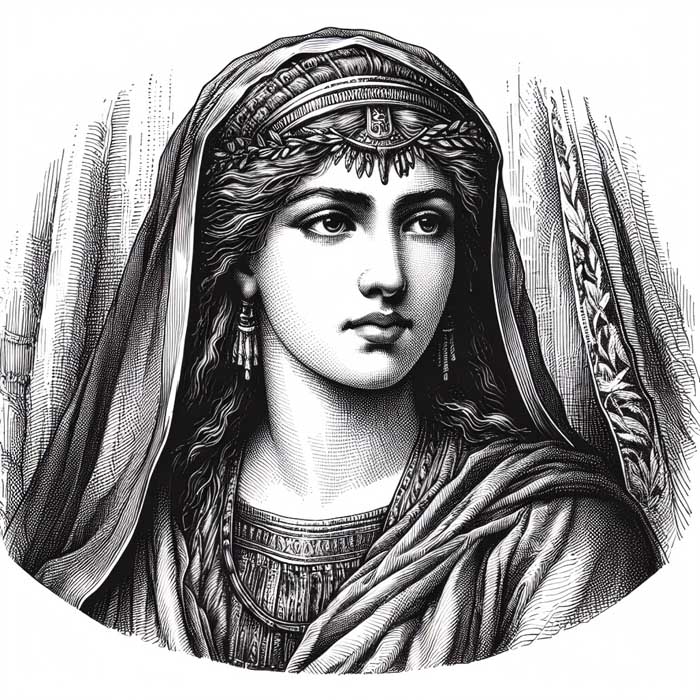
Judge and Prophetess
“Now Deborah, a prophetess, the wife of Lappidoth, judged Israel at that time” (Judges 4:4). “The children of Israel came up to her for judgment” as she lived between Ramah and Bethel (Judges 4:5).
Learn More →Call to Battle
Deborah told Barak, “Go; for this is the day in which Yahweh has delivered Sisera into your hand” (Judges 4:14). She also said Yahweh would “sell Sisera into a woman’s hand” (Judges 4:9).
Learn More →Deborah is the name of two Hebrew women in Scripture. In the passages given, one Deborah is “Rebekah’s nurse” who died and was buried near Bethel, and another Deborah is a prophetess who judged Israel and spoke Yahweh’s command to Barak in the conflict with Sisera.
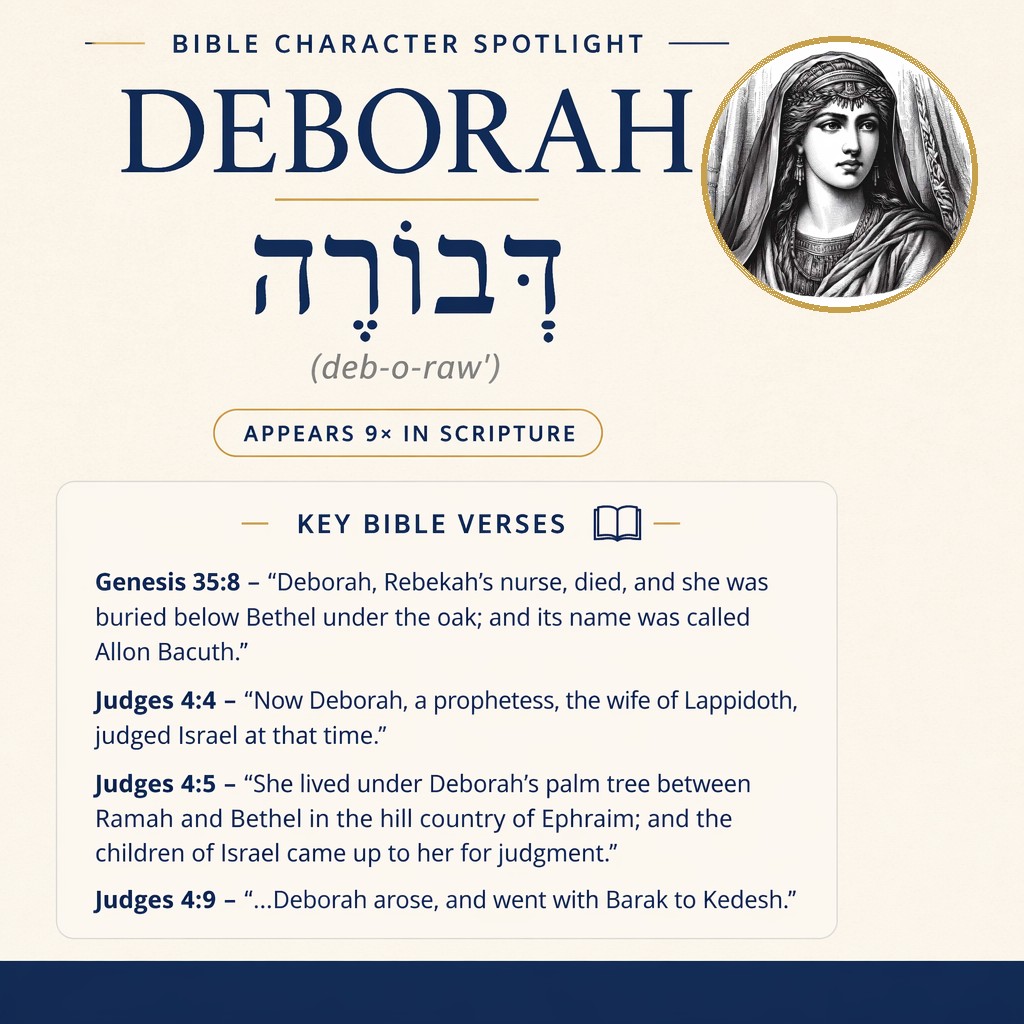
Deborah in Scripture
The first occurrence identifies Deborah as connected to Rebekah’s household and records her death and burial place.
“Deborah, Rebekah’s nurse, died, and she was buried below Bethel under the oak; and its name was called Allon Bacuth.” (Genesis 35:8)
The larger narrative involving the second Deborah appears in Judges 4, where Israel’s distress sets the scene. The chapter opens:
“The children of Israel again did that which was evil in Yahweh’s sight, when Ehud was dead.” (Judges 4:1)
The oppression described is political and military: Yahweh “sold them into the hand of Jabin king of Canaan, who reigned in Hazor,” and “the captain of whose army was Sisera.” (Judges 4:2) Israel’s suffering is emphasized by the details that Sisera had “nine hundred chariots of iron,” and that “he mightily oppressed the children of Israel for twenty years.” (Judges 4:3)
Within this setting Deborah is introduced by role and association.
“Now Deborah, a prophetess, the wife of Lappidoth, judged Israel at that time.” (Judges 4:4)
Her location and the people’s practice of approaching her for legal decisions are then stated plainly.
“She lived under Deborah’s palm tree between Ramah and Bethel in the hill country of Ephraim; and the children of Israel came up to her for judgment.” (Judges 4:5)
From that position she initiates contact with Barak. The narrative gives Barak’s identification and Deborah’s message as a question that assumes Yahweh’s command.
“She sent and called Barak the son of Abinoam out of Kedesh Naphtali, and said to him, ‘Hasn’t Yahweh, the God of Israel, commanded, “Go and lead the way to Mount Tabor, and take with you ten thousand men of the children of Naphtali and of the children of Zebulun? I will draw to you, to the river Kishon, Sisera, the captain of Jabin’s army, with his chariots and his multitude; and I will deliver him into your hand.” ’ ” (Judges 4:6–7)
Barak’s response makes his going contingent on Deborah’s presence.
“Barak said to her, ‘If you will go with me, then I will go; but if you will not go with me, I will not go.’ ” (Judges 4:8)
Deborah agrees to go, but adds a warning about honor and identifies how Sisera will ultimately be delivered.
“She said, ‘I will surely go with you. Nevertheless, the journey that you take won’t be for your honor; for Yahweh will sell Sisera into a woman’s hand.’ Deborah arose, and went with Barak to Kedesh.” (Judges 4:9)
The movement of people and place is then narrated: Barak musters troops, and Deborah accompanies him.
“Barak called Zebulun and Naphtali together to Kedesh. Ten thousand men followed him; and Deborah went up with him.” (Judges 4:10)
The chapter continues by describing developments around Sisera and the battlefield. Sisera is informed that “Barak the son of Abinoam was gone up to Mount Tabor,” so Sisera gathers “all his chariots, even nine hundred chariots of iron,” and his forces “to the river Kishon.” (Judges 4:12–13)
At the key moment Deborah speaks again to Barak with urgency and confidence that Yahweh is acting ahead of him.
“Deborah said to Barak, ‘Go; for this is the day in which Yahweh has delivered Sisera into your hand. Hasn’t Yahweh gone out before you?’ So Barak went down from Mount Tabor, and ten thousand men after him.” (Judges 4:14)
The outcome is credited to Yahweh: “Yahweh confused Sisera, all his chariots, and all his army,” while Barak’s pursuit results in Sisera’s army falling “by the edge of the sword.” (Judges 4:15–16) Sisera himself escapes on foot and flees “to the tent of Jael the wife of Heber the Kenite.” (Judges 4:17) The narrative notes a political condition that explains his refuge: “for there was peace between Jabin the king of Hazor and the house of Heber the Kenite.” (Judges 4:17)
Jael’s interaction with Sisera is described in detail: she invites him into the tent, covers him, gives him a drink, and he instructs her to deny that anyone is present if asked. (Judges 4:18–20) Jael then kills Sisera with a tent peg while he sleeps.
“Then Jael Heber’s wife took a tent peg, and took a hammer in her hand, and went softly to him, and struck the pin into his temples, and it pierced through into the ground, for he was in a deep sleep; so he fainted and died.” (Judges 4:21)
When Barak arrives in pursuit, Jael shows him Sisera’s body.
“Behold, as Barak pursued Sisera, Jael came out to meet him, and said to him, ‘Come, and I will show you the man whom you seek.’ He came to her; and behold, Sisera lay dead, and the tent peg was in his temples.” (Judges 4:22)
The chapter ends by describing the broader result for Israel against Jabin.
“So God subdued Jabin the king of Canaan before the children of Israel on that day.” (Judges 4:23)
“The hand of the children of Israel prevailed more and more against Jabin the king of Canaan, until they had destroyed Jabin king of Canaan.” (Judges 4:24)
Additional verses in Judges 5 place Deborah’s voice in poetic speech, presenting her self-description and calling others to action in song.
“The rulers ceased in Israel. They ceased until I, Deborah, arose; Until I arose a mother in Israel.” (Judges 5:7)
“ ‘Awake, awake, Deborah! Awake, awake, utter a song! Arise, Barak, and lead away your captives, you son of Abinoam.’ ” (Judges 5:12)
“The princes of Issachar were with Deborah. As was Issachar, so was Barak. They rushed into the valley at his feet. By the watercourses of Reuben, there were great resolves of heart.” (Judges 5:15)
Multiple Bearers
Scripture uses the name Deborah for two different women in the verses provided. One is “Deborah, Rebekah’s nurse,” whose death and burial “below Bethel under the oak” are recorded. (Genesis 35:8) The other is “Deborah, a prophetess, the wife of Lappidoth,” who “judged Israel at that time,” lived “under Deborah’s palm tree,” and spoke words attributed to Yahweh’s command in the conflict involving Barak and Sisera. (Judges 4:4–7)
Name and Meaning
In Hebrew the name is written דְּבּוֹרָה, transliterated Debowrah and pronounced deb-o-raw’. According to the lexicon information provided, the name is connected to the word for “the bee,” and the entry notes Deborah as the name of two Hebrew women.
Observation
In Judges 4 Deborah is presented both as a judge to whom “the children of Israel came up … for judgment” (Judges 4:5) and as a prophetess whose words frame the decisive moment: “Go; for this is the day in which Yahweh has delivered Sisera into your hand.” (Judges 4:14)
Frequently Asked Questions
What does the name Deborah mean?
Deborah is given as the name of two Hebrewesses.
How many times does Deborah appear in the Bible?
Deborah appears 9 times.
Who was Deborah in the Bible?
The name Deborah refers to two women: Deborah, Rebekah’s nurse (Genesis 35:8), and Deborah, a prophetess who judged Israel and is called the wife of Lappidoth (Judges 4:4).
Where did people go to receive Deborah’s judgment?
She lived under Deborah’s palm tree between Ramah and Bethel in the hill country of Ephraim, and the children of Israel came up to her for judgment (Judges 4:5).
Explore Further
If you found this page about Deborah interesting and would like to discover more about other biblical characters, explore our comprehensive Encyclopedia of Biblical Characters. For those looking to delve deeper into the Greek origins of these names and terms, our Greek Lexicon is an invaluable resource.
Sources: Name and occurrence data from Strong’s Exhaustive Concordance and STEPBible reference data (CC BY). Scripture quotations from the World English Bible (public domain).




