
Exploring the Meaning of Tribolos in Greek
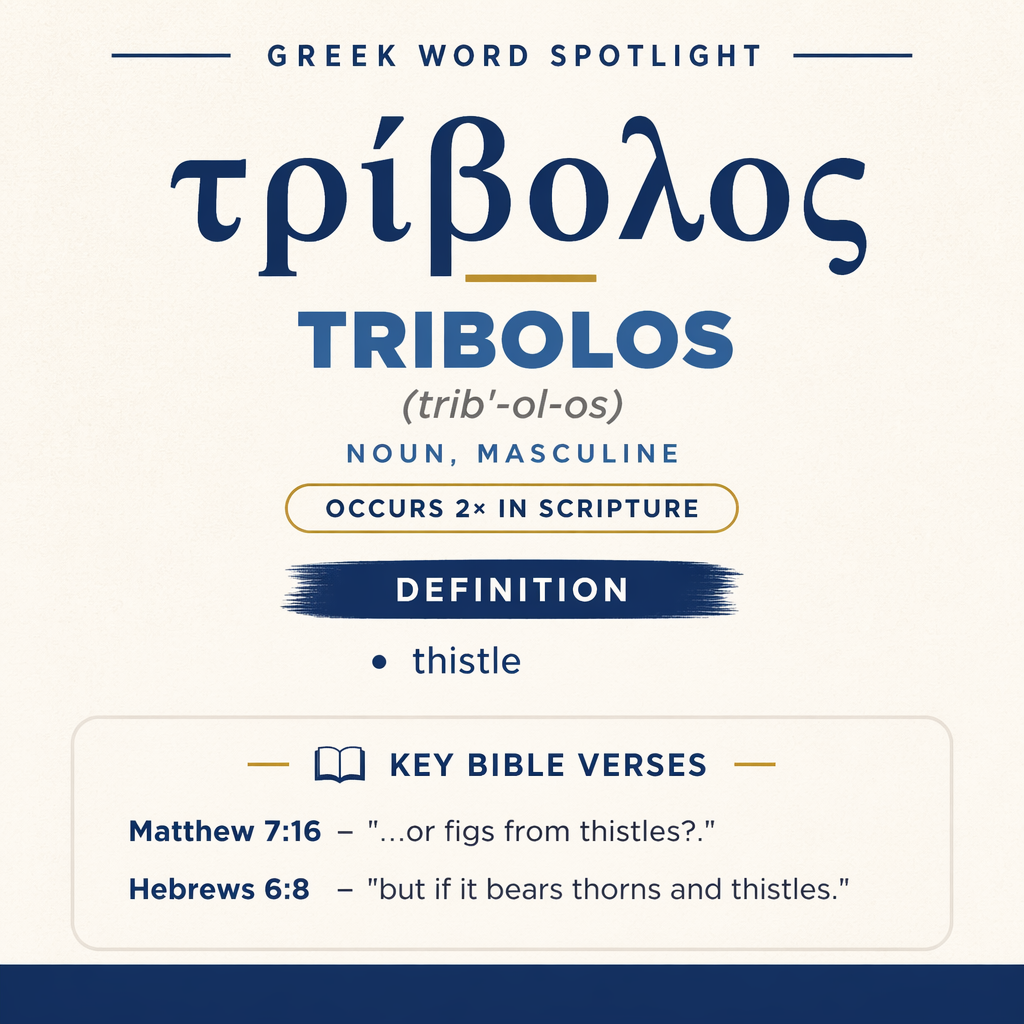
τρίβολος means “thistle” and appears twice in Scripture: Matthew 7:16 and Hebrews 6:8.
Gospel Context
In Matthew 7:16, thistles are contrasted with figs in a question about recognizing fruits.
Learn More →Warning Image
In Hebrews 6:8, land bearing thorns and thistles is rejected, near being cursed, and ends burned.
Learn More →τρίβολος means “thistle,” a prickly plant used in Scripture imagery for what is unproductive and undesirable. It appears in a saying of Jesus about recognizing people by their fruit and in an exhortation in Hebrews contrasting fruitful land with land that produces harmful growth.
Root and Related Words
Strong’s associates τρίβολος with τρεῖς (treis), “three” (Strong’s G5140), and βέλος (belos), “arrow” (Strong’s G956). This pairing points to a form and sound-shape in which the word is heard as a compound built from familiar elements: a numerical term and a term for a projectile.

Occurrences
“By their fruits you will know them. Do you gather grapes from thorns, or figs from thistles?” (Matthew 7:16)
Here τρίβολος sits in a paired contrast: “thorns” on the one side and “thistles” on the other, set against “grapes” and “figs.” The question assumes a plain agricultural expectation: valuable fruit is gathered from appropriate plants, not from plants characterized by sharpness and nuisance growth. In the logic of the sentence, “thistles” are not merely different from a fig tree; they function as a stock example of what does not yield the desired harvest. The word therefore strengthens the force of Jesus’ test—what a person produces corresponds to what that person is—by choosing an image that is easy to picture and hard to dispute: no one goes to thistles expecting figs.
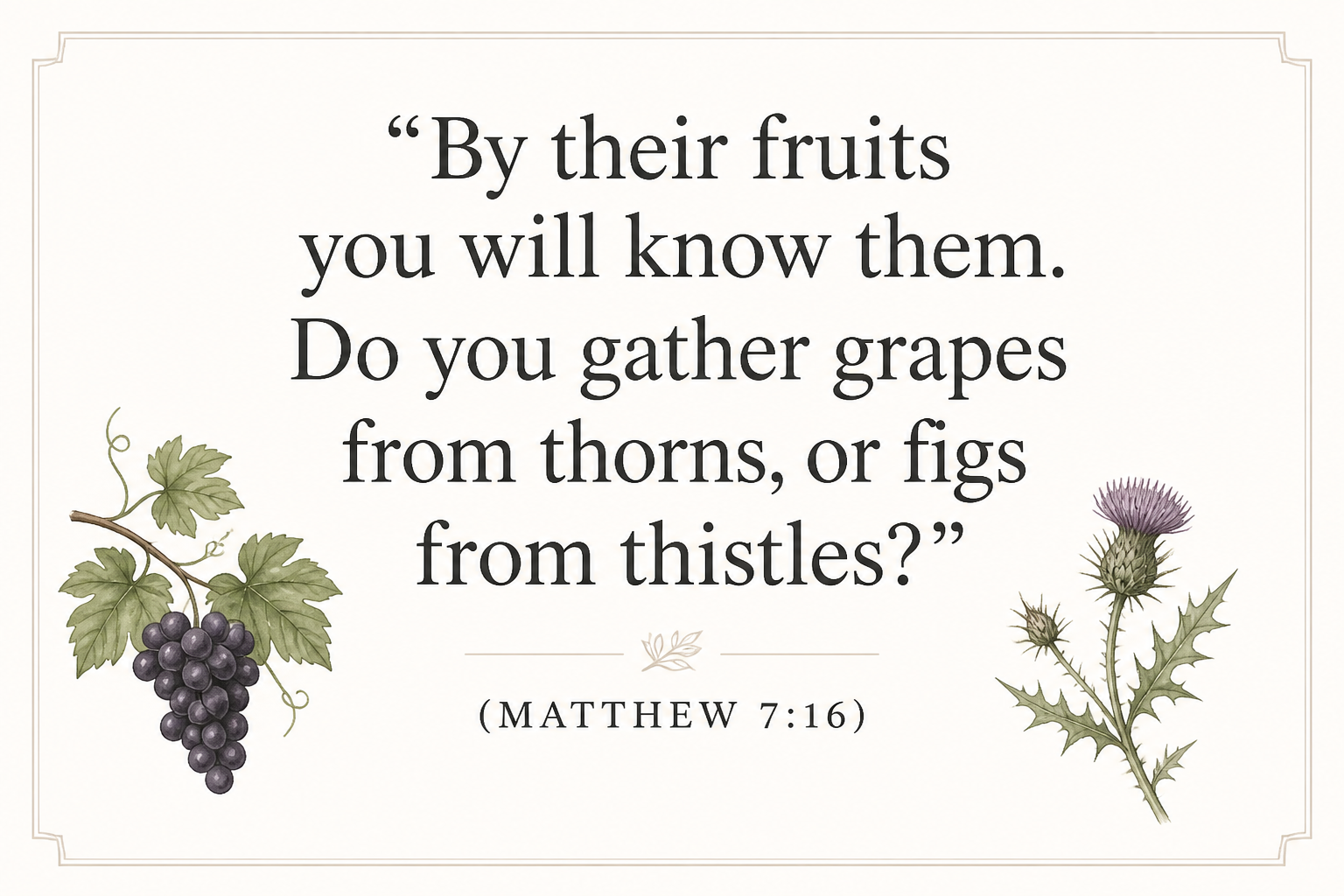
The placement of “thistles” after “thorns” also gives the saying a widened scope. The image does not rest on one kind of problematic growth; it gathers two familiar obstacles to harvesting. τρίβολος contributes to the breadth of the negative category in the illustration: it is one more instance of plant life that may be present in a field or hedgerow but is not the source of edible fruit.
“but if it bears thorns and thistles, it is rejected and near being cursed, whose end is to be burned.” (Hebrews 6:8)
In Hebrews, τρίβολος appears in a conditional statement about what the land “bears.” The verb “bears” frames the plant as a product of the soil: what emerges reveals what the land has yielded. The pairing “thorns and thistles” again collects two kinds of unwanted growth, and τρίβολος contributes the second member of that pair, reinforcing the idea of a field producing what hinders rather than what nourishes.
The sentence then draws out consequences in a sequence: “it is rejected,” “near being cursed,” and finally “whose end is to be burned.” In this chain, “thistles” belong to the evidence that a plot is unfit. The word helps portray a crop that does not merely fail to help; it marks ground as worthy of refusal. The final image—burning—fits the situation described in the verse itself: where thorns and thistles dominate, the land’s “end” is destructive removal rather than harvesting. τρίβολος thus functions as part of the diagnostic description that leads to the verdict and the outcome named in the same sentence.
Sense and Usage
Across these passages, τρίβολος carries a consistent concrete reference: the thistle as a recognizable plant in ordinary experience. Yet its rhetorical weight comes from how such a plant is positioned in relation to human aims. In Matthew 7:16, thistles are the wrong source for “figs”; the image depends on the mismatch between what is sought (fruit) and what is encountered (plants known for being unsuitable for gathering fruit). The word therefore works as a negative indicator: it belongs to the category of growth that cannot satisfy the expectation of a harvest.
In Hebrews 6:8, the thistle is no longer merely the wrong place to look; it is part of what the soil itself produces. The shift from “gather” (Matthew) to “bears” (Hebrews) changes the angle of the picture. Matthew’s saying focuses on recognition—what can be known by looking for fruit where it should be. Hebrews focuses on evaluation—what a field is judged to be when its output is dominated by what does not serve cultivation. In both, τρίβολος is not treated as a neutral botanical label but as a marker of failed or harmful productivity within a farming framework.
The consistent coupling with “thorns” also shapes its usage. The word appears as part of a set of undesirable plants, so that the listener or reader does not isolate a single specimen but sees a broader scene of obstructive growth. The repeated pairing builds a shared register: thistles belong to what frustrates harvesting and invites removal. Even without extended description, τρίβολος contributes texture to the imagery because it names a specific kind of plant that stands over against “grapes” and “figs” in one passage and over against accepted, fruitful produce in the other.
Imagery
The two contexts give τρίβολος a vivid moral and practical resonance while keeping the picture grounded in the field. In Matthew 7:16, thistles sharpen the common-sense force of the question: the mismatch between plant and fruit makes the point immediate. In Hebrews 6:8, thistles darken the scene: a plot bearing them is not simply inconvenient but headed toward rejection and burning. In both cases, τρίβολος brings the reader to the edge of a cultivated space where what grows naturally is contrasted with what is desired, and the presence of thistles signals that the desired end—fruitful harvest—has not been reached.
Sources: Lexical data from Strong’s Exhaustive Concordance and the Translators Brief Lexicon of Extended Strongs for Greek (STEPBible, CC BY). Occurrence data from the Translators Amalgamated Greek New Testament (STEPBible, CC BY). Scripture quotations from the World English Bible (public domain).




