
Exploring the Meaning of Tribos in Greek
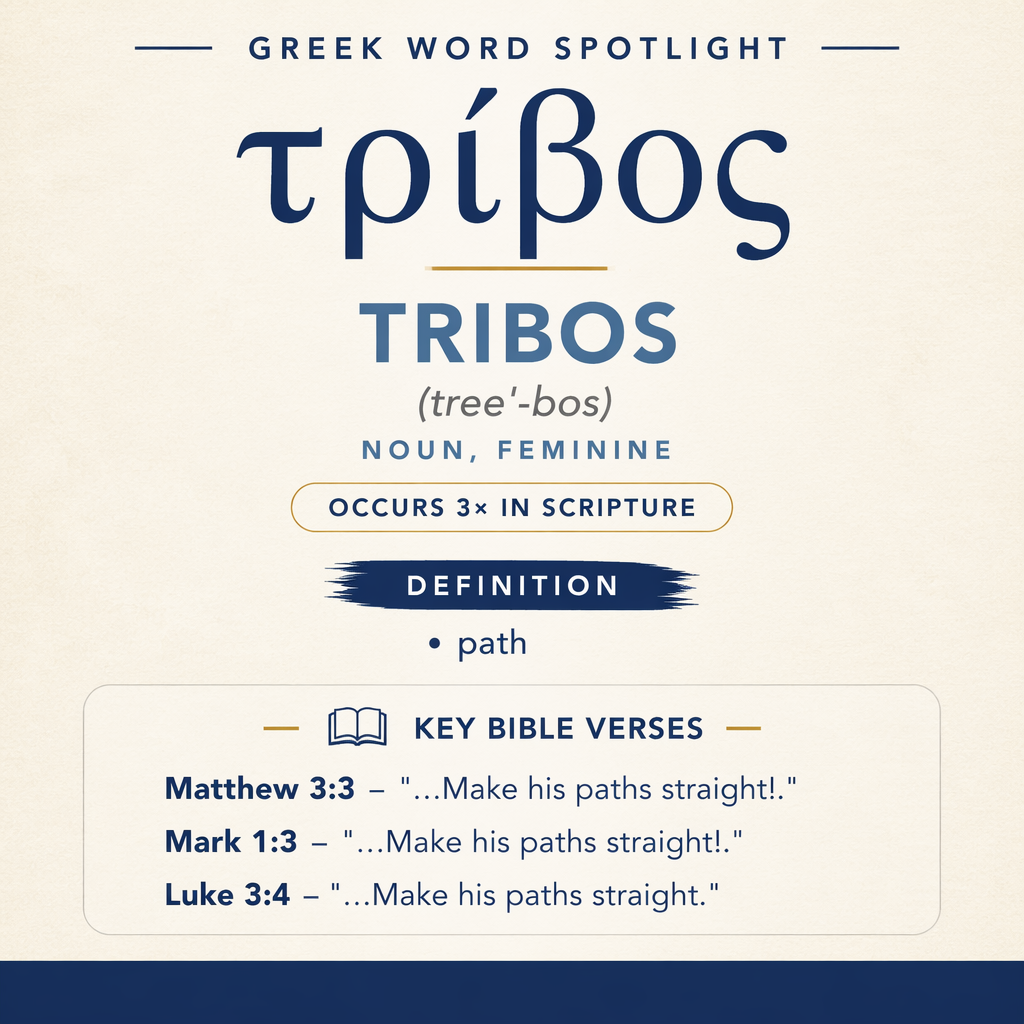
τρίβος means “path” and appears three times in Scripture: Matthew 3:3, Mark 1:3, and Luke 3:4.
Scripture Occurrences
It occurs three times in Scripture: Matthew 3:3, Mark 1:3, and Luke 3:4.
Learn More →Isaiah Quotation
In each occurrence, the verse quotes Isaiah about a “voice … in the wilderness” preparing the way and straightening paths.
Learn More →τρίβος means “path” and appears in the New Testament in the citation of Isaiah’s words about preparing for the Lord. In each setting it belongs to a proclamation “in the wilderness” that calls for paths to be made straight.
Occurrences
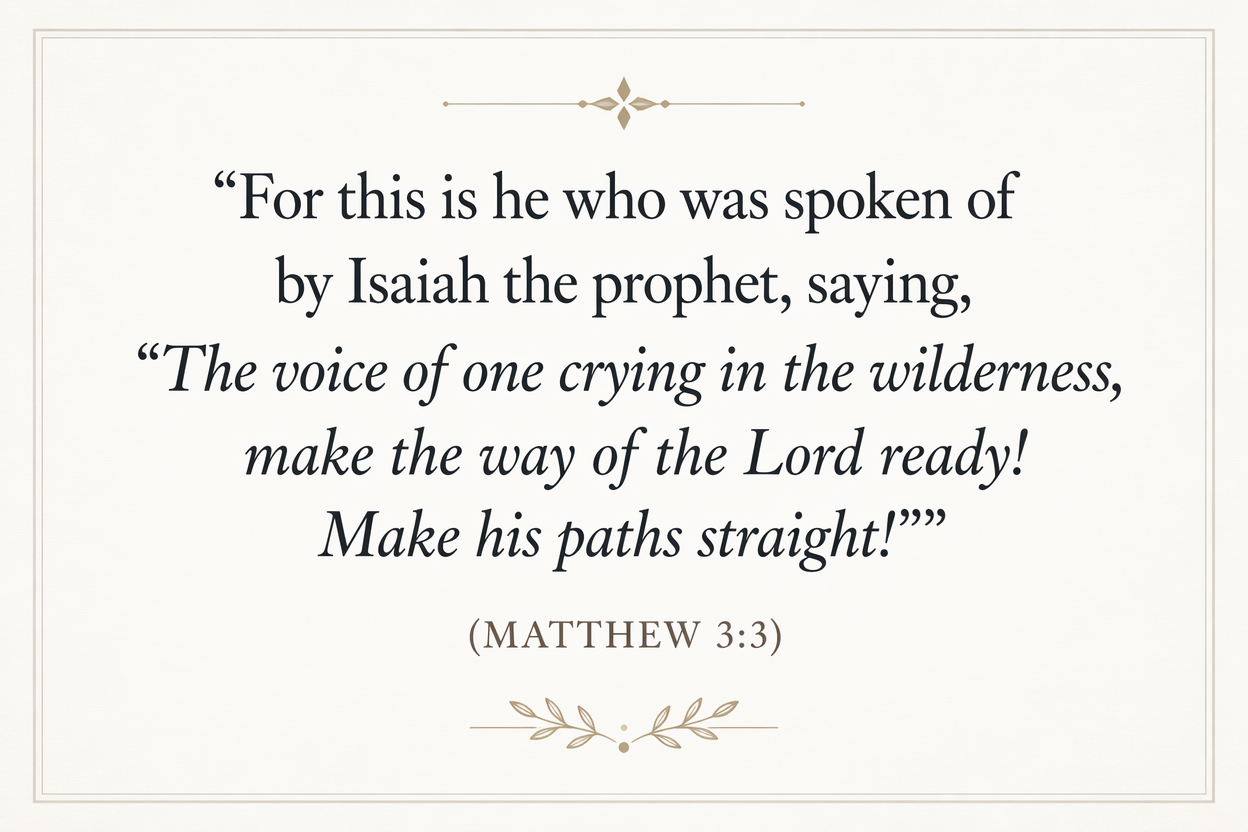
“For this is he who was spoken of by Isaiah the prophet, saying, “The voice of one crying in the wilderness, make the way of the Lord ready! Make his paths straight!”” (Matthew 3:3)
Here τρίβος stands within a pair of parallel commands. First comes “make the way of the Lord ready,” then the further imperative, “Make his paths straight!” The shift from “the way” (singular) to “paths” (plural) paints preparation as more than a single roadway; it includes the network of paths that lead toward the Lord’s coming. In this scene the “voice” is “crying in the wilderness,” so the word “paths” brings tangible direction and route-language into a setting that might otherwise feel trackless. The command assumes that paths can be evaluated and altered: they can be made “straight,” not left wandering or obstructed. τρίβος therefore contributes an image of practical readiness expressed as the straightening of actual routes.
“the voice of one crying in the wilderness, ‘Make ready the way of the Lord! Make his paths straight!’ ” (Mark 1:3)
Mark presents the line as a direct quotation framed by the announcing voice. The two imperatives again stand side by side: “Make ready the way of the Lord!” and “Make his paths straight!” τρίβος contributes the concrete object of the second command: the Lord’s “paths.” Within the short, urgent rhythm of the quotation, “paths” focuses the hearer’s imagination on where movement will occur and how it should proceed. The word also helps balance the proclamation: the “way” is to be made ready, and the “paths” are to be straight. In Mark’s wording, the command presses for immediate action—readiness is pictured not as an inward attitude but as attention to the path itself, reshaped so it is straight.
“As it is written in the book of the words of Isaiah the prophet, “The voice of one crying in the wilderness, ‘Make ready the way of the Lord. Make his paths straight.” (Luke 3:4)
Luke introduces the quotation with a more explicit literary frame: “As it is written in the book of the words of Isaiah the prophet.” Against that backdrop, τρίβος functions as part of what is “written,” anchoring Luke’s presentation of the proclamation in scripted wording. Within the quotation, the voice is again “crying in the wilderness,” and the two commands follow: “Make ready the way of the Lord. Make his paths straight.” In Luke’s phrasing, “paths” stays closely attached to “his,” keeping the paths oriented to the Lord rather than to the hearers. The word “paths” thus carries the image of routes that belong to the Lord’s approach and are to be rendered straight, as though the proper arrival is facilitated by the condition of these paths.

Sense and Usage
Across these passages τρίβος names a “path” in a way that fits the wilderness setting: a wilderness can be imagined as lacking roads, yet the quotation speaks as if paths exist and can be prepared. The word therefore supplies a point of contact between the location (“in the wilderness”) and the call to preparation (“Make ready… Make… straight”). The proclaimed readiness is described in terms of a path that is workable—something one can act upon.
The repeated pairing of “way” and “paths” shapes how “path” is heard. “Way” is the broader route to be made ready; “paths” are the specific lines of travel that must be “straight.” Because the command is not merely to have paths, but to make them straight, the focus falls on the quality and directness of the path. A path, in these verses, is not an abstract concept but a route with direction. Straightness implies that a path can be bent, indirect, or difficult, and the proclamation calls for a condition suited to unhindered approach. τρίβος, then, participates in the imagery of clearing and aligning routes so they serve the Lord’s coming.
The plural “paths” also matters within the quoted line. Even when there is a single “way of the Lord,” there are “paths” that are his. This plural can suggest that preparation touches multiple routes of approach, not just one main road. Within the quotation’s compact phrasing, the plural amplifies the scope of readiness: it is not enough to attend to a singular track; the paths as paths—whatever lines of travel are envisioned—are to be straightened. In each Gospel’s citation, τρίβος helps express the call’s comprehensiveness through its ordinary, physical referent.
Finally, the consistent association with “his” keeps the noun’s sense tied to the Lord’s movement. These are not simply any paths in the wilderness; they are “his paths.” The command is therefore framed as aligning the paths to the one whose way is being prepared. The word “path” remains concrete, yet it is drawn into a larger proclamation that centers on the Lord.
Imagery
The imagery carried by τρίβος in these verses is that of a wilderness route being made straight. The scene is not a settled city street but a place where a “voice” cries out and where readiness must be expressed in the condition of the paths. Within that picture, “paths” evokes the lines a traveler would take and the deliberate work of making those lines straight, so that the Lord’s approach is met with prepared routes.
Sources: Lexical data from Strong’s Exhaustive Concordance and the Translators Brief Lexicon of Extended Strongs for Greek (STEPBible, CC BY). Occurrence data from the Translators Amalgamated Greek New Testament (STEPBible, CC BY). Scripture quotations from the World English Bible (public domain).




