
Exploring the Meaning of Timiotes in Greek
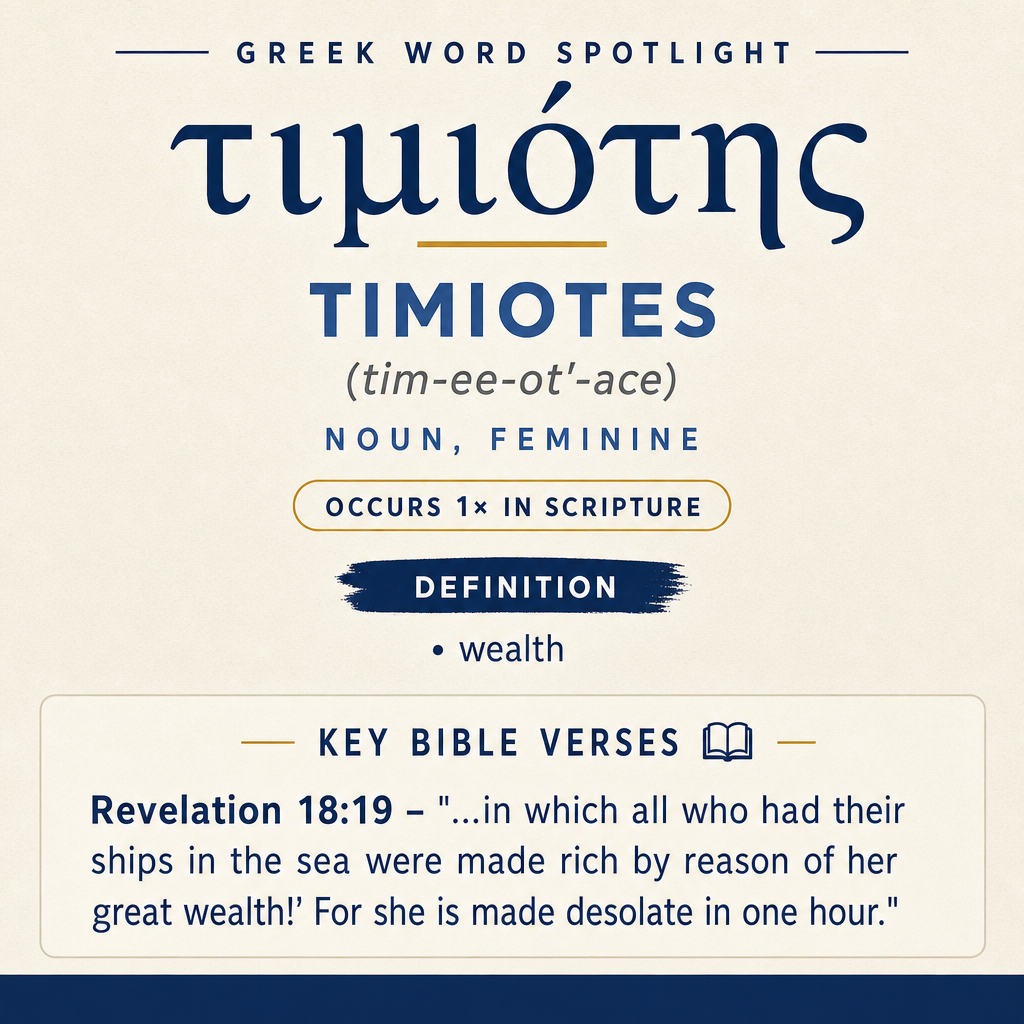
τιμιότης means “wealth” and occurs once in Scripture, in Revelation 18:19.
Biblical Occurrence
This word appears 1 time in Scripture. Its occurrence is in Revelation 18:19.
Learn More →Verse Context
In Revelation 18:19, it appears in a lament over “the great city,” spoken with weeping and mourning.
Learn More →Timiotēs means “wealth” and appears in Revelation’s lament over a ruined maritime city. In that single scene, the word names the economic abundance that had enriched those tied to the city’s trade, and it heightens the shock of her sudden desolation.
Root and Related Words
Timiotēs is derived from timios (τίμιος), “precious” (Strong’s G5093). The related adjective supplies the evaluative backdrop behind the noun: the city’s material abundance is treated as something of high worth in the eyes of those who profited from it.

Occurrences
“They cast dust on their heads, and cried, weeping and mourning, saying, ‘Woe, woe, the great city, in which all who had their ships in the sea were made rich by reason of her great wealth!’ For she is made desolate in one hour.” (Revelation 18:19)
In this lament, timiotēs stands at the center of the merchants’ grief: the “great city” had been the source of their enrichment, and her “great wealth” is given as the reason their shipping interests prospered. The setting is explicitly maritime—“their ships in the sea”—so the wealth in view is not described as private savings tucked away, but as a public abundance that draws commerce and distributes profit outward to those who traffic with the city. The mourners mark their grief with physical gestures (“cast dust on their heads”) and with repeated cries (“Woe, woe”), and the noun helps explain why the loss feels catastrophic: the city’s wealth had become a shared economic engine for many.
The verse also sets the city’s “great wealth” alongside abrupt devastation: “For she is made desolate in one hour.” The wealth is not presented as slowly diminishing or gradually shifting elsewhere; it is framed as something substantial that nevertheless offers no protection against sudden collapse. That contrast intensifies the lament: what had seemed secure enough to make many “rich” proves unable to resist becoming “desolate” with startling speed. In this way, timiotēs functions rhetorically as the height from which the fall is measured—the greater the wealth, the more startling the desolation.
Because the mourners speak in the first person plural (“saying”) and refer to “all who had their ships in the sea,” the verse portrays the wealth as something widely participated in, at least by those in the trade network. The noun therefore gathers up not only the city’s internal abundance but also the prosperity that radiated to external partners. The city’s wealth is big enough to be called “great,” and its reach is broad enough that “all” with ships are said to have been enriched by it; the lament turns the noun into a shorthand for the whole commercial system now lost.
Sense and Usage
Within Revelation 18:19, “wealth” is not an abstract ideal but an experienced economic condition: it “made rich” those connected to the city’s shipping. The verse ties wealth to mechanisms—ships, sea trade, and a city that anchors an economy—so the sense carries the weight of prosperity that is both measurable and socially consequential. The mourners do not merely regret that a city has fallen; they lament the destruction of a prosperity that had structured livelihoods.
The phrase “by reason of her great wealth” places the noun inside a causal explanation. Wealth is treated as an operative factor that produces effects: it draws shipping, enables profit, and enriches participants. In the same breath, the text undercuts any assumption that wealth guarantees endurance. The city’s wealth is described as “great,” yet her condition flips to “desolate” “in one hour.” Thus the word, in this usage, carries an implicit tension between magnitude and fragility: wealth can be extensive and influential, and yet it can be erased with shocking suddenness.
The mourners’ reaction also clarifies how wealth functions in human perception within the scene. They weep and mourn not in generalized sorrow but with a specific economic memory: this was the city “in which” their enrichment happened. Wealth becomes personal and communal at once—personal because it “made rich” those speaking, communal because the group includes “all” with ships in the sea. The word therefore supports the passage’s portrayal of shared dependence: a city’s wealth can bind together a wide range of people through profit, and its loss can unleash a correspondingly wide lament.
Finally, the pairing of “great city” and “great wealth” creates an amplifying effect. The city’s greatness is not defined here by governance, culture, or military strength, but by economic abundance that benefits maritime traders. In that framing, timiotēs helps explain what “greatness” looks like to the mourners: the city is great because it is rich and because its riches spill over into the lives of those who do business with it.
Imagery
The imagery surrounding timiotēs is sharply concrete: ships on the sea, dust cast on heads, voices raised in weeping and mourning, and a city that goes from prosperous to desolate “in one hour” (Revelation 18:19). “Great wealth” is thus pictured not as a static pile of value but as the lifeblood of a trading world—until it is silenced by sudden ruin, leaving only grief where profit once flowed.
Sources: Lexical data from Strong’s Exhaustive Concordance and the Translators Brief Lexicon of Extended Strongs for Greek (STEPBible, CC BY). Occurrence data from the Translators Amalgamated Greek New Testament (STEPBible, CC BY). Scripture quotations from the World English Bible (public domain).





