
Exploring the Meaning of Timotheos in Greek
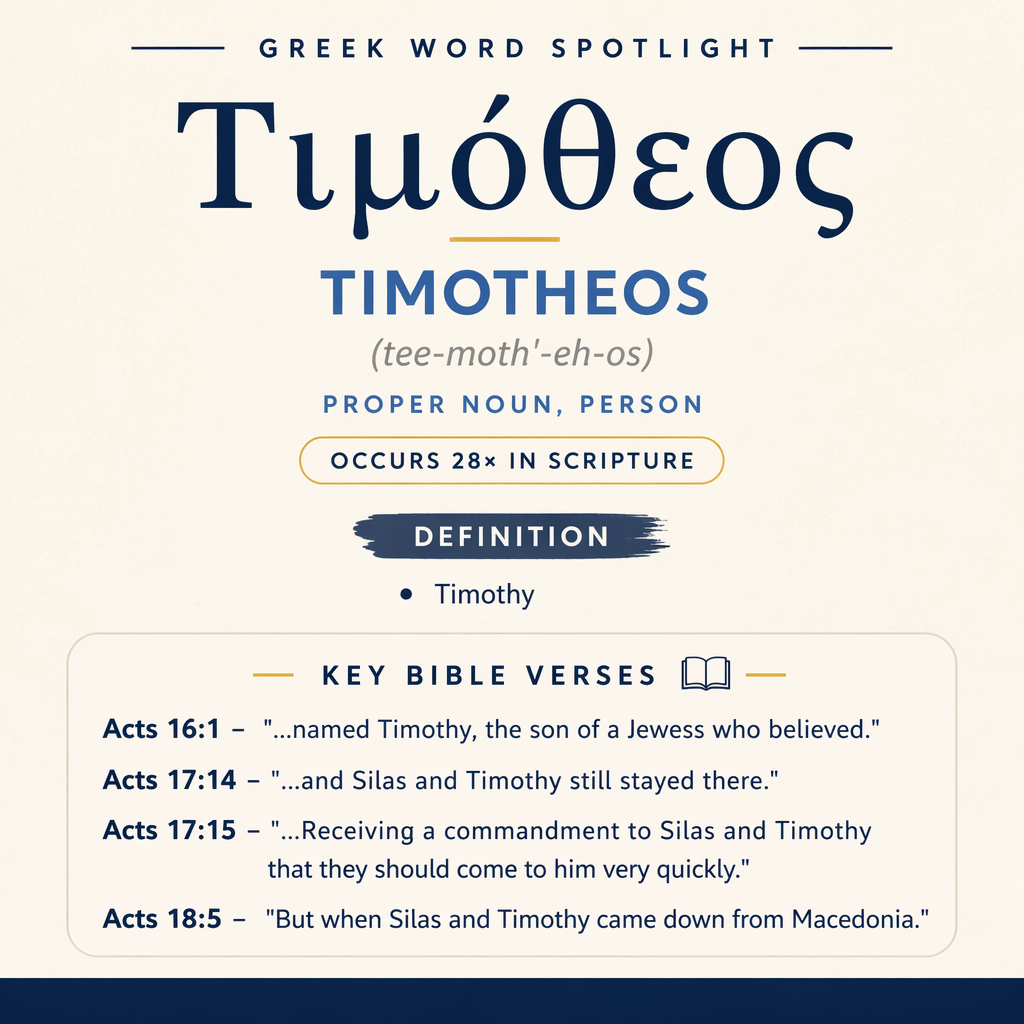
Τιμόθεος (Timotheos) means Timothy and occurs 28 times in Scripture, including Acts 16:1; 17:14–15; 18:5; 19:22; 20:4; Romans 16:21; 1 Corinthians 4:17.
Acts References
In Acts, Timothy is named as a disciple and appears alongside Paul, Silas, and others (Acts 16:1; 17:14–15; 18:5; 19:22; 20:4).
Learn More →Pauline Mentions
Paul includes Timothy as a fellow worker who greets the Romans (Romans 16:21). Paul also sends Timothy to Corinth as his beloved and faithful child in the Lord (1 Corinthians 4:17).
Learn More →Τιμόθεος denotes Timothy, a named individual who appears in narrative scenes in Acts and in greetings and remarks within Pauline letters. Across these passages he is presented in relation to Paul’s movements, co-workers, and communications with assemblies.
Occurrences
Acts 16:1 — “He came to Derbe and Lystra: and behold, a certain disciple was there, named Timothy, the son of a Jewess who believed; but his father was a Greek.”
Here Τιμόθεος introduces a particular disciple by name and situates him within a family description: his mother is “a Jewess who believed,” while “his father was a Greek.” The naming functions to single him out as a distinct person in the account and anchors him to Derbe and Lystra through Paul’s arrival there.

Acts 17:14 — “Then the brothers immediately sent out Paul to go as far as to the sea, and Silas and Timothy still stayed there.”
Τιμόθεος appears in a moment of urgent travel planning. While Paul is sent toward the sea, “Silas and Timothy” remain behind; the name marks Timothy as one of the companions whose location differs from Paul’s at this point, emphasizing the temporary separation within the group.
Acts 17:15 — “But those who escorted Paul brought him as far as Athens. Receiving a commandment to Silas and Timothy that they should come to him very quickly, they departed.”
In this scene Timothy is one of the two recipients of a specific instruction: he is to come to Paul “very quickly.” The name is tied to responsiveness and coordination—Timothy is not merely present but addressed as someone expected to move promptly in relation to Paul’s needs in Athens.
Acts 18:5 — “But when Silas and Timothy came down from Macedonia, Paul was compelled by the Spirit, testifying to the Jews that Jesus was the Christ.”
Τιμόθεος is again paired with Silas, and his arrival “from Macedonia” marks a turning point in the narrative description of Paul’s activity. Timothy’s coming is part of the timing that frames Paul’s intensified testimony—his presence is included in the circumstances surrounding Paul’s Spirit-compelled proclamation.
Acts 19:22 — “Having sent into Macedonia two of those who served him, Timothy and Erastus, he himself stayed in Asia for a while.”
Here Timothy is identified as one of “two of those who served him” and is dispatched on an assignment into Macedonia. The name functions in a logistical statement: Timothy is entrusted with travel and service on Paul’s behalf while Paul remains in Asia.
Acts 20:4 — “These accompanied him as far as Asia: Sopater of Beroea; Aristarchus and Secundus of the Thessalonians; Gaius of Derbe; Timothy; and Tychicus and Trophimus of Asia.”
Τιμόθεος appears within a list of companions accompanying Paul “as far as Asia.” The bare mention “Timothy” among men linked to various places situates him as part of an entourage spanning multiple regions, contributing to the sense of a coordinated company traveling together.
Romans 16:21 — “Timothy, my fellow worker, greets you, as do Lucius, Jason, and Sosipater, my relatives.”
In this closing greeting Timothy is explicitly characterized as “my fellow worker.” The proper name carries relational weight: Timothy’s greeting is presented as part of the network of people associated with Paul, and the descriptor underscores shared labor rather than mere acquaintance.
1 Corinthians 4:17 — “Because of this I have sent Timothy to you, who is my beloved and faithful child in the Lord, who will remind you of my ways which are in Christ, even as I teach everywhere in every assembly.”
Τιμόθεος is named as Paul’s emissary to the Corinthians. Beyond identification, this verse assigns him a role (“I have sent Timothy to you”) and a purpose (“who will remind you of my ways which are in Christ”), while also describing his relationship to Paul as “my beloved and faithful child in the Lord.” The name thus stands for a person trusted to represent Paul’s teaching and manner of life to an assembly.
1 Corinthians 16:10 — “Now if Timothy comes, see that he is with you without fear, for he does the work of the Lord, as I also do.”
Here Timothy is the anticipated visitor, and the name is bound to pastoral concern: the Corinthians are instructed to ensure he is “without fear.” The reason given—“for he does the work of the Lord, as I also do”—aligns Timothy’s activity with Paul’s own, so the name evokes a co-laborer whose reception matters for the mission’s work.
1 Corinthians 16:24 — “My love to all of you in Christ Jesus. Amen.”
This closing line provides the letter’s final expression of affection, forming part of the epistolary setting in which earlier references to Timothy occur. Within the letter’s closing atmosphere, Timothy’s earlier mention as a coming co-worker is framed by Paul’s broad “love to all of you in Christ Jesus.”
2 Corinthians 1:1 — “Paul, an apostle of Christ Jesus through the will of God, and Timothy our brother, to the assembly of God which is at Corinth, with all the saints who are in the whole of Achaia:”
Τιμόθεος appears in the letter’s opening identification of senders: “Paul… and Timothy our brother.” The name contributes to the epistle’s authority and tone by presenting Timothy not as a mere companion but as associated with the sending voice, while “our brother” places him within the shared family language of the community addressed.
2 Corinthians 1:19 — “For the Son of God, Jesus Christ, who was preached among you by us, by me, Silvanus, and Timothy, was not “Yes and no,” but in him is “Yes.”
In this doctrinally charged sentence, Timothy is one of the named preachers through whom the Corinthians heard the proclamation: “by me, Silvanus, and Timothy.” His name is attached to the “us” who preached Christ, reinforcing that Timothy participated publicly in the message that Paul now defends as consistent and affirmative in Christ.

Sense and Usage
As a proper name, Τιμόθεος functions primarily to identify a particular individual, but the surrounding clauses repeatedly load the name with relational and vocational significance. In Acts, Timothy is introduced with biographical detail (“a certain disciple… the son of a Jewess who believed; but his father was a Greek,” Acts 16:1) and then appears as a mobile co-worker whose presence, absence, and movements help map Paul’s mission. The narrative uses the name to track where companions are stationed (“Silas and Timothy still stayed there,” Acts 17:14), who receives urgent directions (“a commandment to Silas and Timothy,” Acts 17:15), and who arrives from a region at a decisive moment (“Silas and Timothy came down from Macedonia,” Acts 18:5). Timothy is also portrayed as delegated for service: he is among those Paul “sent into Macedonia” as one who “served him” (Acts 19:22), and he is included in a multinational traveling party “as far as Asia” (Acts 20:4). In each case, the proper name anchors a real person within concrete mission logistics—travel, assignments, and companionship.
In the letters, Timothy’s name is woven into the social fabric of early assemblies through greetings, commendations, and co-authorship. Romans 16:21 presents him as “my fellow worker,” meaning the name carries the sense of partnership in ongoing labor that is close enough to include personal greetings. In 1 Corinthians, Timothy is not only known to Paul but is entrusted to represent Paul to the Corinthian assembly: “I have sent Timothy to you” (1 Corinthians 4:17). The description “my beloved and faithful child in the Lord” gives Timothy a filial place within Paul’s circle, and the function assigned to him—reminding them of Paul’s ways “even as I teach everywhere in every assembly”—connects his coming with continuity of instruction. Later the letter anticipates Timothy’s arrival and instructs the church on how to treat him: “see that he is with you without fear” (1 Corinthians 16:10). The rationale offered, “for he does the work of the Lord, as I also do,” places Timothy’s labor on the same plane of divine service as Paul’s, so the name implicitly calls for respect and protective hospitality.
Second Corinthians uses the name in formal and public ways. The opening salutation joins Timothy to Paul’s address: “Paul… and Timothy our brother” (2 Corinthians 1:1). This locates Timothy within the letter’s sending side and establishes him as a recognized figure to “the assembly of God which is at Corinth.” Later, Timothy is included among the named proclaimers of Christ to the Corinthians (“by me, Silvanus, and Timothy,” 2 Corinthians 1:19). In this context the name is linked to the act of preaching itself, making Timothy part of the shared history between messenger and recipients. Across these epistolary occurrences, Timothy is consistently presented as integrated into Paul’s ministry—greeting, being sent, potentially arriving, co-signing, and being remembered as a preacher among them.
Imagery
These passages attach Timothy’s name to movement and shared work: staying behind while Paul departs (Acts 17:14), being summoned to come quickly (Acts 17:15), traveling down from Macedonia (Acts 18:5), being sent ahead as one who serves (Acts 19:22), and accompanying a wider group as far as Asia (Acts 20:4). In the letters the imagery shifts to interpersonal bonds and public ministry—“fellow worker” (Romans 16:21), a trusted envoy who can “remind” an assembly (1 Corinthians 4:17), a laborer to be received “without fear” (1 Corinthians 16:10), “our brother” in the opening of a letter (2 Corinthians 1:1), and a named participant in preaching Christ (2 Corinthians 1:19). The proper name therefore evokes a recognizable figure whose identity is consistently framed by companionship, service, and communication between churches.
Sources: Lexical data from Strong’s Exhaustive Concordance and the Translators Brief Lexicon of Extended Strongs for Greek (STEPBible, CC BY). Occurrence data from the Translators Amalgamated Greek New Testament (STEPBible, CC BY). Scripture quotations from the World English Bible (public domain).




