
Exploring the Meaning of Thrombos in Greek
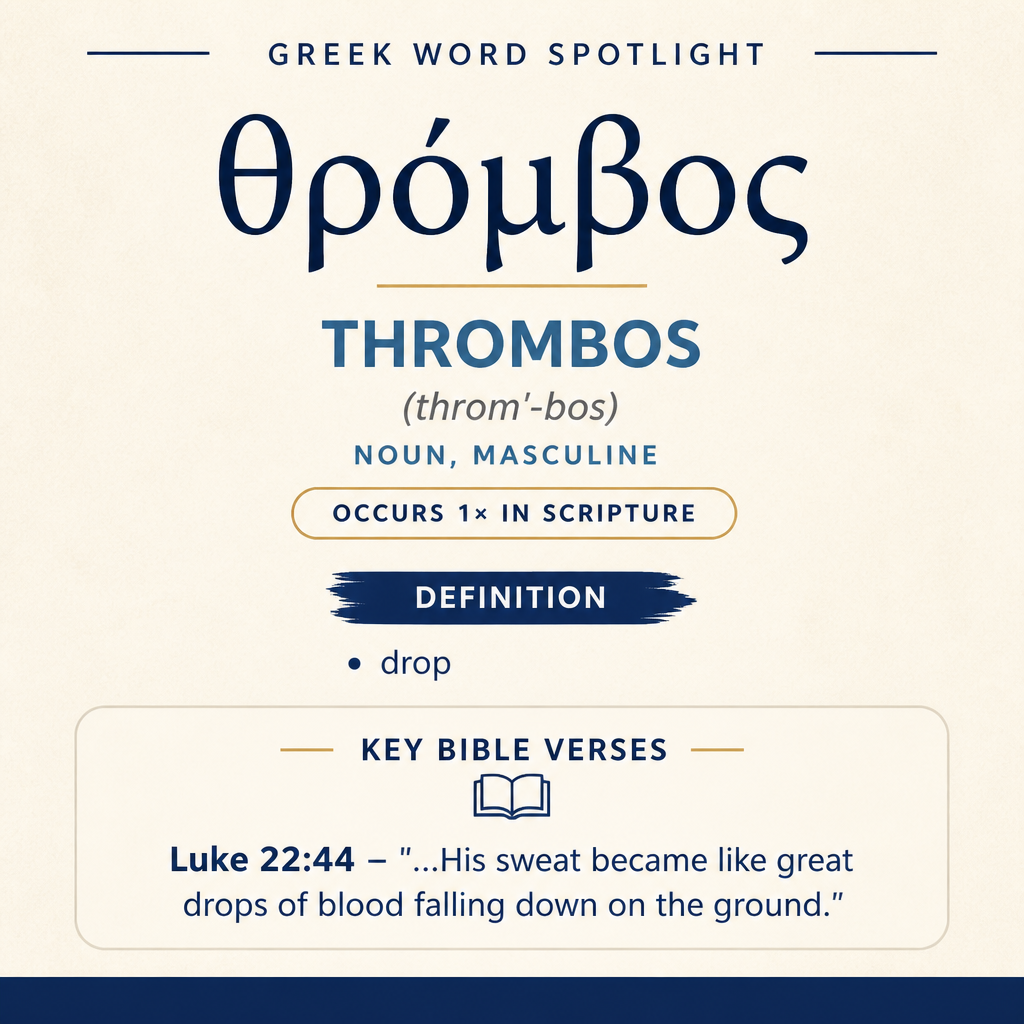
θρόμβος means “drop” and appears once in Scripture in Luke 22:44.
Luke Context
In Luke 22:44, Jesus’ sweat became like great drops of blood falling to the ground.
Learn More →θρόμβος means “drop” and appears in the account of Jesus’ prayer in Gethsemane. There it gives a vivid physical shape to what is described falling to the ground.
Root and Related Words
θρόμβος is linked with the verb τρέφω (trephō), “to feed” (Strong’s G5142).

Occurrences
“Being in agony he prayed more earnestly. His sweat became like great drops of blood falling down on the ground.” (Luke 22:44)
Here θρόμβος is the concrete unit of what is seen as falling: not a vague dampness, but discrete “drops,” and not small ones—“great drops.” The line places these drops in motion (“falling down”) and gives them an end point (“on the ground”), so the word works with the verbs to frame a bodily, observable phenomenon rather than a merely internal experience. The comparison “like great drops of blood” also ties the “drops” to appearance and likeness: the sweat is described in terms of how it looked as it fell, with the drop-language providing the basic shape of the image. In this scene, the word thus contributes to the depiction of intensity by making the perspiration describable in countable, heavy units that can be imagined striking the earth.
Sense and Usage
The sense “drop” suits a context where a liquid is presented as separating into individual, falling portions. Luke 22:44 combines three features that bring out what “drop” does in a sentence: size (“great”), resemblance (“like … of blood”), and downward movement (“falling down on the ground”). Within that single line, θρόμβος serves as the shape-word that allows the writer to speak about sweat not only as something present on the body but as something that collects, forms, and descends in visible, weighty beads.
Because the verse pairs “drops” with “blood” by likeness, the word can carry a strong visual force without turning the sentence into a technical description. “Drop” stays within ordinary physical language, while the simile intensifies the picture: the reader is led to imagine large, dark, bloodlike drops rather than a light sheen. The word therefore supports the narrative’s movement from inner struggle (“Being in agony … he prayed more earnestly”) to outward expression that can be pictured in the world of the garden—liquid falling and reaching the soil.
In this usage, “drop” also provides a kind of pacing. A “drop” implies repetition: one after another, falling. Even without specifying a number, the image of “great drops … falling down” suggests sustained exertion and ongoing physical effect during the prayer. The term thus functions as a bridge between the earnestness of the prayer and the tangible consequence described in the body.
Imagery
Luke 22:44 sets θρόμβος in an earthy, grounded image: sweat that “became like great drops of blood” and then “falling down on the ground.” The word gathers the scene into something the eye can follow—from the body to the earth—so that the agony is not only stated but pictured in heavy, falling drops.
Sources: Lexical data from Strong’s Exhaustive Concordance and the Translators Brief Lexicon of Extended Strongs for Greek (STEPBible, CC BY). Occurrence data from the Translators Amalgamated Greek New Testament (STEPBible, CC BY). Scripture quotations from the World English Bible (public domain).




