Exploring the Meaning of Theomacheo in Greek
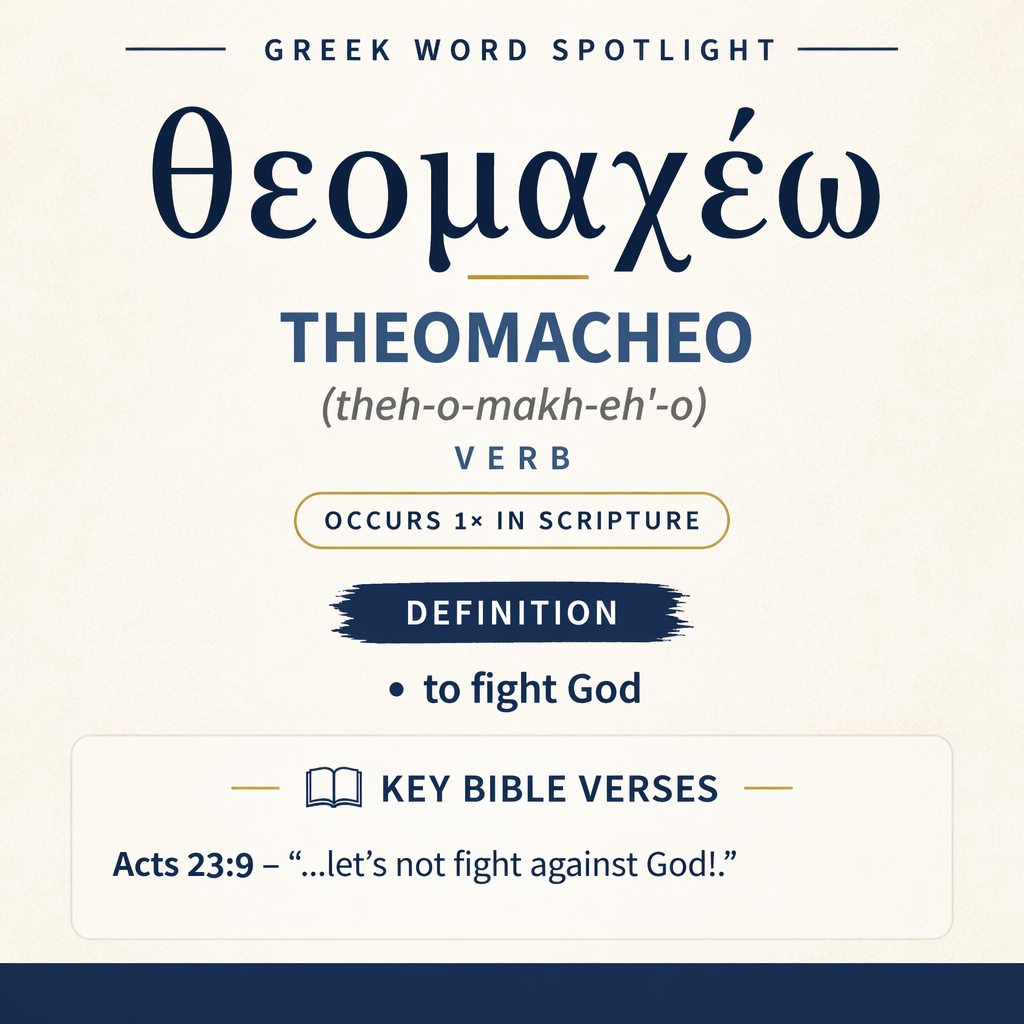
θεομαχέω means “to fight God” and appears once in Scripture, in Acts 23:9.
Verse Context
In Acts 23:9, it appears amid a “great clamor” and contention involving scribes of the Pharisees’ party.
Learn More →θεομαχέω means “to fight God” and appears once in the New Testament, in Acts 23:9. In that scene it functions as a caution placed on the lips of disputing voices, framing resistance to a claimed revelation as a kind of warfare directed toward God.
Root and Related Words
θεομαχέω (Theomacheo) derives from θεομάχος (theomachos), meaning “opposing God” (Strong’s G2314). The related form names the posture of opposition; the verb expresses that posture as an action.

Occurrences
“A great clamor arose, and some of the scribes of the Pharisees’ part stood up, and contended, saying, “We find no evil in this man. But if a spirit or angel has spoken to him, let’s not fight against God!”” (Acts 23:9)
In Acts 23:9 the word is used within a burst of contention: “A great clamor arose,” and certain scribes “stood up, and contended.” Their speech is divided into a judgment (“We find no evil in this man”) and a conditional warning (“But if a spirit or angel has spoken to him…”). θεομαχέω supplies the moral and theological weight of that warning. The scribes imagine a scenario in which the man’s claims are not merely human speech but communication mediated by “a spirit or angel.” Under that condition, opposition would not simply be disagreement with a person; it would become action directed “against God.” The verb therefore marks a boundary: the disputants may argue about the man’s case, but they should not cross into a kind of resistance that would put them in the posture of active conflict with God.
The immediate rhetoric is noteworthy for its restraint. The speakers do not claim certainty that “a spirit or angel has spoken to him”; they phrase it as a possibility (“if”). Yet the possibility is treated as serious enough to change how they should behave. θεομαχέω thus operates as a deterrent word: it names the worst-case implication of continued hostility, pressing the crowd to recognize that their contest could take on a different object—God Himself—if the message truly has divine origin. Even inside a noisy public dispute (“clamor”), the verb introduces the idea that some conflicts are not merely horizontal (person against person) but can become vertical (people against God).
The choice to phrase the warning as “let’s not fight against God!” also gives the word a communal force. It is not addressed only to an opponent; it is voiced as a group resolution (“let’s not…”). In context, the verb frames the debate as a shared danger: the community of arguers could collectively take up a stance of opposition that, under the stated condition, would amount to fighting God. The word therefore functions as a check on zeal within contention, reminding hearers that religious dispute can misidentify its true target.
Sense and Usage
The single attestation of θεομαχέω presents it as a concrete, conflict-laden verb. “To fight God” is not treated as an inner attitude alone but as an outward course of action implied by continued contention under certain spiritual premises. In Acts 23:9, the “fight” is not described with weapons or physical struggle; it arises in the setting of argument, accusation, and public clamor. The verb therefore fits a setting where opposition can be carried by speech, decisions, and collective momentum—forms of conflict that still qualify as “fighting” when they are directed against God.
The conditional framing (“if a spirit or angel has spoken to him”) shows how the verb works as a warning tied to the source of a message. The issue at hand is not only the character of “this man” (“We find no evil in this man”) but whether his speech is backed by a divine messenger. θεομαχέω draws a line between contesting a human claim and contesting a claim that may bear divine authority. In effect, the verb concentrates attention on the object of the opposition. If the man’s words come from God’s initiative—mediated here by “a spirit or angel”—then resistance changes its nature: it becomes hostility toward God Himself.
Because the verb is deployed in the negative imperative (“let’s not…”), the usage emphasizes prevention rather than description. It names what must be avoided more than what has already occurred. The word functions as a rhetorical brake within a volatile situation: it compresses the gravity of misdirected opposition into a single, vivid notion of combat against God. This gives the listeners a stark alternative to continued escalation: to proceed without due caution is to risk placing themselves in direct conflict with God.
The verb also casts the debate in covenantal terms of allegiance, without needing to elaborate them. In a dispute where various parties “contended,” the term “fight against God” implies that there is a side one can wrongly take—one that is not merely anti-human but anti-divine. The warning thus invites a moment of recognition: even when passions are high and voices loud, the ultimate question is not simply who wins the argument but whether one’s opposition has become opposition to God.
Imagery
Acts 23:9 places θεομαχέω amid noise and disagreement—“a great clamor”—yet the word evokes a much larger battlefield than the immediate scene. The imagery is that of conflict transferred upward: a dispute that seems to be with “this man” is reimagined as a struggle “against God” if the man’s message has come through “a spirit or angel.” The verb therefore carries the stark picture of human contention swelling into an attempt to resist God’s own action.
Sources: Lexical data from Strong’s Exhaustive Concordance and the Translators Brief Lexicon of Extended Strongs for Greek (STEPBible, CC BY). Occurrence data from the Translators Amalgamated Greek New Testament (STEPBible, CC BY). Scripture quotations from the World English Bible (public domain).