
Exploring the Meaning of Theostuges in Greek
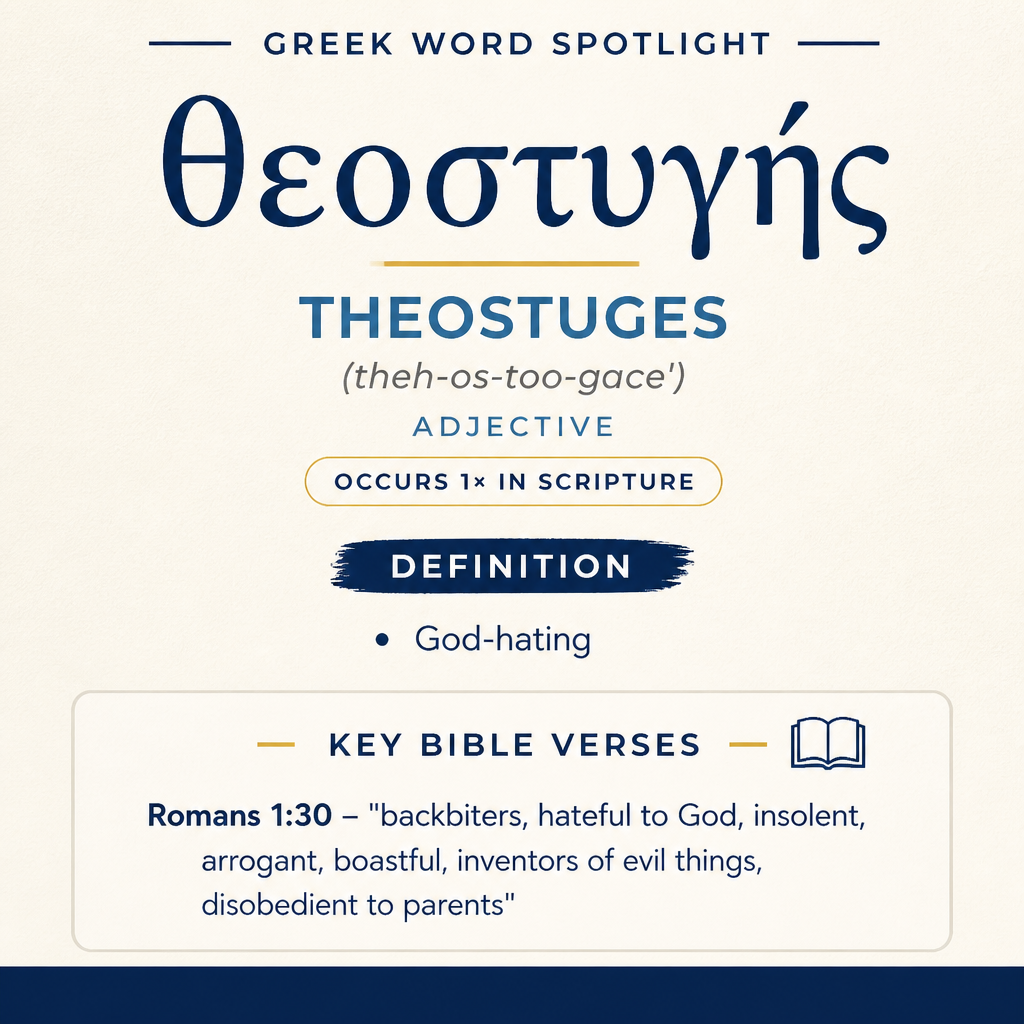
θεοστυγής means “God-hating” and appears once in Scripture, in Romans 1:30.
Verse Context
Romans 1:30 includes “hateful to God” among a list of vices. The verse also mentions backbiters, insolent, arrogant, and boastful.
Learn More →Theostuges means “God-hating,” and it appears once in the New Testament, in Paul’s catalog of vices in Romans 1:30. In that list it functions as a sharply evaluative descriptor, naming a posture set against God within a wider pattern of corrupt speech and behavior.
Root and Related Words
Theostuges is formed from theos (θεός), “God” (Strong’s G2316), and stygnetos (στυγητός), “hated” (Strong’s G4767). The compound places “God” as the object to which the hatred is directed, yielding a single adjective that identifies a person or group by that orientation.

Occurrences
“backbiters, hateful to God, insolent, arrogant, boastful, inventors of evil things, disobedient to parents,” (Romans 1:30)
In Romans 1:30, Theostuges stands amid a chain of characterizations, most of them expressed as adjectives or participles that describe people by what they are like and what they do. The phrase “hateful to God” appears between “backbiters” and “insolent,” tying the word to a cluster of social and moral breakdown that is visible in the surrounding terms: harmful speech (“backbiters”), aggressive self-assertion (“insolent, arrogant, boastful”), creative wrongdoing (“inventors of evil things”), and rejection of basic authority structures (“disobedient to parents”). In this immediate setting, the word marks more than a private emotion; it reads as a settled posture that coheres with the outward pattern of life the verse portrays.
The placement of “hateful to God” also gives the list a vertical dimension. Several items describe horizontal sins—how people speak about others, how they treat others, and how they relate to parents. Theostuges names a stance toward God that underlies and accompanies those relational failures. Within the verse’s cadence, it functions as a diagnostic term: along with the other descriptors, it identifies a kind of person, not a momentary lapse. The adjective’s force comes from the directness of its target (“to God”): it frames the hostility as aimed not merely at moral norms or human authorities but at God himself.
Because it is set among other terms that depict pride and defiance (“insolent, arrogant, boastful”), Theostuges in this verse contributes a theological edge to the moral portrait. The list does not read as a random assortment; it piles up traits that mutually reinforce each other, so that “hateful to God” becomes part of a composite picture of rebellion expressed in speech, attitude, creativity turned toward “evil things,” and refusal of parental obedience. The word therefore helps interpret the rest: the social damage in “backbiters” and the familial disorder in “disobedient to parents” are not treated as isolated problems but as consistent with a deeper enmity directed Godward.
Sense and Usage
As an adjective meaning “God-hating,” Theostuges is inherently relational: it defines a subject by the object of its hatred. In Romans 1:30, it is not used in a comparative or partial way, but as a categorical label within a vice list. That usage gives it a compressed, verdict-like quality; it is less a psychological description of fluctuating feeling and more a moral-theological identification that places the person in opposition to God.
The single attested context also shows how the term operates rhetorically. It is one item in a rapid enumeration, and its brevity intensifies its impact. “Hateful to God” is placed where it can be heard as an explanation for the traits around it: if a person is God-hating, then arrogance and boastfulness fit; if a person is God-hating, then “inventors of evil things” fits; if a person is God-hating, then “disobedient to parents” fits. Theostuges thus functions as a kind of moral center of gravity within the string of descriptors, anchoring visible actions and attitudes to a fundamental antipathy toward God.
The wording in Romans 1:30 also shows that the term belongs to the language of indictment rather than the language of self-description. It is not presented as a confession or a self-applied label; it is part of an external assessment made within a broader argument. In that argumentative setting, the adjective helps name a condition that is socially recognizable (it stands among traits expressed in behavior) while also being theologically charged (its target is “God”).
Because it is a compound built from “God” and “hated,” the term’s semantics are tightly bounded: it does not merely say that the person is hostile in general, but specifies the direction of hostility. In Romans 1:30, that specificity matters because the surrounding items could be read purely in terms of interpersonal ethics; Theostuges prevents that narrowing by explicitly placing God in view. The list therefore portrays a breakdown that is at once communal, familial, and Godward: speech that harms, pride that elevates self, inventive commitment to evil, and disobedience in the home are all gathered under a description that includes hatred directed toward God.
Imagery
Even in a single occurrence, Theostuges carries stark imagery by the company it keeps. Romans 1:30 surrounds “hateful to God” with the sounds of corrosive speech (“backbiters”), the posture of defiant pride (“insolent, arrogant, boastful”), the energy of devising wrongdoing (“inventors of evil things”), and the fracture of household order (“disobedient to parents”). The word paints hostility toward God not as an abstract idea but as a reality that manifests in a whole way of life.
Sources: Lexical data from Strong’s Exhaustive Concordance and the Translators Brief Lexicon of Extended Strongs for Greek (STEPBible, CC BY). Occurrence data from the Translators Amalgamated Greek New Testament (STEPBible, CC BY). Scripture quotations from the World English Bible (public domain).




