Exploring the Meaning of Theodidaktos in Greek
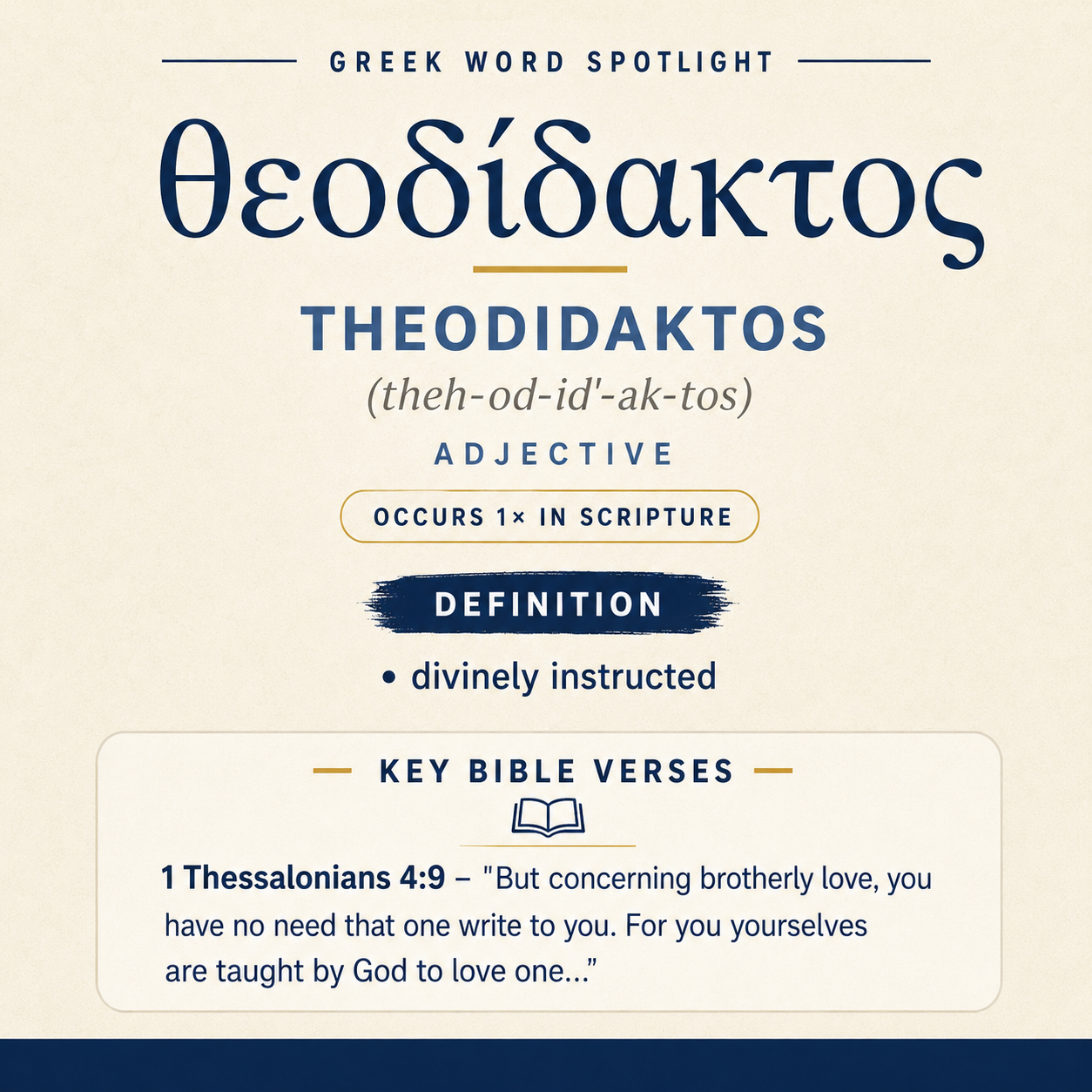
θεοδίδακτος means “divinely instructed” and appears once in Scripture, in 1 Thessalonians 4:9.
Scripture Occurrence
This word occurs 1 time in Scripture. Its single occurrence is in 1 Thessalonians 4:9.
Learn More →Verse Context
In 1 Thessalonians 4:9, it describes being taught by God to love one another.
Learn More →θεοδίδακτος expresses the idea of being divinely instructed. It appears in the New Testament in Paul’s exhortation about love within the believing community.
Root and Related Words
θεοδίδακτος is formed from θεός (theos), “God” (Strong’s G2316), and διδάσκω (didasko), “to teach” (Strong’s G1321). The compound brings these ideas together to describe instruction whose source is God.

Occurrences
“But concerning brotherly love, you have no need that one write to you. For you yourselves are taught by God to love one another,” (1 Thessalonians 4:9)
In this sentence the word functions to explain why additional written instruction is unnecessary “concerning brotherly love.” Paul points away from his own pen (“you have no need that one write to you”) and toward an instruction already operating among the Thessalonians: “you yourselves are taught by God.” The wording places the community’s love for one another under God’s direct tutelage. The result of that instruction is immediately stated in the verse itself—“to love one another”—so the adjective ties the Thessalonians’ practice of love to a divine initiative rather than merely to human persuasion or external coaching.

The immediate context in the verse is relational and communal: “brotherly love” and “one another” frame the kind of behavior in view. Within that frame, θεοδίδακτος underscores that the instruction is not simply information about love but instruction that takes effect within the community’s life, producing a shared pattern of mutual love. Paul’s phrasing, “you yourselves,” also gives the term a confirming force: it appeals to what they already know as a lived reality, not as a new directive that must be imposed from outside.
Sense and Usage
As “divinely instructed,” θεοδίδακτος characterizes people whose learning is attributed to God as teacher. In 1 Thessalonians 4:9, the instruction is expressed as a completed or present reality (“you yourselves are taught by God”), and it is oriented toward a concrete moral outcome: “to love one another.” The term therefore carries an inherently practical emphasis in this setting—divine instruction is shown by the direction it gives and the behavior it shapes.
The way the verse is constructed also highlights the sufficiency and authority of that instruction. Paul does not deny the value of writing in general, but for this topic he stresses that their formation has already taken place at a deeper level: God’s own teaching has addressed the matter. The adjective, then, does not merely compliment their knowledge; it grounds their capacity for brotherly love in God’s action. In doing so, it also frames Christian love as something learned—an imparted way of life—rather than a mere impulse or preference. The Thessalonians’ mutual love is presented as the fruit of being instructed by God.
Because the verse connects “taught by God” directly with “to love one another,” the word’s force in usage is tightly bound to the idea of a divine teacher shaping a community’s relationships. The instruction is not described as abstract doctrine but as training that issues in a recognizable pattern: brothers and sisters loving each other. θεοδίδακτος thus serves Paul’s pastoral point: their existing practice of love is itself evidence that they stand under God’s instruction, making further exhortation on the topic comparatively unnecessary.
Imagery
Although θεοδίδακτος is not a visual term, 1 Thessalonians 4:9 evokes a clear relational picture: a community in which “brotherly love” is already present and “one another” is the focus. The word places that scene in a classroom-like relationship with God as the teacher—an unseen but decisive source—so that the community’s mutual love is pictured as something learned from God and practiced among people.
Sources: Lexical data from Strong’s Exhaustive Concordance and the Translators Brief Lexicon of Extended Strongs for Greek (STEPBible, CC BY). Occurrence data from the Translators Amalgamated Greek New Testament (STEPBible, CC BY). Scripture quotations from the World English Bible (public domain).